Creatine is the best-researched supplement for strength training: it helps you squeeze out a rep or two more on hard sets, which over months adds up to more strength and muscle. Take 3 to 5 grams of creatine monohydrate every day, at any time, with or without a loading phase. It’s cheap, safe for healthy people, and most of the scary stories about it are myths.
What creatine does
Your muscles store a small amount of phosphocreatine, a quick fuel used to rebuild ATP during short, all-out efforts: a heavy set of 5, a sprint, a jump. Those stores run low within about 10 seconds of maximal work. Supplementing raises them by roughly 20 % on average (more if you start low, like vegetarians), so you can keep producing force a bit longer.
In the gym this looks unspectacular in a single session: maybe one more rep on your last set of squats. But one more rep on most hard sets, for months, means more training stimulus. That’s why creatine reliably improves strength and lean mass when combined with lifting. On its own, without training, it does very little.
Creatine benefits, backed by evidence
The ISSN position stand (Kreider et al., 2017) summarises hundreds of studies. The well-supported benefits:
- More strength and power in repeated high-intensity efforts.
- More lean mass when combined with resistance training, partly water at first, then genuine muscle from better training.
- Better work capacity across sets, so more total volume in a session.
- Possibly faster recovery between hard sessions, although this evidence is less consistent.
Emerging but not yet settled areas include brain function (especially under sleep deprivation) and healthy ageing in older adults who also train. Interesting, but don’t take creatine for those reasons alone.
How to take creatine
Which type?
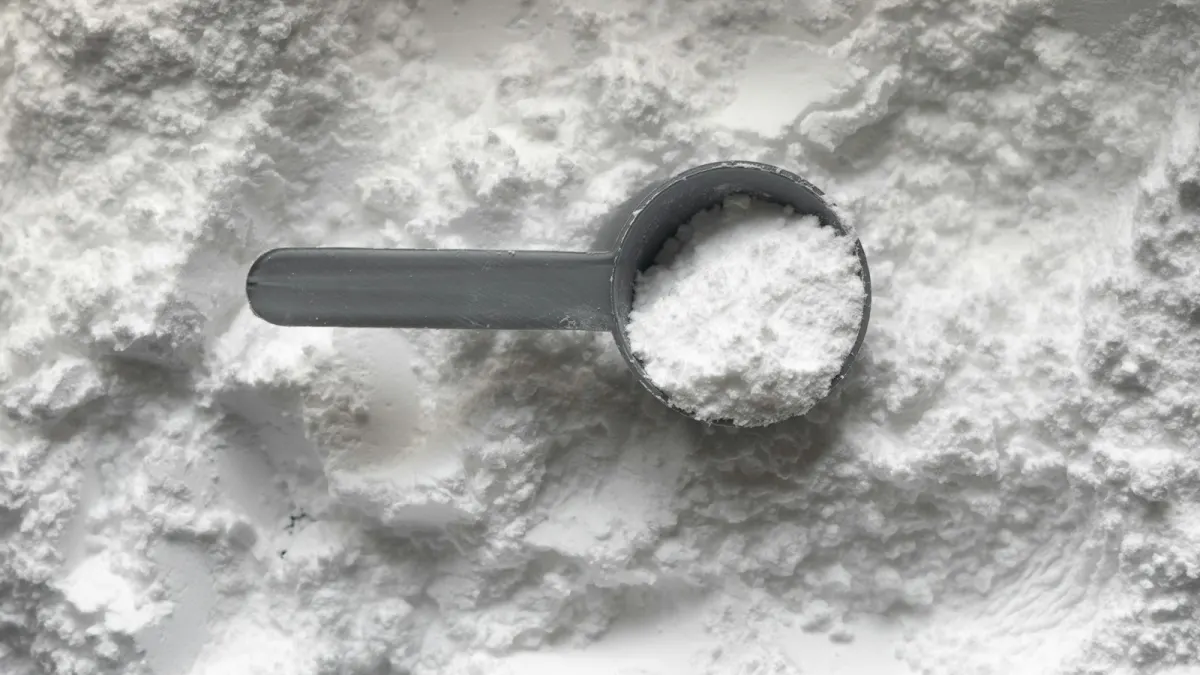
Creatine monohydrate. It’s the form used in almost all the research, it’s cheap, and nothing has been shown to beat it. “Creapure” is simply a well-known source of monohydrate. Buffered creatine, creatine HCl, ethyl ester and fancy blends cost more without better results. Micronised monohydrate dissolves more easily, which is the only real difference.
How much creatine per day?
| Approach | Daily dose | Muscles saturated after |
|---|---|---|
| No loading | 3–5 g once a day | about 3–4 weeks |
| Loading | ~20 g a day (4 × 5 g) for 5–7 days, then 3–5 g | about 1 week |
Both work. In a classic study, Hultman and colleagues (1996) found that 3 g a day for four weeks reached roughly the same muscle levels as a six-day 20 g load followed by a low maintenance dose. Loading just gets you there faster. If you’re heavier than about 90 kg (200 lb), the upper end of 5 g a day makes sense; some people use 0.1 g per kg.
When to take it
Whenever you’ll remember. Some studies hint at a tiny advantage for taking it around your workout, but the difference is small and inconsistent. What matters is saturation, built up day after day. Mixing it into a post-workout shake or your morning coffee or yoghurt is fine. Heat doesn’t destroy it in the time it takes to drink.
Side effects and myths
The 2021 review by Antonio and colleagues went through the most common questions one by one. Here’s where the evidence stands.
“Creatine causes water retention and bloating”
Partly true, mostly misunderstood. You’ll store extra water inside your muscles in the first weeks: that’s how creatine works. It shows on the scale (often 0.5–2 kg) but doesn’t make you look soft. Bloating or stomach upset is more likely with big loading doses; splitting the dose or skipping the load solves it.
“Creatine damages your kidneys”
In healthy people, studies lasting up to several years haven’t found kidney harm at normal doses. The confusion comes from blood tests: creatine raises creatinine, the marker doctors use to estimate kidney function, so the test can look worse without anything being wrong. If you get blood work done, tell your doctor you take creatine. If you have kidney disease, don’t take it without medical advice.
“Creatine makes you lose your hair”
This comes from a single 2009 study in 20 rugby players (van der Merwe et al.), where creatine raised the ratio of DHT to testosterone, a hormone linked to male-pattern baldness. Hair loss itself wasn’t measured, and the finding hasn’t been replicated. Current evidence doesn’t show that creatine causes hair loss. If you’re genetically prone to baldness and worried, that’s a reasonable conversation to have with a dermatologist.
“Creatine causes cramps and dehydration”
Studies in athletes training in the heat haven’t found more cramps or dehydration; some even found fewer. Drink normally.
“Creatine is a steroid”
No. It’s a compound made from amino acids, which your body produces itself and which you get from meat and fish. It has no hormonal action like anabolic steroids.
Who benefits most
- Anyone doing strength training with sets of roughly 1–15 reps.
- Vegetarians and vegans, who start with lower muscle stores and tend to respond more. See vegan muscle building.
- Older lifters, alongside training, to support strength and muscle.
- Team-sport athletes with repeated sprints.
Some people are “non-responders” because their stores are already high, often big meat-eaters. You won’t know until you try it for a month.
Who should avoid it or ask a doctor first: anyone with kidney disease, anyone on medication affecting the kidneys, and pregnant or breastfeeding women (not because of known harm, but due to limited research).
Creatine in the bigger picture
Creatine is a small multiplier on top of the things that actually build muscle: hard training with progressive overload, enough protein (see how much protein to build muscle), enough calories and sleep. If those aren’t in place, no supplement will compensate. We rank the others honestly in our guide to supplements for muscle growth: creatine is at the top, and the list of genuinely useful ones is short.
How to tell if it’s working
Creatine’s effect is a few percent: easy to miss without numbers. Before you start, note your working weights and reps on a few key lifts. After four to eight weeks, compare. If your reps on the last sets have crept up a little more than usual, it’s helping.
Brick makes that comparison easy: every set shows what you did last time, PRs are flagged automatically and each exercise has an estimated 1RM trend line. You can also add a note to a workout (“started creatine”) so you know where to look on the chart later.
Quick summary: how to take creatine
- Buy plain creatine monohydrate powder.
- Take 3–5 g every day, any time, with water, a shake or food.
- Load with 20 g a day for a week only if you want results faster.
- Keep taking it on rest days; no need to cycle.
- Expect a small bump on the scale and slightly better reps over the following weeks.
Frequently asked questions
Do I need to load creatine?
No. Loading (about 20 g a day for 5–7 days) just fills your muscles faster, in about a week instead of three to four. Taking 3–5 g a day from the start gets you to the same place, with less chance of stomach upset.
Should I take creatine on rest days?
Yes. Creatine works by keeping your muscle stores topped up, so take it every day, training or not. Skipping the odd day doesn't matter much; skipping weeks lets the stores drop back.
Does creatine make you gain weight?
Usually 0.5 to 2 kg (1 to 4 lb) in the first weeks, mostly water stored inside the muscle. That's not fat, and it's not the puffy look people worry about. Over months, part of the extra weight is real muscle from better training.
Do I need to cycle creatine?
No. There's no evidence your body stops responding or that breaks are needed. Long-term daily use has been studied for years without problems in healthy people.
Is creatine safe for teenagers?
Research in adolescents is limited but hasn't shown safety problems at normal doses. For a teenager, sleep, food and a good training plan matter far more; if they want to use it, it's worth involving a parent and a doctor.
Sources
- Kreider RB, Kalman DS, Antonio J, Ziegenfuss TN, Wildman R, Collins R, Candow DG, Kleiner SM, Almada AL, Lopez HL (2017). International Society of Sports Nutrition position stand: safety and efficacy of creatine supplementation in exercise, sport, and medicine. Journal of the International Society of Sports Nutrition
- Antonio J, Candow DG, Forbes SC, Gualano B, Jagim AR, Kreider RB, et al. (2021). Common questions and misconceptions about creatine supplementation: what does the scientific evidence really show?. Journal of the International Society of Sports Nutrition
- Hultman E, Söderlund K, Timmons JA, Cederblad G, Greenhaff PL (1996). Muscle creatine loading in men. Journal of Applied Physiology
- van der Merwe J, Brooks NE, Myburgh KH (2009). Three weeks of creatine monohydrate supplementation affects dihydrotestosterone to testosterone ratio in college-aged rugby players. Clinical Journal of Sport Medicine