Progressive overload means asking your muscles to do a little more than last time, so they have a reason to keep adapting. In practice you add reps, then weight, and sometimes sets, while keeping your technique and effort the same. The simplest way to do it is double progression: work inside a rep range, add reps until you hit the top of the range on every set, then add the smallest weight jump and start again. None of it works unless you know exactly what you did last time.
What is progressive overload?
Your body adapts to what you regularly ask of it. The first time you lift 60 kg for 3 sets of 8, it’s a real challenge, and your muscles respond by getting stronger and, over time, bigger. Repeat the exact same workout for six months and it maintains what you have, but gives your body little reason to build more.
Progressive overload is the fix: you raise the demand gradually, so the training stays a challenge as you get stronger. The latest position stand from the American College of Sports Medicine, an overview of 137 systematic reviews and more than 30,000 participants, ends on exactly that note: healthy adults should do progressive resistance training to improve strength, muscle size and performance (Currier et al., 2026).
It doesn’t mean adding weight every workout forever. The goal is a trend that goes up over weeks and months.
The ways to progress: load, reps, sets
There are several ways to make training harder. Not all of them are real overload.
| Lever | What it looks like | Best for | Watch out |
|---|---|---|---|
| Reps | 60 kg × 8 → 60 kg × 10 | Everything, especially small muscles | Only counts if technique and rest stay the same |
| Load | 60 kg × 10 → 62.5 kg × 8 | Strength, big compound lifts | Jumps can be huge on light exercises |
| Sets | 3 sets → 4 sets | Muscle growth when load and reps stall | Easy to overdo; add one at a time |
| Shorter rest | 2 min → 1 min | Rarely worth it | Makes you lose reps, so less useful work |
Reps or load? A 2022 study had trained lifters progress for 8 weeks either by adding load in a fixed rep range or by adding reps with a fixed load. Muscle growth was similar between groups. Load progression had a small, uncertain edge on 1RM strength (Plotkin et al., 2022). The ACSM overview points the same way: heavier loads (around 80% of your 1RM and above) help most for maximal strength, while higher weekly volume, 10 or more sets per muscle, helps most for muscle growth (Currier et al., 2026).
So both levers work. If your main goal is a stronger squat or bench press, load matters more over time. If your goal is muscle, reps and sets are just as valid.
One rule makes all of this count: keep everything else the same. Ten half-depth reps after 4 minutes of rest are not “more” than eight clean reps after 2 minutes.
Double progression: the simplest method that works
Double progression uses two levers in sequence: reps first, then weight.
- Pick a rep range, for example 3 sets of 8–12.
- Choose a weight you can lift for at least 8 reps on every set, stopping 1–3 reps before failure.
- Each session, try to add a rep or two somewhere.
- When you hit 12 reps on all three sets with good form, add the smallest weight jump next time. Your reps drop back toward 8, and you climb again.
Here’s what it looks like on the bench press:
| Week | Weight | Set 1 | Set 2 | Set 3 |
|---|---|---|---|---|
| 1 | 60 kg | 10 | 9 | 8 |
| 2 | 60 kg | 11 | 10 | 9 |
| 3 | 60 kg | 12 | 11 | 10 |
| 4 | 60 kg | 12 | 12 | 12 |
| 5 | 62.5 kg | 9 | 9 | 8 |
This lines up with the classic ACSM guideline: raise the load by about 2–10% once you can do one or two reps more than your target (Ratamess et al., 2009).
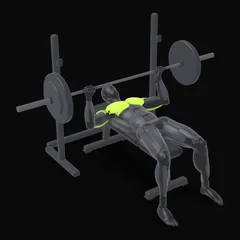
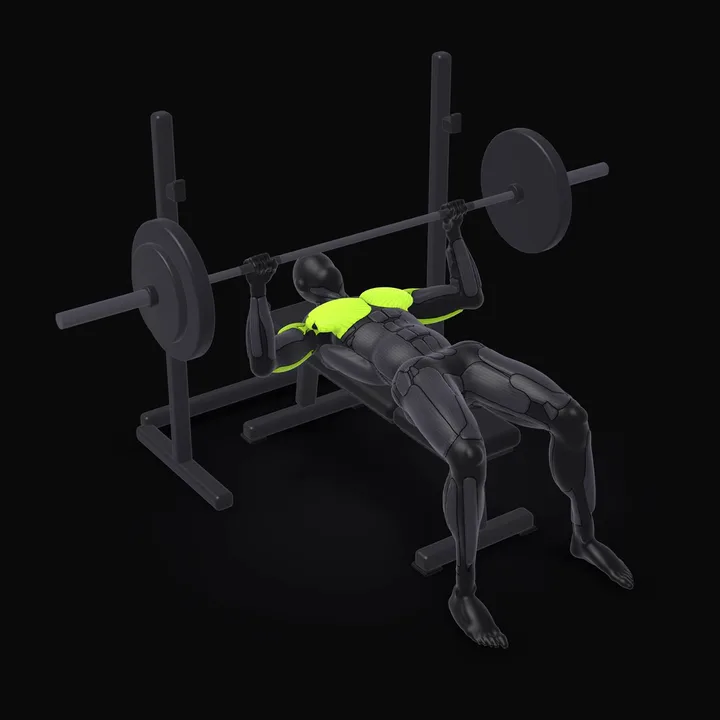 Barbell Bench PressLie on the bench with your eyes under the bar and your feet planted on the floor. Grip the bar slightly wider than shoulder width and pull your shoulder blades back and down.How to do the Barbell Bench Press →
Which rep range should you use?
For muscle growth, the rep range matters less than people think. A 2021 review by Schoenfeld and colleagues concluded that muscle can be built across a wide spectrum of loads, from heavy sets of 5 to light sets of 20 or more, as long as the sets are hard. For maximal strength, heavier loads keep an advantage, because strength is partly the skill of lifting heavy (Schoenfeld et al., 2021).
A practical setup:
| Exercise type | Rep range | Typical effort |
|---|---|---|
| Main strength lifts (squat, bench, deadlift, press) | 3–6 | 1–3 reps in reserve |
| Compound lifts for muscle | 6–12 | 1–3 reps in reserve |
| Isolation and small muscles | 10–20 | 0–2 reps in reserve |
Wider ranges are easier to progress in: 6–8 leaves two reps of room before the next weight jump, 8–12 leaves four. On a lateral raise, a range of 12–20 is often the only way to progress without jumps that wreck your form.
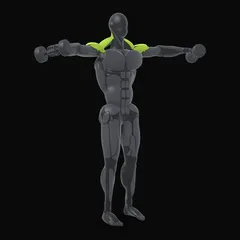
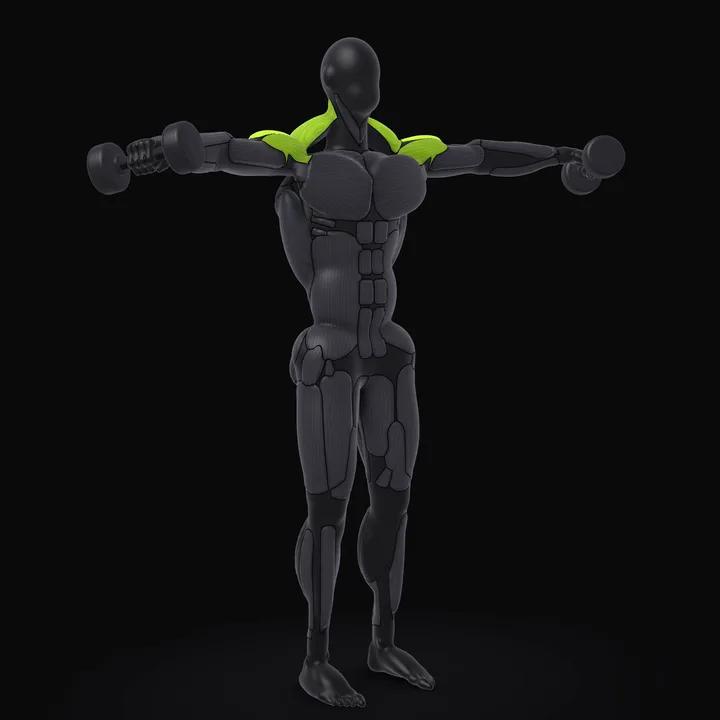 Dumbbell Lateral RaiseStand with a dumbbell in each hand at your sides and your elbows slightly bent. Raise the dumbbells out to the sides to shoulder height, leading with your elbows.How to do the Dumbbell Lateral Raise →
RIR and RPE: how hard should each set be?
Progression only means something if your effort is consistent. That’s what RIR (reps in reserve) and RPE (rating of perceived exertion) are for. The lifting-specific scale links the two: RPE 10 = 0 reps left, RPE 9 = 1 rep left, RPE 8 = 2 reps left, and so on (Zourdos et al., 2016). The practical benefit is autoregulation: on a good day the same target RIR lets you lift more, on a bad day less, without forcing a number written weeks ago (Helms et al., 2016).
How close to failure do you need to go?
- A 2023 meta-analysis found no clear advantage to training to full failure over stopping just short of it for muscle growth (Refalo et al., 2023).
- A 2024 series of meta-regressions suggested that growth improves as sets end closer to failure, while strength gains were similar across a wide range of RIR. Load mattered more for strength. The authors call the analysis exploratory, since RIR had to be estimated (Robinson et al., 2024).
The sensible middle ground: end most working sets 1–3 reps short of failure. Take the last set of an isolation exercise or a machine to failure now and then, to calibrate your sense of effort. Avoid grinding heavy squats and deadlifts to failure: the fatigue cost is high and so is the risk of a form breakdown.
If you’re new, expect to misjudge: in the original RIR study, novices rated a true max lift as easier than experienced lifters did (Zourdos et al., 2016). It’s a skill you build.
Adding sets: the volume lever
When reps and load both stall, adding a set is often the next step for muscle growth. Weekly volume is one of the strongest drivers of hypertrophy, and 10 or more hard sets per muscle per week tends to do better than fewer (Currier et al., 2026).
Add one set per muscle per week, on the muscle that’s lagging, and only if you’re recovering well. Adding sets to everything at once is a fast way to stop progressing anywhere. And volume doesn’t replace effort: four lazy sets don’t beat three good ones.
Track it, or you’re guessing
All of this depends on knowing exactly what you lifted last time. “About 60 kg for about 10” is not a target you can beat.
Two numbers make progress visible:
- Personal records (PRs). Most of your PRs won’t be 1-rep maxes. They’ll be rep PRs: 62.5 kg for 10 when your best was 62.5 kg for 9.
- Estimated 1RM. A formula turns any set into an estimate of your one-rep max, so 100 kg × 5 and 92.5 kg × 8 become comparable. The trend over weeks tells you more than any single session.
Brick is built for this. When you log a set, your numbers from last time are already there, so you know exactly what to beat. Logging is one tap, PRs are detected automatically, and your estimated 1RM for each exercise is drawn as a trend, so you can see the line go up, or notice early that it has gone flat.
Beginner vs intermediate: how fast should you progress?
The method stays the same at every level. What changes is the speed.
| Level | Typical rate on main lifts | What progression looks like |
|---|---|---|
| Beginner (first months) | More weight almost every session or every week | Simple linear jumps, or fast double progression |
| Intermediate | New weight every 2–4 weeks; reps in between | Double progression, planned blocks |
| Advanced | Small gains over months | Planned blocks, careful volume and fatigue management |
Early progress is fast because much of it comes from learning the movements. If you’re in that phase, a simple full-body beginner program is all you need. As an intermediate, a good month might mean two more reps per set and one weight jump. That’s real progress.
Do you need a fancy periodization model? Probably not. The 2026 ACSM overview found that periodization didn’t consistently change outcomes (Currier et al., 2026). Consistent, measurable progression matters more than the name of the scheme.
When should you deload?
An international consensus of strength and physique coaches defines a deload as a planned period of lighter training, meant to reduce physical and mental fatigue, help recovery and leave you ready for the next block of hard work (Bell et al., 2023). In that paper, deloads are described as commonly taken every 4–6 weeks for about a week, and the coaches agreed they can be planned ahead or taken when needed.
A typical deload week:
- Cut your sets roughly in half.
- Keep the weights the same or slightly lighter.
- Stop every set far from failure (3–4+ reps in reserve).
Is a deload mandatory? The research is thin. In one controlled study, a week off at the midpoint of a 9-week program produced the same muscle growth as training straight through, but slightly smaller strength gains (Coleman et al., 2024). The lesson: a deload should be lighter training, not necessarily a week off, and you take it because you need it, not because the calendar says so.
Signs you need one: your lifts drop for two or more sessions in a row, joints feel achy, sleep gets worse, and you dread training.
Plateaus: what to do when progress stalls
A plateau is when your reps and your estimated 1RM on a lift stop moving for 3 weeks or more. One bad session is not a plateau.
Work through this list in order, and change one thing at a time:
- Recovery first. Short sleep, a big calorie deficit or a stressful month stalls progress faster than any program flaw.
- Check your effort. If your sets end 4–5 reps short of failure, you’re not pushing enough. If you grind to failure on everything, you might be too fatigued to progress.
- Check your rest. Rest that drifts from 2 to 4 minutes, or down to 45 seconds, makes your numbers impossible to compare. Pick a rest time between sets and stick to it.
- Change the rep range. Stuck on 3×5? Spend a few weeks on 3×8–10, then come back.
- Add a set to the lift or the muscle that’s stuck.
- Swap the variation for a block: a dumbbell bench press instead of the barbell, pull-ups instead of the lat pulldown, or Romanian deadlifts to support your deadlift.
- Deload, then rebuild from slightly below your previous best.
A sample 4-week block
Here’s how an intermediate lifter might run their squat for 3 sets of 6–8, raising effort across the block before backing off:
| Week | Plan | Target effort |
|---|---|---|
| 1 | 100 kg, 3 × 6–8 | 3 reps in reserve |
| 2 | Same weight, add reps | 2 reps in reserve |
| 3 | Same weight or +2.5 kg if all sets hit 8 | 1 rep in reserve |
| 4 | Deload: 2 × 6 at 90 kg | 4 reps in reserve |
| 5 | Restart near your week-2 numbers, with the new weight if you earned it | 3 reps in reserve |
Use the same logic on your other lifts.
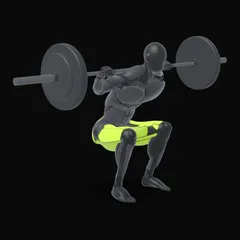
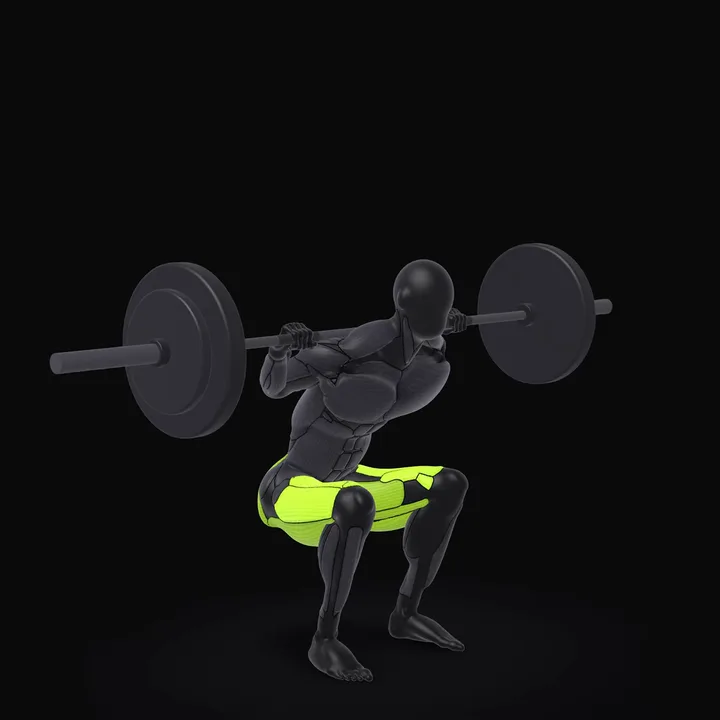 Barbell SquatPlace the bar on your upper back, not on your neck, and step out of the rack. Stand with feet slightly wider than shoulder width, toes turned out a little.How to do the Barbell Squat →
Frequently asked questions
How often should I increase the weight?
Only when you've earned it: when you hit the top of your rep range on every set with clean form. For beginners that can be almost every session on the big lifts. For intermediates it's more like every two to four weeks, with reps going up in between.
Is adding reps progressive overload?
Yes. Doing more reps with the same weight at the same effort means you're stronger than last time. A 2022 study found that progressing reps or progressing load built similar muscle over eight weeks. Reps are often the easier lever on small exercises where weight jumps are big.
Can I progressive overload in a calorie deficit?
Often, yes, especially as a beginner or when coming back after a break. Leaner, more experienced lifters usually progress slower when dieting, and holding your numbers is already a good result. If your lifts drop for several weeks in a row, look at your deficit and your sleep first.
Do I need to progress every single workout?
No. Bad days happen and progress is never a straight line. Judge it over weeks: if your reps or your estimated 1RM trend upward across a month, you're progressing, even with a few flat sessions in between.
What if the next weight jump is too big?
Stay at your current weight and keep adding reps, or add a set. On dumbbell and cable exercises, a wider rep range (for example 12–20) gives you room to grow before the next jump. Small 0.5–1.25 kg plates also help on barbell lifts.
Sources
- Currier BS, D'Souza AC, Fiatarone Singh MA, et al., Phillips SM (2026). American College of Sports Medicine Position Stand. Resistance Training Prescription for Muscle Function, Hypertrophy, and Physical Performance in Healthy Adults: An Overview of Reviews. Medicine & Science in Sports & Exercise
- Ratamess NA, Alvar BA, Evetoch TK, Housh TJ, Kibler WB, Kraemer WJ, Triplett NT (2009). American College of Sports Medicine position stand. Progression models in resistance training for healthy adults. Medicine & Science in Sports & Exercise
- Plotkin D, Coleman M, Van Every D, Maldonado J, Oberlin D, Israetel M, et al., Schoenfeld BJ (2022). Progressive overload without progressing load? The effects of load or repetition progression on muscular adaptations. PeerJ
- Schoenfeld BJ, Grgic J, Van Every DW, Plotkin DL (2021). Loading Recommendations for Muscle Strength, Hypertrophy, and Local Endurance: A Re-Examination of the Repetition Continuum. Sports
- Zourdos MC, Klemp A, Dolan C, et al. (2016). Novel Resistance Training-Specific Rating of Perceived Exertion Scale Measuring Repetitions in Reserve. Journal of Strength and Conditioning Research
- Helms ER, Cronin J, Storey A, Zourdos MC (2016). Application of the Repetitions in Reserve-Based Rating of Perceived Exertion Scale for Resistance Training. Strength and Conditioning Journal
- Refalo MC, Helms ER, Trexler ET, Hamilton DL, Fyfe JJ (2023). Influence of Resistance Training Proximity-to-Failure on Skeletal Muscle Hypertrophy: A Systematic Review with Meta-analysis. Sports Medicine
- Robinson ZP, Pelland JC, Remmert JF, Refalo MC, Jukic I, Steele J, Zourdos MC (2024). Exploring the Dose-Response Relationship Between Estimated Resistance Training Proximity to Failure, Strength Gain, and Muscle Hypertrophy: A Series of Meta-Regressions. Sports Medicine
- Bell L, Strafford BW, Coleman M, Androulakis Korakakis P, Nolan D (2023). Integrating Deloading into Strength and Physique Sports Training Programmes: An International Delphi Consensus Approach. Sports Medicine - Open
- Coleman M, Burke R, Augustin F, et al., Schoenfeld BJ (2024). Gaining more from doing less? The effects of a one-week deload period during supervised resistance training on muscular adaptations. PeerJ