To grow calves, train them like a muscle you actually care about: two to four times a week, 8–16 hard sets in total, with a deep stretch and a pause at the bottom of every rep, and heavier weights over time. Do both straight-knee raises (for the gastrocnemius) and bent-knee raises (for the soleus). Genetics influence how your calves look, but they rarely explain why calves don’t grow. Usually the training does.
Genetics vs training
There’s truth in the “calves are genetic” idea. Some people have long calf muscles that fill the lower leg and short Achilles tendons; others have muscles that sit high with a long tendon below. That affects the shape and how big your calves can look. You can’t change your insertion points.
But here’s what’s usually going on with “stubborn” calves:
- Two or three sets at the end of leg day, when you’re exhausted.
- Fast, bouncy reps through the top half of the range.
- The same weight for years.
That would stall any muscle. Train calves properly for three to six months before deciding your genetics are to blame.
The two calf muscles
| Muscle | Where | Crosses the knee? | Best trained by |
|---|---|---|---|
| Gastrocnemius | The visible “diamond” at the top | Yes | Straight-knee raises: standing calf raise, leg press calf raise, donkey calf raise |
| Soleus | Underneath, wider, extends lower | No | Bent-knee raises: seated calf raise |
Because the gastrocnemius crosses the knee, bending your knee slackens it and shifts most of the work to the soleus. That’s why a complete calf program has both standing and seated raises. The soleus is the bigger of the two and adds width to the lower leg, so don’t skip it.
Why the stretch matters so much
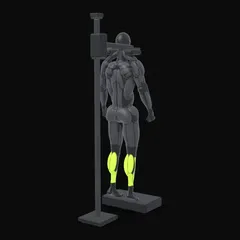
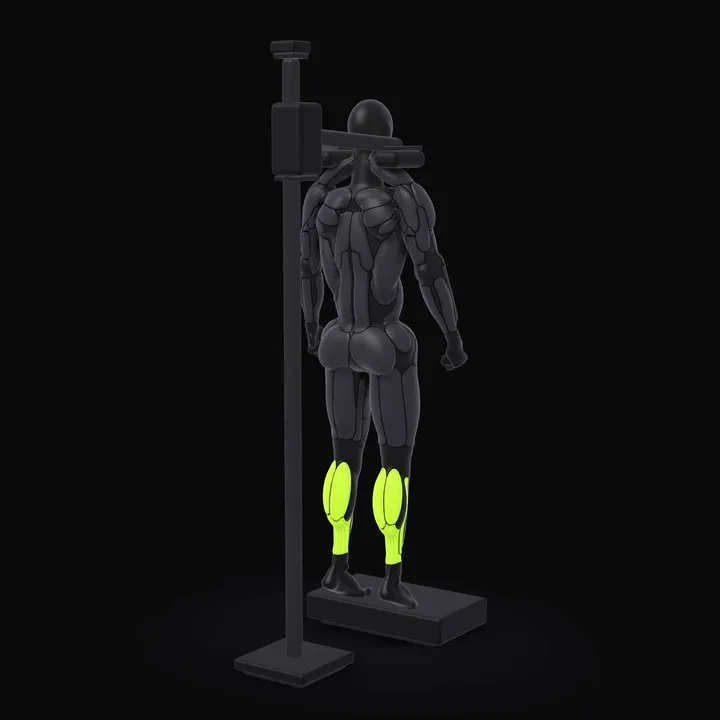 Standing Calf RaisePut your shoulders under the pads and the balls of your feet on the edge of the step. Lower your heels slowly as far as you can to stretch your calves.How to do the Standing Calf Raise →
The bottom of the calf raise, with your heel below the step and the calf stretched, appears to be where the growth happens. In an 8-week study, people who trained only the bottom (stretched) half of the calf raise grew their medial gastrocnemius by about 15 %, compared with about 7 % for full-range reps and about 3 % for top-half reps (Kassiano et al., 2023).
That doesn’t mean you should only do half reps. It means:
- Get a deep stretch at the bottom of every rep, heel well below the platform.
- Pause there for 1–2 seconds to kill the bounce from your Achilles tendon.
- Rise to the top under control.
- When you can’t complete full reps anymore, keep going with partial reps in the bottom half until you can’t move the weight.
How often and how much
Calves are used to daily work and recover quickly. Training a muscle at least twice a week tends to grow it more than once a week (Schoenfeld et al., 2016), and calves handle even more frequency well.
| Level | Hard calf sets per week | Sessions |
|---|---|---|
| Beginner | 6–8 | 2 |
| Intermediate | 8–16 | 2–4 |
| Calves as a priority | 12–20 | 3–4 |
Reps: 8–20 per set, the last couple of reps genuinely hard. Rest 60–90 seconds.
A calf plan that works
Split across your week, for example on two leg days and one upper day:
Session 1 (leg day)
| Exercise | Sets × reps | Rest |
|---|---|---|
| Standing calf raise | 4 × 8–12 | 90 s |
| Seated calf raise | 2 × 12–20 | 60 s |
Session 2 (second leg day)
| Exercise | Sets × reps | Rest |
|---|---|---|
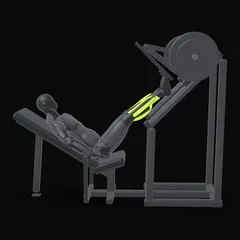
| Leg press calf raise | 3 × 10–15 | 90 s |
| Seated calf raise | 3 × 15–20 | 60 s |
Session 3 (upper day, optional)
| Exercise | Sets × reps | Rest |
|---|---|---|
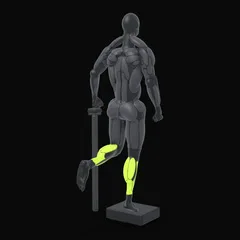
| Single-leg calf raise on a step, holding a dumbbell | 3 × 10–15 per leg | 60 s |
That’s 12–15 sets a week. Run it for at least 12 weeks before judging the results. If you’re building a whole leg session around it, the leg day workout shows where calves fit.
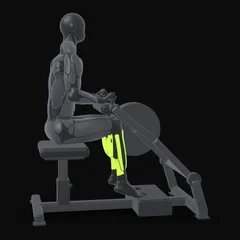
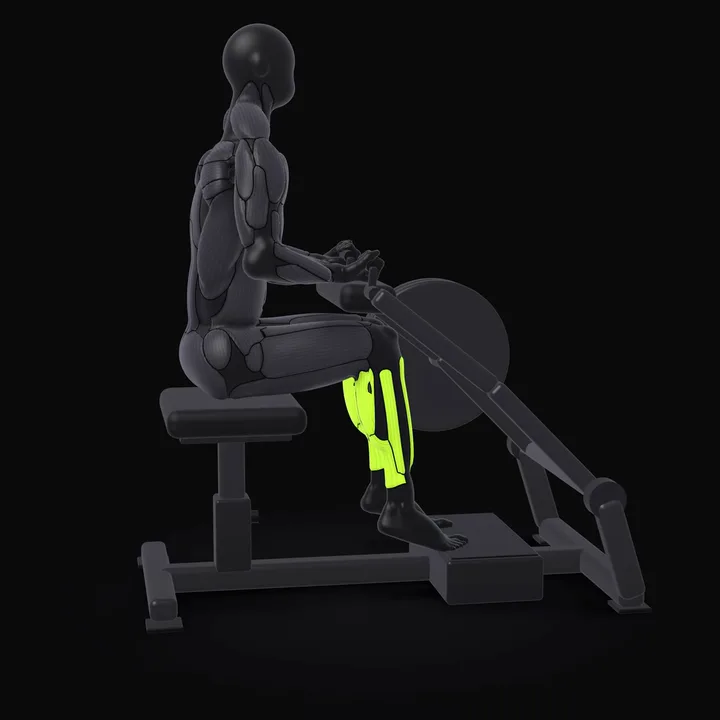 Machine Seated Calf RaiseSit in the machine with the pads on your thighs near your knees and the balls of your feet on the edge of the step. Release the safety lever and lower your heels slowly.How to do the Machine Seated Calf Raise →
Calf raise technique
- Balls of your feet on the edge of the step or platform, toes pointing straight ahead (turning them in or out changes little and isn’t worth worrying about).
- Knees straight but not locked on standing raises. Bending them during the rep turns it into a half squat.
- Drive up through the big toe side of your foot rather than rolling to the outside.
- Slow down. About 2 seconds up, a squeeze at the top, 2–3 seconds down, 1–2 second pause in the stretch.
- Use straps or a machine if holding dumbbells limits the set.
How to progress calves
Calves are strong. Many people can raise more than their bodyweight on a machine or leg press for 10 controlled reps after some training. Use double progression with a 10–15 range: when every set reaches 15 with a full pause, add weight. Write it down; it’s easy to drift into the same weight for months without noticing.
Training calves at home
You don’t need a machine. A stair step and a dumbbell or backpack are enough:
- Single-leg calf raises on a step, holding onto a railing for balance and a dumbbell in the other hand. Training one leg at a time doubles the load on each calf.
- Bent-knee calf raises for the soleus: sit on a chair with the balls of your feet on a thick book or plate and a heavy backpack across your knees.
- Use the same rules: deep stretch, pause, slow tempo, and add weight once you hit 15–20 clean reps.
What results to expect
Calves are slow to change compared with chest or arms, partly because they’re already trained every day by walking. With consistent, hard training, many people notice firmer, fuller calves within two to three months and a measurable increase in circumference within six months. Measure at the widest point, relaxed, on the same day each month; it’s a better guide than the mirror.
Common calf mistakes
- Bouncing. The Achilles tendon is a spring. Bouncing lets it do the work. Pause at the bottom.
- Half reps at the top. You skip the part of the range that builds the most muscle.
- Only standing raises. Add seated work for the soleus.
- Training them last and lightly. Try putting calves first in a session for a couple of months.
- Expecting walking or running to do it. Your calves already do that all day.
Calves are also part of a complete lower body for runners and lifters alike. For the bigger picture on growing any muscle, see how to build muscle, and for the principle behind adding load week to week, how to apply progressive overload.
Frequently asked questions
Can you grow calves if you have bad genetics?
Yes. Genetics set your starting size and shape, for example how high the muscle sits and how long the tendon is, but almost everyone can grow their calves with proper training. Most 'genetically stubborn' calves have simply never been trained hard through a full range.
How often should I train calves?
Two to four times a week works well. Calves recover quickly, so frequent short sessions of 3 to 4 hard sets are easier to sustain than one big session.
Should calf raises be high or low reps?
Both work. A range of about 8 to 20 reps, taken close to failure, is a good default. Very heavy sets of 5 tend to turn into bouncing, and very light sets of 50 take forever to reach a hard effort.
Does walking or running build calves?
Not much beyond beginner levels. Your calves are used to carrying you around all day, so they need heavier, deliberate training to grow.
Why do my calves burn but not grow?
The burn comes from fast, short-range reps. Growth comes from loading the muscle in a deep stretch, pausing at the bottom and progressing the weight over time.
Sources
- Kassiano W, Costa B, Kunevaliki G, Soares D, Zacarias G, Manske I, Takaki Y, Ruggiero MF, et al. (2023). Greater Gastrocnemius Muscle Hypertrophy After Partial Range of Motion Training Performed at Long Muscle Lengths. Journal of Strength and Conditioning Research
- Schoenfeld BJ, Ogborn D, Krieger JW (2016). Effects of Resistance Training Frequency on Measures of Muscle Hypertrophy: A Systematic Review and Meta-Analysis. Sports Medicine