To build muscle, you need four things working together: resistance training with hard sets that get harder over time, enough protein (about 1.6 g per kg of body weight a day), enough total food, and enough sleep. Then you need time, measured in months and years rather than weeks. Everything else, from supplements to special techniques, is a small add-on. This guide explains how muscle growth works and how to get each of those four things right, with links to deeper articles on every topic.
How muscle growth works
When you lift something challenging, your muscle fibres produce high levels of tension. That tension is detected by the muscle cells and triggers a cascade of signals that increase muscle protein synthesis: the process of building new proteins inside the fibres. Over weeks and months, if you build more protein than you break down, the fibres get thicker. That’s hypertrophy.
A widely cited review identified mechanical tension as the primary driver of muscle growth, with metabolic stress (the “pump” and burn) and muscle damage playing possible supporting roles (Schoenfeld, 2010). Later research has put even more weight on tension. For you, that means: the goal of a set isn’t to feel sore or pumped; it’s to make your muscles work hard against a challenging load.
Three things follow from this:
- The stimulus must be hard enough. Sets need to be close to failure.
- It must be repeated. One workout does almost nothing; months of workouts do a lot.
- It must increase over time. As you adapt, the same weights stop being challenging.
Training: the signal
Effort: how hard each set should be
A meta-analysis found that muscle growth increased as sets were taken closer to failure (Refalo et al., 2023). In practice, end most sets with about 0–3 reps left in the tank: you could do one to three more with good form, but not five. Isolation exercises can go to failure; heavy squats and deadlifts are better left a rep or two short. Training to failure covers the details.
Load and reps
You don’t need to lift very heavy to grow. A network meta-analysis found similar muscle growth across low, moderate and high loads, while heavier loads were better for maximal strength (Lopez et al., 2021). A practical range for muscle is 5–30 reps per set, with most sets between 6 and 15. Heavier sets for compound lifts, lighter sets for isolation exercises.
Volume: how many sets
More weekly sets generally produce more growth, with diminishing returns as you go higher (Pelland et al., 2025). Good starting points:
| Training age | Hard sets per muscle per week |
|---|---|
| Beginner (under 1 year) | 6–10 |
| Intermediate (1–3 years) | 10–16 |
| Advanced | 12–20+, if recovery allows |
The full explanation, including how to count compound exercises, is in how many sets per muscle per week.
Frequency: how often
Training each muscle at least twice a week has produced more growth than once a week in meta-analytic data (Schoenfeld et al., 2016). That’s easy with full-body training three times a week, an upper/lower split four times a week, or push/pull/legs over six days. Best workout split compares them.
Exercise choice
Build your program on compound exercises that train several muscles at once, then add isolation exercises for muscles that need more direct work:
| Movement | Examples |
|---|---|
| Squat | Squat, leg press, split squat |
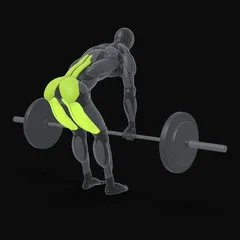
| Hinge | Romanian deadlift, deadlift, hip thrust |
| Horizontal push | Bench press, dumbbell press, push-up |
| Vertical push | Shoulder press |
| Horizontal pull | Cable row, dumbbell row |
| Vertical pull | Pull-up, lat pulldown |
| Isolation | Curls, triceps extensions, lateral raises, leg curls, calf raises |
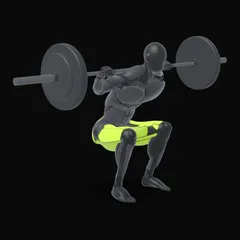
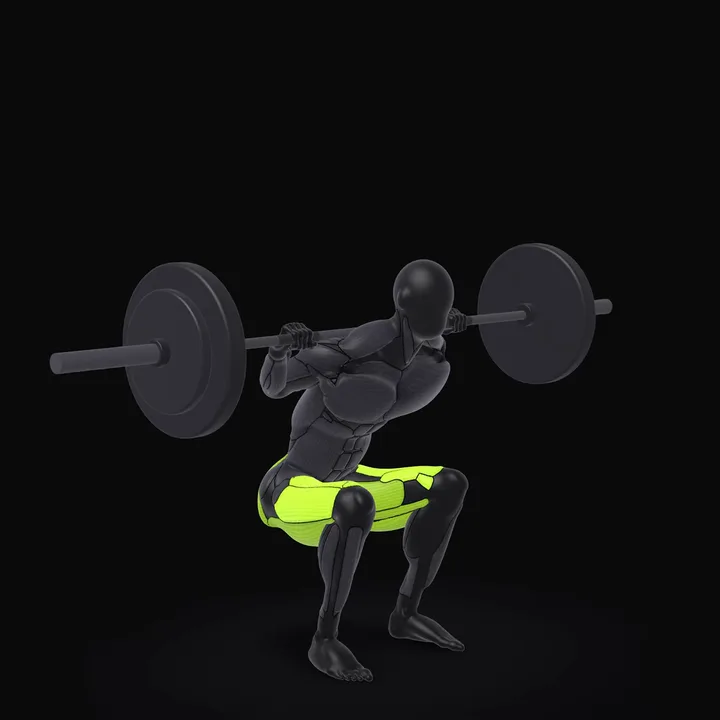 Barbell SquatPlace the bar on your upper back, not on your neck, and step out of the rack. Stand with feet slightly wider than shoulder width, toes turned out a little.How to do the Barbell Squat →
Progressive overload
This is the principle that ties it all together. As your muscles adapt, you add a rep, a little weight or a set. The simplest method is double progression: pick a rep range, work up to the top of it on every set, then add weight. How to apply progressive overload walks you through it.
Progressive overload only works if you know what you did last time. Write it down.
A program to start with
If you’re new, a simple full-body routine three times a week is ideal; the beginner gym workout plan gives you one with every set and rep written out. If you’ve been training a while, our programs cover full body, upper/lower and push/pull/legs.
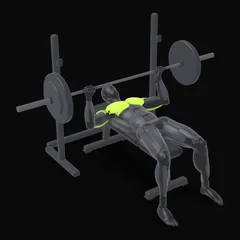
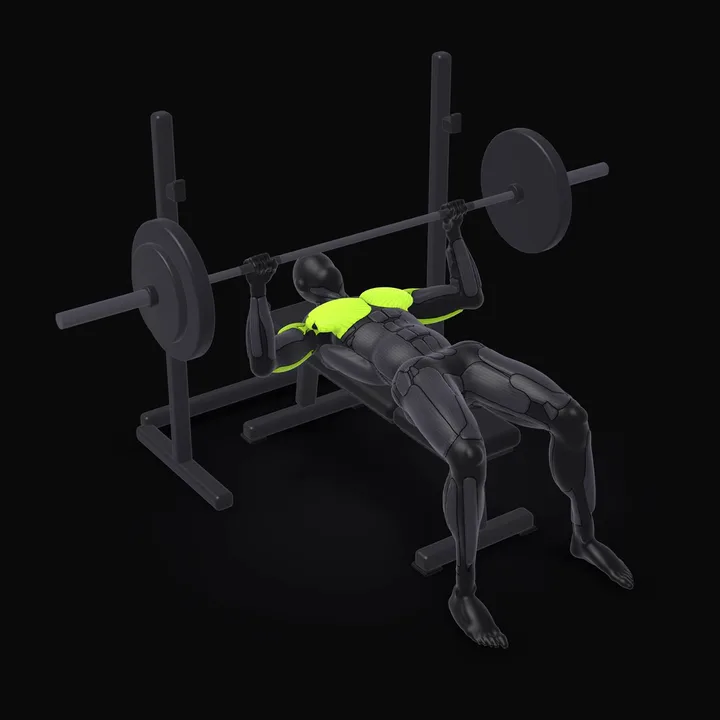 Barbell Bench PressLie on the bench with your eyes under the bar and your feet planted on the floor. Grip the bar slightly wider than shoulder width and pull your shoulder blades back and down.How to do the Barbell Bench Press →
Nutrition: the building material
Protein
Muscle is built from protein. A meta-analysis on protein supplementation and resistance training found that benefits to muscle gain levelled off at about 1.6 g of protein per kg of body weight per day, with an upper confidence limit of about 2.2 g/kg (Morton et al., 2018). For a 75 kg (165 lb) person, that’s about 120 g a day. Spread it over 3–5 meals.
| Body weight | Daily protein (1.6 g/kg) | Upper range (2.2 g/kg) |
|---|---|---|
| 60 kg (132 lb) | about 95 g | about 130 g |
| 75 kg (165 lb) | about 120 g | about 165 g |
| 90 kg (198 lb) | about 145 g | about 200 g |
More detail, including food examples, in how much protein to build muscle.
Calories
Muscle is easiest to build when you eat slightly more than you burn. A small surplus (a gain of about 0.25–0.5 % of your body weight per week) supports growth without adding much fat. You can also build muscle at maintenance, or even in a deficit if you’re new to training or have fat to lose, but it’s slower. See how to bulk for the details.
Supplements
Not required. Protein powder is convenient food. Creatine monohydrate has solid evidence for small additional gains in strength and muscle. Most other products have weak evidence.
Sleep and recovery: where growth happens
Training is the signal; recovery is where you adapt. Sleep is the biggest factor. In one study, a single night without sleep reduced muscle protein synthesis by about 18 % and shifted hormones in a direction less favourable for muscle (Lamon et al., 2021). Aim for 7–9 hours most nights.
Other recovery basics:
- Rest days. Muscles don’t need a full week off, but they do need 48–72 hours before being trained hard again.
- Manage stress. Life stress affects recovery as much as training stress.
- Deload when needed. A lighter week every 6–10 weeks, or when performance drops, helps you come back stronger.
Time and expectations
Muscle growth is slow. Beginners gain fastest, often noticeably in the first two to three months. After a year or two, progress slows to a fraction of that. The biggest predictor of results isn’t the perfect program; it’s training consistently for years. Realistic numbers by month and year are in how long it takes to build muscle.
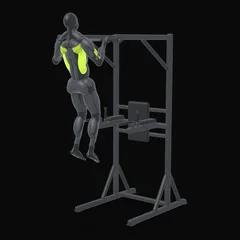
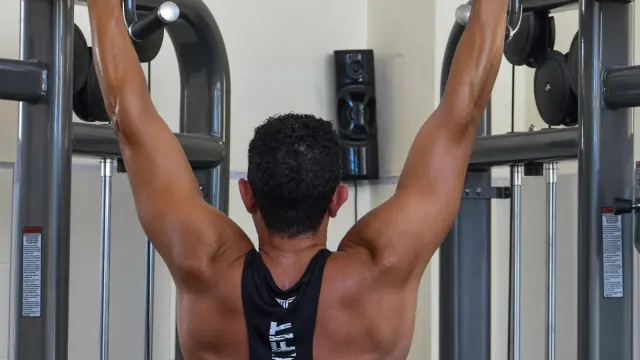
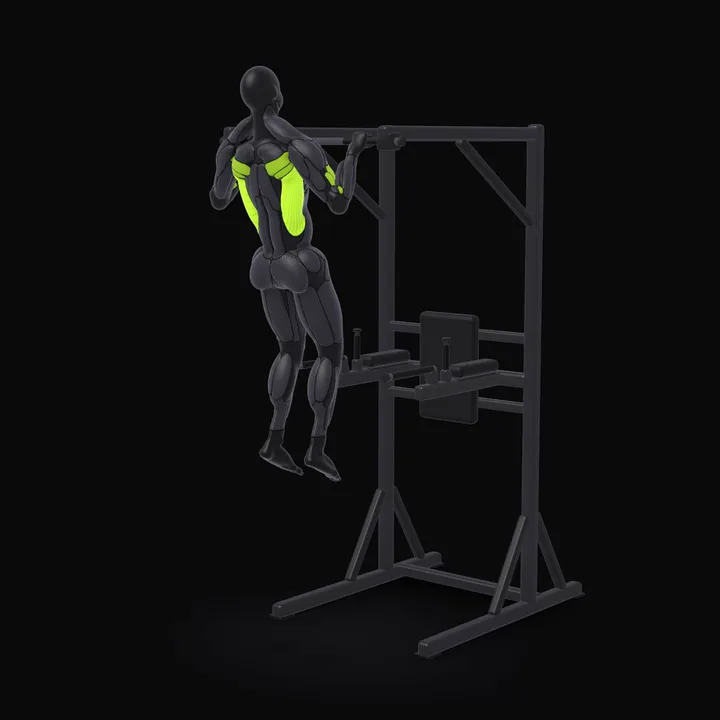 Pull-upGrab the bar with palms facing forward, hands slightly wider than your shoulders. Hang with straight arms and brace your core.How to do the Pull-up →
What a muscle-building week looks like
Putting it all together, here’s what a solid week looks like for someone with a year of training behind them:
| Day | Training | Food and recovery |
|---|---|---|
| Monday | Upper body: bench press, rows, shoulder press, pulldowns, arms | Protein at 3–4 meals, 7–9 h sleep |
| Tuesday | Lower body: squat, Romanian deadlift, leg press, leg curl, calves | Same |
| Wednesday | Rest or a walk | Same; slightly fewer carbs is fine |
| Thursday | Upper body: incline press, pull-ups, chest-supported row, lateral raises, arms | Same |
| Friday | Lower body: deadlift or hack squat, split squats, leg extension, calves | Same |
| Weekend | Rest, active hobbies | Keep protein and sleep consistent |
That’s about 10–16 hard sets per muscle per week, every muscle trained twice, four sessions of about an hour. Nothing fancy, and that’s the point.
Does it work the same for everyone?
The principles do. The pace differs:
- Women build muscle at a similar rate relative to their starting size, though absolute gains are usually smaller. The training principles are the same; see the gym workout plan for women.
- Older lifters still build muscle, just a bit more slowly, with more attention to recovery and joint-friendly exercise choices.
- Very lean “hardgainers” often simply aren’t eating enough. Tracking food for a couple of weeks usually reveals it.
- People with more body fat can often build muscle while losing fat, especially at the start.
The most common reasons people don’t build muscle
- Sets aren’t hard enough. Lots of easy sets feel like work but don’t drive growth.
- No progression. The same weights for months.
- Not enough protein or food. Especially common in people trying to “stay lean” while building.
- Inconsistency. Three weeks on, two weeks off.
- Program hopping. A new plan every month means never running one long enough to work.
- Poor sleep. Five hours a night is a real handicap.
Fix those six and almost any reasonable program will work.
Frequently asked questions
How fast can you build muscle?
Beginners who train well and eat enough can often gain around 0.5 to 1 kg (1 to 2 lb) of muscle per month in their first year, with the rate slowing each year after that. Women typically gain about half that in absolute terms. Your starting point, age and consistency all matter.
Can you build muscle without going to the gym?
Yes. Bodyweight exercises, dumbbells or kettlebells at home can build muscle as long as the sets are hard and you keep making them harder over time.
Do I need supplements to build muscle?
No. Food, training and sleep do the work. Protein powder is a convenient way to hit your protein target, and creatine monohydrate has good evidence for a small extra benefit, but neither is required.
Can I build muscle and lose fat at the same time?
Yes, especially if you're new to lifting, returning after a break or carrying extra body fat. It's called body recomposition. Experienced, lean lifters usually build muscle faster in a small calorie surplus.
Is it too late to build muscle after 40 or 50?
No. Muscle responds to training at any age. Gains are usually a bit slower and recovery matters more, but people in their sixties and seventies still build muscle and strength with resistance training.
Sources
- Schoenfeld BJ (2010). The Mechanisms of Muscle Hypertrophy and Their Application to Resistance Training. Journal of Strength and Conditioning Research
- Pelland JC, Remmert JF, Robinson ZP, Hinson SR, Zourdos MC (2025). The Resistance Training Dose Response: Meta-Regressions Exploring the Effects of Weekly Volume and Frequency on Muscle Hypertrophy and Strength Gain. Sports Medicine
- Lopez P, Radaelli R, Taaffe DR, et al. (2021). Resistance Training Load Effects on Muscle Hypertrophy and Strength Gain: Systematic Review and Network Meta-analysis. Medicine & Science in Sports & Exercise
- Refalo MC, Helms ER, Trexler ET, Hamilton DL, Fyfe JJ (2023). Influence of Resistance Training Proximity-to-Failure on Skeletal Muscle Hypertrophy: A Systematic Review with Meta-analysis. Sports Medicine
- Morton RW, Murphy KT, McKellar SR, Schoenfeld BJ, Henselmans M, Helms E, Aragon AA, Devries MC (2018). A systematic review, meta-analysis and meta-regression of the effect of protein supplementation on resistance training-induced gains in muscle mass and strength in healthy adults. British Journal of Sports Medicine
- Lamon S, Morabito A, Arentson-Lantz E, Knowles O, Vincent GE, Condo D, Alexander SE, Garnham A, et al. (2021). The effect of acute sleep deprivation on skeletal muscle protein synthesis and the hormonal environment. Physiological Reports
- Schoenfeld BJ, Ogborn D, Krieger JW (2016). Effects of Resistance Training Frequency on Measures of Muscle Hypertrophy: A Systematic Review and Meta-Analysis. Sports Medicine