A deload week is a planned week of easier training, usually with about half your normal sets and slightly lighter weights, that lets fatigue clear so you can keep progressing. Take one when your lifts have stalled or dropped for a couple of weeks, your joints ache, or motivation has fallen off, or schedule one every 6–10 weeks of hard training. You won’t lose muscle, and you’ll usually come back stronger. Below are the signs, three ways to deload, and how to decide whether you need one at all.
What is a deload?
Training creates two things: fitness (you get stronger and build muscle) and fatigue (you feel beaten up and perform worse). Normally fitness wins and your lifts go up. Over weeks of hard training, though, fatigue can build faster than it clears. Your performance flattens or drops, even though you’re probably still fitter than before. A deload lowers the training stress so the fatigue clears and the fitness shows.
Experts in strength and physique sports, surveyed in a consensus study, described deloading as a short period of reduced training demand, mostly by cutting volume, aimed at reducing fatigue and improving readiness to train (Bell et al., 2023).
Signs you need a deload
- Main lifts stalled or dropped for 2 or more weeks despite good sleep and food.
- Joints or tendons aching more than usual, especially elbows, knees and shoulders.
- Weights that should feel easy feel heavy in your warm-ups.
- Motivation to train has dropped noticeably.
- Sleep has worsened, or you feel run-down outside the gym.
One bad session isn’t a sign. A pattern over one or two weeks is.
How to deload: three methods
| Method | What changes | Best for |
|---|---|---|
| 1. Cut volume (most common) | Half the sets, same exercises, weights about 10 % lighter | Almost everyone |
| 2. Cut intensity | Same sets, weights 20–30 % lighter, far from failure | When joints are the issue |
| 3. Cut both / active rest | A few easy sessions, or a week off with walks and mobility | When you’re very run-down, travelling, or sick |
Example: a volume deload
| Exercise | Normal week | Deload week |
|---|---|---|
| Squat | 4 × 6 at 100 kg (225 lb) | 2 × 6 at 90 kg (200 lb) |
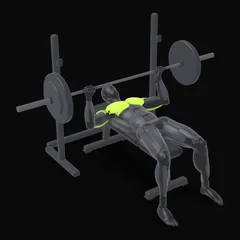
| Bench press | 4 × 8 at 80 kg (175 lb) | 2 × 8 at 70 kg (155 lb) |
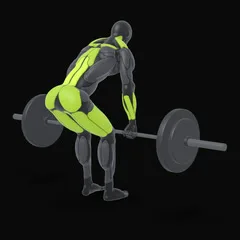
| Romanian deadlift | 3 × 10 at 80 kg | 2 × 10 at 70 kg |
| Lateral raise | 4 × 15 | 2 × 15 |
Keep every set comfortably short of failure, around 3–4 reps in reserve. Sessions take about half as long. That’s the point.
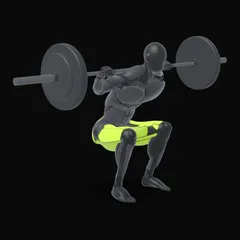
 Barbell SquatPlace the bar on your upper back, not on your neck, and step out of the rack. Stand with feet slightly wider than shoulder width, toes turned out a little.How to do the Barbell Squat →
Do you need deloads at all?
Not always. There’s limited direct research on deloads. One study had trained participants take a full week off training in the middle of a 9-week program; compared with a group that trained straight through, they gained similar muscle, with some strength measures improving slightly less (Coleman et al., 2024). In other words, a short break didn’t hurt muscle growth, but it didn’t magically boost it either.
We also know that strength and muscle can be maintained for weeks or months on much less training than usual, as long as loads stay reasonably heavy (Spiering et al., 2021). So a deload costs you very little.
| You are… | Planned deloads? |
|---|---|
| A beginner on a simple 3-day program | Usually not needed; deload only if you stall or feel run-down |
| An intermediate training 4–6 days with high volume | Helpful every 6–10 weeks, or by feel |
| Training hard while cutting calories | Often useful, as recovery is worse |
| Preparing for a powerlifting meet | A taper in the last week or two works like a deload |
Deloading on different programs
- Full body 3 days a week: run all three sessions with half the sets and slightly lighter weights.
- Upper/lower or push/pull/legs: keep the same days, halve the sets, and drop the last exercise of each session.
- Strength programs with percentages: use about 60–70 % of your training max for a few sets of 3–5 reps, crisp and fast.
- Bodyweight training: step back one level on each progression for the week, or halve your sets.
- If you also run or play a sport: reduce that as well, or the deload won’t reduce your total fatigue much.
Planned vs reactive deloads
Planned: you schedule a lighter week every 6–10 weeks, often at the end of a training block. Good if you tend to push through fatigue, or if your program has blocks that build in difficulty.
Reactive: you deload when the signs show up. Good if you’re experienced at reading your own fatigue and keep a log that shows when performance drops.
Many lifters combine them: a planned deload every 8–10 weeks, and an earlier one if they need it.
Tracking makes deloads smarter
The best signal is your numbers. If your estimated strength on the main lifts drops for two weeks in a row, or reps on the same weights keep falling, that’s a much better trigger than a random date on the calendar.
Coming back after a deload
Return to your normal training the week after. Many people set small PRs in the first week or two back, because the fatigue has cleared. If you came back and still feel flat, look beyond training: sleep, stress, food and illness are often the real issue. Overtraining symptoms covers when fatigue is more than just a hard block, and how to break a plateau has the full checklist for stalled lifts.
Common deload mistakes
- Turning the deload into a test week. Lighter means lighter.
- Doing extra cardio or sports to “make up” for it. That just moves the fatigue elsewhere.
- Deloading every three weeks. If you need that many, your normal training is probably too much.
- Never deloading while lifts slide for months.
For how deloads fit into a progression plan, see how to apply progressive overload.
Frequently asked questions
Will I lose muscle during a deload week?
No. A week of lighter training won't cost you muscle. Muscle and strength can be maintained for weeks or months with much less training than usual, and one study found that even a full week off in the middle of a program led to similar muscle gains.
How often should I deload?
There's no fixed rule. Many lifters deload every 6 to 10 weeks, or when they notice signs of accumulated fatigue. Beginners on simple programs often don't need planned deloads at all.
Should I take a week off instead of deloading?
Either can work. A deload keeps your technique and routine going with lighter training. A full week off is fine too, especially if you're tired, travelling or nursing aches. You'll usually feel stiff for a session or two afterwards.
Is a deload the same as a rest week?
Not exactly. A deload means training with reduced volume or intensity; a rest week means no training. Both reduce fatigue; a deload keeps more practice in.
Sources
- Bell L, Strafford BW, Coleman M, Androulakis Korakakis P, Nolan D (2023). Integrating Deloading into Strength and Physique Sports Training Programmes: An International Delphi Consensus Approach. Sports Medicine - Open
- Coleman M, Burke R, Augustin F, et al., Schoenfeld BJ (2024). Gaining more from doing less? The effects of a one-week deload period during supervised resistance training on muscular adaptations. PeerJ
- Spiering BA, Mujika I, Sharp MA, Foulis SA (2021). Maintaining Physical Performance: The Minimal Dose of Exercise Needed to Preserve Endurance and Strength Over Time. Journal of Strength and Conditioning Research