To grow your biceps, do two or three curl variations each week that load the muscle from different arm positions (one with the elbow behind your body, one in front), add a hammer curl for the brachialis underneath, and get 6–12 hard sets a week with a full stretch at the bottom of every rep. Then add weight or reps over time. Below is how the two heads of the biceps work, what arm position and grip really change, and a simple routine.
Long head vs short head
The biceps brachii has two heads that join into one tendon at the elbow:
- The long head runs on the outside of the arm and crosses the front of your shoulder joint. When your arm is behind your body, it’s stretched.
- The short head runs on the inside and attaches to the front of the shoulder blade (the coracoid process). It’s less affected by shoulder position.
Both heads bend your elbow and rotate your forearm so the palm turns up (supination). You can’t fully isolate one from the other, but you can shift the emphasis by changing where your arm is.
Under the biceps sits the brachialis, a pure elbow flexor that works in any grip. An MRI study found it’s about the same volume as the biceps itself, around 144 cm³ each in young adults (Holzbaur et al., 2007). Ignoring it means ignoring half your elbow flexor muscle.
Why the stretch matters
Where in the range of motion you load a muscle seems to matter. In a five-week study, people training elbow flexors in the extended (stretched) part of the curl range gained significantly more muscle thickness, about 8.9 % versus 3.4 %, than people training in the flexed (shortened) part of the range (Sato et al., 2021). Only the stretched-range group gained significant strength.
You don’t need to do partial reps. You need curls where the bottom half is hard and you don’t cut it short. That’s why the incline curl and the preacher curl are so popular: both make the bottom of the curl challenging.
The curl variations that matter
| Curl | Arm position | Emphasis | Why use it |
|---|---|---|---|
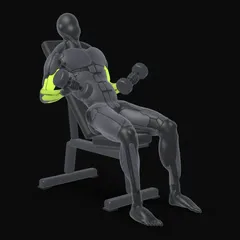
| Incline dumbbell curl | Behind the body | Long head, stretched | Hardest at the bottom |
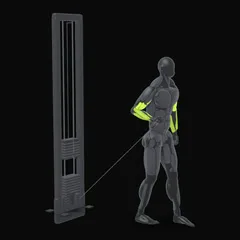
| Behind-the-back cable curl | Behind the body | Long head, constant tension | Cable loads the stretch |
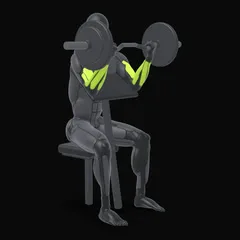
| EZ-bar preacher curl | In front | Short head, stretched | Strict, no cheating |
| Spider curl | In front, hanging | Short head, peak contraction | Hard at the top |
| EZ-bar curl or barbell curl | At the sides | Both heads | Heaviest loads, easy to progress |
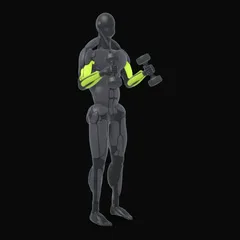
| Hammer curl | At the sides, neutral grip | Brachialis, brachioradialis | Arm thickness, forearms |
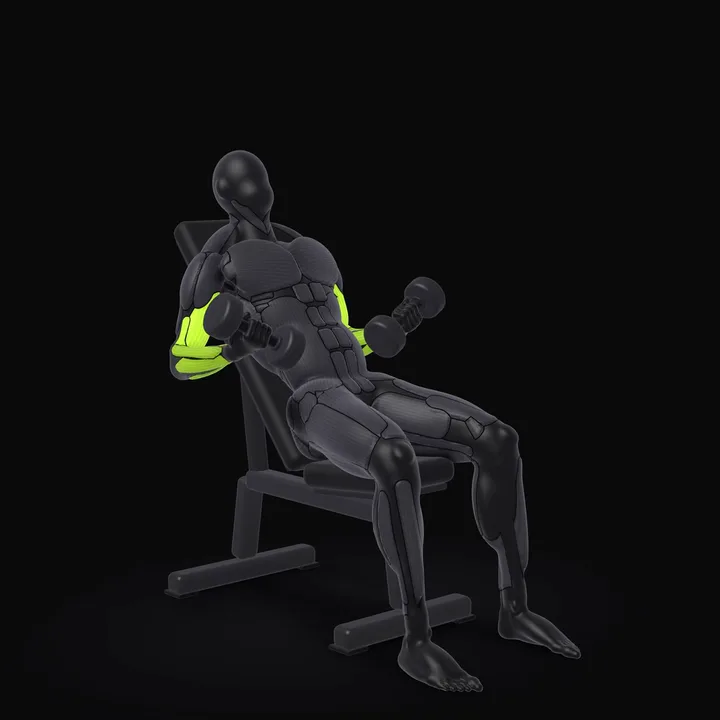 Dumbbell Incline CurlSet the bench to 45–60 degrees and sit back against it. Let your arms hang straight with the dumbbells, palms facing forward.How to do the Dumbbell Incline Curl →
Grip matters too
- Palms up (supinated): full biceps involvement. Rotating your palm up as you curl a dumbbell uses the biceps’ supination role.
- Neutral (hammer): shifts work to the brachialis and brachioradialis.
- Palms down (reverse curl): mostly brachioradialis and brachialis, much less biceps. Good for forearms.
An EZ bar is a compromise between supinated and neutral, often easier on the wrists than a straight bar.
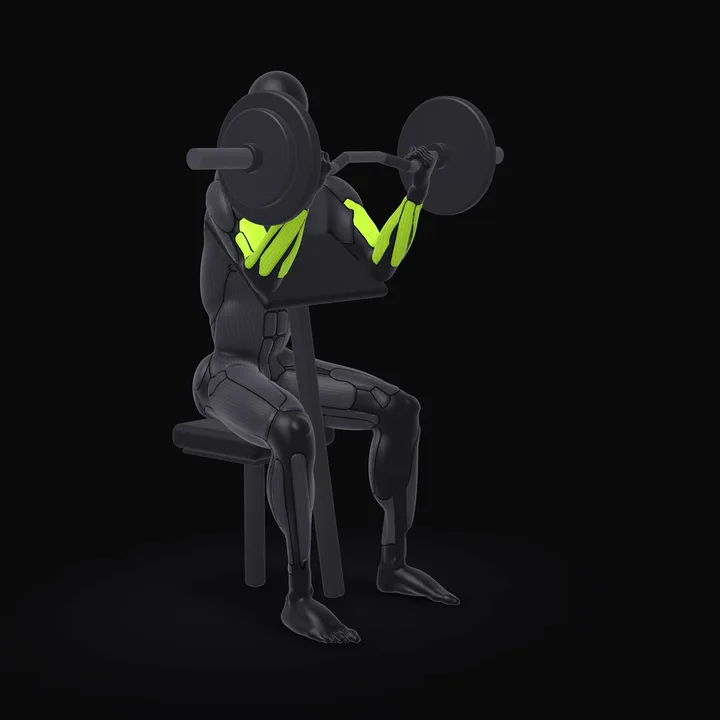 EZ Bar Preacher CurlAdjust the seat so your armpits rest on top of the preacher pad. Grab the EZ bar with palms up and your upper arms on the pad.How to do the EZ Bar Preacher Curl →
How many sets for biceps?
More weekly volume generally produces more growth (Schoenfeld et al., 2017). Your biceps already get work from every row, pulldown and chin-up, so direct curls are on top of that:
| Level | Direct biceps sets per week |
|---|---|
| Beginner | 2–4 (compound pulls do most of the work) |
| Intermediate | 6–10 |
| Advanced | 8–14 |
Split them across two or three sessions. Four sets twice a week beats eight sets once.
A sample biceps routine
Do this block at the end of two pull or upper sessions a week:
Session 1
| Exercise | Sets × reps | Rest |
|---|---|---|
| EZ-bar curl | 3 × 8–12 | 90 s |
| Incline dumbbell curl | 2 × 10–15 | 60–90 s |
Session 2
| Exercise | Sets × reps | Rest |
|---|---|---|
| Preacher curl | 3 × 8–12 | 90 s |
| Hammer curl | 2 × 10–12 | 60 s |
That’s 10 hard sets a week, covering the long head, the short head and the brachialis. If you’re on a push/pull/legs split, put one session on each pull day. For the whole arm picture, including the triceps, read how to get bigger arms.
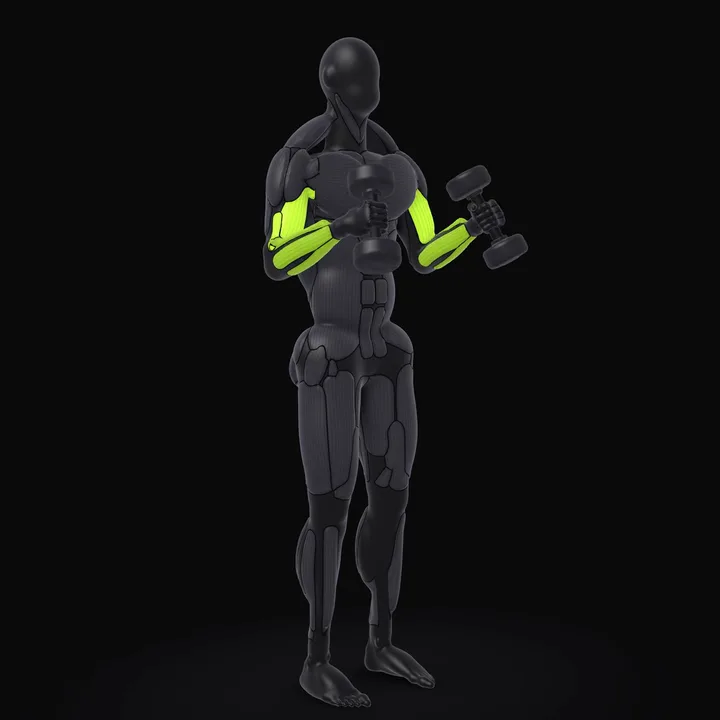 Dumbbell Hammer CurlStand with a dumbbell in each hand at your sides, palms facing each other. Keep your elbows close to your sides.How to do the Dumbbell Hammer Curl →
Technique for bigger biceps
- Lock your elbows in place. On standing curls, your elbows can move forward a little at the top, but they shouldn’t swing back and forth.
- Lower slowly. Two to three seconds down. The stretched bottom of the curl is the most productive part.
- Straighten your arm fully at the bottom of every rep, without relaxing completely.
- Keep your wrists neutral. Curling your wrists inward at the top shifts the work to your forearms.
- Focus on the muscle. On isolation exercises like curls, thinking about the biceps contracting does appear to help growth. The article on the mind muscle connection explains when that works.
How to progress curls
Curl jumps are relatively big. Use double progression with a range like 8–12: work up to 12 on every set, then go up to the next dumbbell or add 2.5 kg (5 lb) to the bar. Cheat a little on the last rep or two if you like, but if the weight only moves with a full-body swing, it’s too heavy.
Small weekly improvements add up. A dumbbell curl that goes from 12 kg to 18 kg for the same reps over a year means a lot of new muscle.
Common biceps mistakes
- Only doing standing curls. Add an incline or behind-the-back curl and a preacher or spider curl.
- Half reps. Stopping short at the bottom skips the most valuable part.
- Too heavy, too much swing. Your lower back and front delts end up doing the curling.
- Forgetting the triceps. They’re the bigger muscle. See how to grow triceps.
- Neglecting compound pulls. Heavy chin-ups and rows build a base that curls build on. How to do pull-ups is a good place to start.
Frequently asked questions
How many times a week should I train biceps?
Two or three times. Your biceps also work during rows and pull-downs, so two short blocks of direct curls per week on top of your back training is enough for most people.
Which curl is best for the biceps long head?
Curls where your elbow is behind your body: incline dumbbell curls and behind-the-back cable curls. They stretch the long head, which runs over the front of the shoulder.
Which curl is best for the biceps short head?
Curls with your arms in front of your body, like preacher curls and spider curls. They shorten the long head, so the short head does relatively more of the work.
Do hammer curls work the biceps?
Partly. Hammer curls hit the brachialis and brachioradialis more than regular curls. The brachialis sits under the biceps and is about as big, so it's well worth training for overall arm size.
Are chin-ups enough for biceps?
They're a strong biceps exercise and enough for beginners. As you get more advanced, adding direct curls usually leads to more biceps growth than chin-ups alone.
Sources
- Sato S, Yoshida R, Kiyono R, Yahata K, Yasaka K, Nunes JP, Nosaka K, Nakamura M (2021). Elbow Joint Angles in Elbow Flexor Unilateral Resistance Exercise Training Determine Its Effects on Muscle Strength and Thickness of Trained and Non-trained Arms. Frontiers in Physiology
- Holzbaur KR, Murray WM, Gold GE, Delp SL (2007). Upper limb muscle volumes in adult subjects. Journal of Biomechanics
- Schoenfeld BJ, Ogborn D, Krieger JW (2017). Dose-response relationship between weekly resistance training volume and increases in muscle mass: A systematic review and meta-analysis. Journal of Sports Sciences