The mind muscle connection is the practice of focusing your attention on the muscle you’re training, feeling it contract and stretch, rather than just moving the weight. Research supports it for building muscle, with limits: it increases muscle activity at light and moderate loads, and in one 8-week study it led to more biceps growth than focusing on the weight. It helps most on isolation exercises and matters much less on heavy compound lifts, where focusing on the movement outcome usually works better.
What is the mind muscle connection?
In research terms, it’s an internal focus of attention: thinking about your body and the muscle doing the work. The opposite is an external focus: thinking about the effect of the movement on the outside world, such as the bar moving, the weight going up or pushing the floor away.
Sports science has long shown that an external focus usually improves performance in skills like jumping, throwing or lifting maximal weights. Bodybuilders, on the other hand, have long sworn by “feeling the muscle”. The research suggests both are right, for different goals.
What the research says
Muscle activity
In a study on the bench press, trained participants were asked to focus either on their chest or on their triceps during sets at different loads. Focusing on a muscle increased its activity at 20–60 % of their maximum, but at 80 % the effect disappeared (Calatayud et al., 2016). When the load gets heavy, your body recruits everything it can regardless of where your attention goes.
Muscle growth
The bigger question is whether more activity means more growth. In an 8-week study, untrained men did curls and leg extensions with either an internal focus (“squeeze the muscle”) or an external focus (“get the weight up”). The internal focus group grew their biceps roughly twice as much (about 12 % vs 7 %), while quadriceps growth didn’t differ significantly between groups (Schoenfeld et al., 2018).
That’s one small study in untrained people, so treat it as a promising signal rather than settled science. Why the biceps responded and the quads didn’t isn’t clear; one possibility is that it’s easier to focus on a small muscle you can see.
Why it might work
When you lift a light or moderate weight, your body doesn’t need every available muscle fibre, and it can share the work between several muscles in different ways. On a curl, the biceps, brachialis and forearm muscles all help; on a pulldown, your arms can steal work from your lats. Directing your attention to one muscle seems to shift more of that shared work onto it. With very heavy loads, there’s nothing left to shift: every muscle that can help is already working flat out, which fits with the bench press findings above.
There’s also a practical side. Focusing on the muscle usually makes people slow down, control the lowering and use a full range of motion. Some of the benefit may simply come from better technique.
When the mind muscle connection helps
| Situation | Use an internal focus? | Why |
|---|---|---|
| Isolation exercises (curls, raises, flyes, extensions) | Yes | Small muscles, moderate loads, focus increases their work |
| Machines and cables for hypertrophy | Yes | Stable, so attention can go to the muscle |
| Back exercises (pulldowns, rows) | Often | Helps many lifters stop pulling with their arms |
| Warm-up sets | Yes | Good time to “find” the muscle |
| Heavy compound lifts (squat, deadlift, bench at 80 %+) | Mostly no | External cues (“push the floor”, “bar to the ceiling”) tend to help performance |
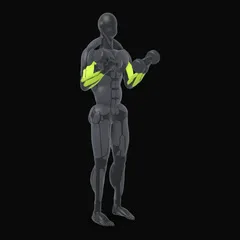
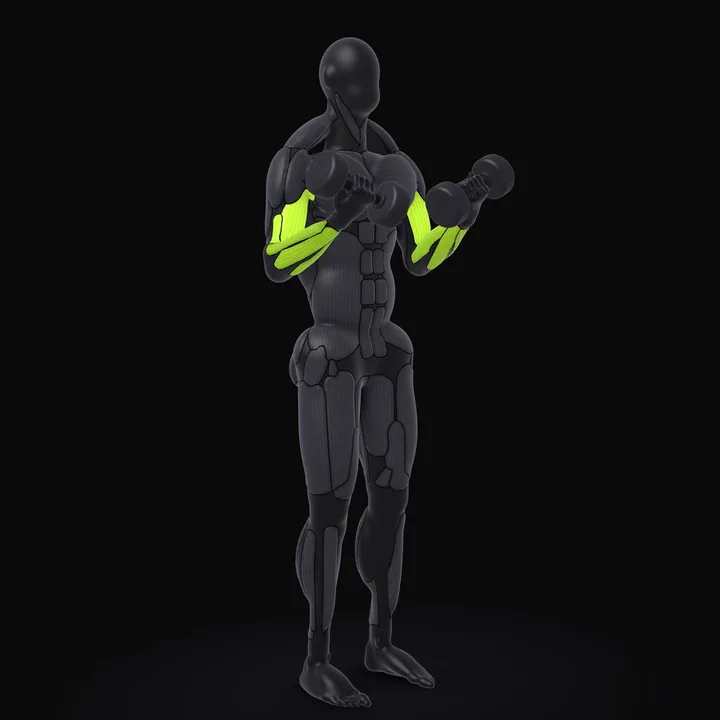 Dumbbell Biceps CurlStand with a dumbbell in each hand at your sides, palms facing forward. Keep your elbows close to your sides.How to do the Dumbbell Biceps Curl →
How to practise it
- Lower the weight. If you’re swinging, you can’t focus on anything except surviving the set. Use about 60–70 % of what you’d normally handle at first.
- Slow the lowering to 2–3 seconds and pause briefly in the contracted position.
- Touch the muscle. Put your hand on your biceps, pec or lat before the set, or between reps on single-arm exercises.
- Use cues that point at the muscle, for example:
- Curls: “bring your pinky toward your shoulder, squeeze the biceps”.
- Cable flyes: “hug a tree, squeeze your chest together”.
- Pulldowns: “drive your elbows into your back pockets”.
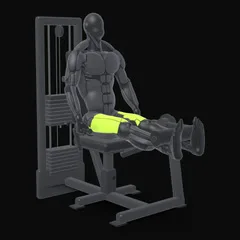
- Leg extensions: “squeeze your quads hard at the top for one second”.
- Do a few practice reps with no weight, contracting the muscle as hard as you can.
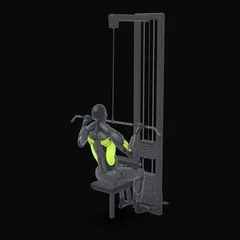
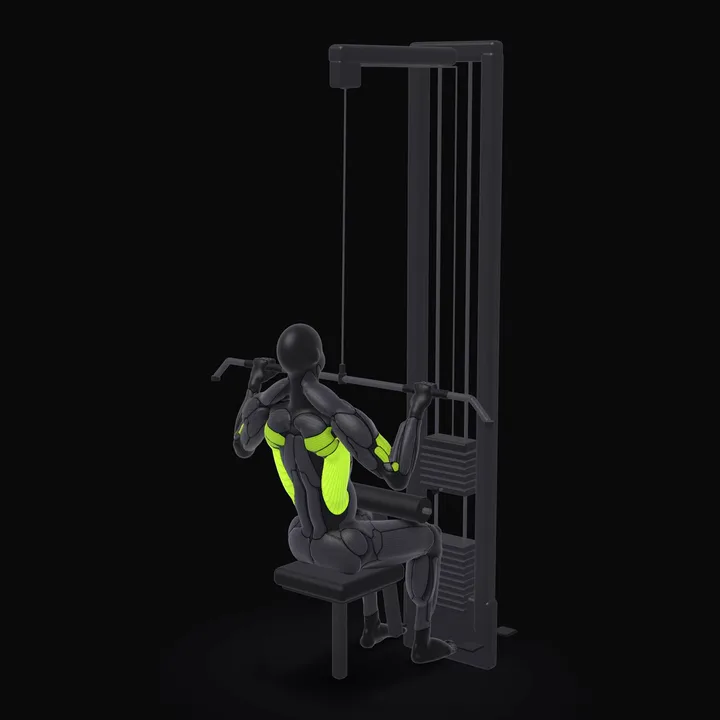 Cable Lat PulldownAdjust the thigh pad to lock your legs in and grab the wide bar slightly wider than your shoulders. Sit with your chest up and lean back slightly.How to do the Cable Lat Pulldown →
“I can’t feel it”: fault and fix
Most people who say the mind muscle connection doesn’t work for them are fighting one of a handful of problems. The fix is usually a setup change, not more concentration.
| What you feel | What’s usually happening | Try this |
|---|---|---|
| Pulldowns and rows in your biceps, not your back | Hands are doing the pulling, grip is too tight | Use a thumbless or loose grip or straps, think “elbows down and back”, pause with the bar at your upper chest |
| Lateral raises in your traps and neck | Shrugging as the weight goes up, load too heavy | Drop the weight, lead with your elbows, stop just below shoulder height, keep your shoulders “long” |
| Bench press and flyes in the front of your shoulders | Shoulders roll forward, elbows flare wide | Pull your shoulder blades back and down before the set, tuck elbows slightly, try a pec deck to learn the squeeze |
| Hip thrusts in your lower back or hamstrings | Arching at the top, feet too far out | Tuck your chin and ribs down, finish with a glute squeeze rather than a back arch, bring feet closer until shins are vertical at the top |
| Curls in your forearms | Wrists curling, grip crushing the handle | Keep wrists neutral, hold the dumbbell a little looser, slow the top half |
| Rows in your lower back | Torso rocking to move the weight | Switch to a chest-supported row so the bench takes your torso out of it |
If a muscle still doesn’t show up after a few sessions of honest effort, swap the exercise. Being able to feel one variation and not another is common, and there’s no prize for forcing it.
Muscle-by-muscle activation drills
A short drill before your working sets can help you locate the muscle. Keep it light and quick: one or two sets of 10–15 reps, nowhere near failure. The goal is a clear contraction, not fatigue.
- Lats: straight-arm pulldowns. With your elbows locked, your arms can’t steal the work, so you feel the lats pull the bar to your thighs.
- Rear delts: face pulls or a reverse pec deck, pausing for a second with your arms wide.
- Glutes: glute bridges on the floor with a 2-second squeeze at the top before your squats or hip thrusts.
- Chest: a few light cable flyes, squeezing your hands together for a second at the end.
- Side delts: light lateral raises with a pause at the top, thinking “push the dumbbells out to the walls”.
You can also do the drill without equipment: contract the muscle as hard as you can for 5–10 seconds, like posing. It sounds silly but it’s an easy way to teach your brain where the muscle is.
The trap: chasing the feeling instead of progress
The mind muscle connection can go wrong when it becomes the goal. Lifters chase a “pump” or a burn, keep the weights light forever and stop progressing. Muscle growth still depends on hard sets and getting stronger over time, as covered in how to build muscle.
A good balance:
- Focus on the muscle, then still try to beat last week’s reps or weight with good form.
- Use internal focus on most isolation work and lighter sets, and external focus on your heavy compound lifts.
- Judge the result by your logbook and measurements over months, not by how a single set felt.
How to program it in a workout
The simplest approach is to split each session by focus:
- Start with the heavy compound lift (squat, bench, deadlift, row, overhead press) using external cues. Your aim here is performance and adding load over time.
- Move to lighter compound or machine work (8–12 reps) where you can start shifting attention to the target muscle.
- Finish with isolation exercises (10–20 reps) using a full internal focus, slow lowering and a brief squeeze at the top.
Even with a strong muscle focus, the sets still need to be hard. Stopping 1–3 reps short of failure is a good target for isolation work; RPE and RIR explains how to judge that.
Here’s what a pull day can look like:
| Exercise | Sets × reps | Focus |
|---|---|---|
| Barbell row | 3 × 6–8 | External: “pull the bar to your belly button” |
| Lat pulldown | 3 × 8–12 | Internal: “elbows into your back pockets”, 1-second pause |
| Chest-supported row | 3 × 10–12 | Internal: “squeeze the shoulder blades together” |
| Face pull | 2 × 12–15 | Internal: rear delts, pause with arms wide |
| Dumbbell curl | 3 × 10–15 | Internal: slow lowering, squeeze at the top |
Log the weight and reps for every exercise, including the isolation ones. If you’re “feeling it” more but your reps on a lift haven’t moved in six weeks, the feeling isn’t paying off and the session needs more progressive overload.
Related techniques
- Tempo: slowing down the lowering phase gives you more time to feel the muscle. Time under tension explains what tempo does and doesn’t do.
- Training close to failure: the last few reps of a hard set recruit the most muscle fibres regardless of focus. Training to failure covers how close to go.
- Exercise choice: if you can’t feel a muscle on one exercise, another might suit you better. A chest-supported row often fixes “I can’t feel my back”.
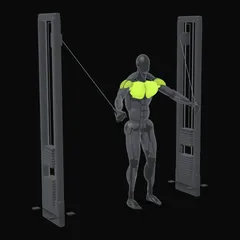
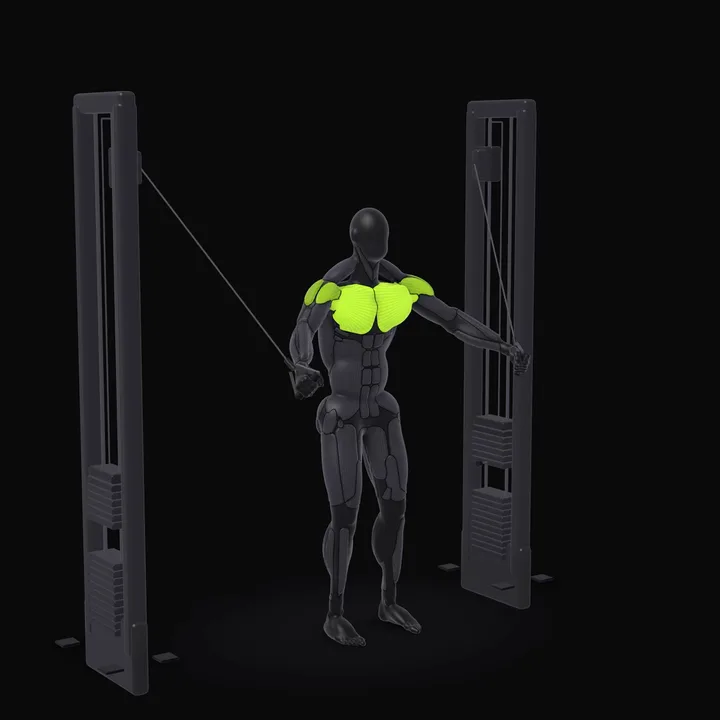 Cable FlySet the pulleys high, take a handle in each hand and step forward. Lean slightly forward with your elbows softly bent.How to do the Cable Fly →
Common mistakes
- Using it on everything, including heavy squats, and losing performance.
- Going so light that sets are no longer hard.
- Thinking it replaces progression. It doesn’t.
- Giving up on an exercise because you “don’t feel it”. Some muscles, like the quads in a squat, work hard even if you don’t feel them much.
Frequently asked questions
Is the mind muscle connection real?
Yes. Studies show that focusing on a muscle increases its electrical activity during an exercise, and one 8-week study found greater biceps growth when people focused on the muscle compared with focusing on moving the weight. The effect is clearest on isolation exercises with moderate loads.
Should I use the mind muscle connection on squats and deadlifts?
Usually not as your main focus. On heavy compound lifts, thinking about the outcome, like pushing the floor away or driving the bar up, tends to help performance more. Save muscle focus for lighter sets and isolation work.
How do I feel my back muscles when training?
Use a weight you can control, pause at the end of each rep, and think about your elbows moving rather than your hands pulling. Touching the muscle or having someone tap it before the set can also help you find it.
Does the mind muscle connection matter for beginners?
It can help beginners learn which muscles an exercise should work. But beginners gain most from learning good technique and progressing the weight; don't let the search for a 'feeling' replace adding reps and load.
Does a pump mean the muscle is growing?
Not on its own. A pump is temporary swelling from blood and fluid in the muscle, and it fades within an hour or so. It can tell you the right muscle worked, but growth shows up over weeks as more reps, more load and measurable size, not in how full a muscle looks after one set.
Sources
- Calatayud J, Vinstrup J, Jakobsen MD, Sundstrup E, Brandt M, Jay K, Colado JC, Andersen LL (2016). Importance of mind-muscle connection during progressive resistance training. European Journal of Applied Physiology
- Schoenfeld BJ, Vigotsky A, Contreras B, Golden S, Alto A, Larson R, Winkelman N, Paoli A (2018). Differential effects of attentional focus strategies during long-term resistance training. European Journal of Sport Science