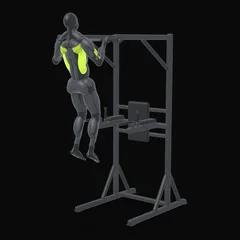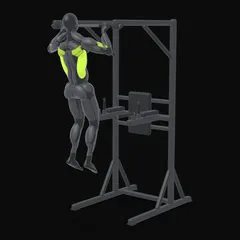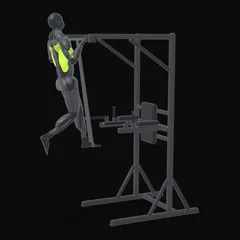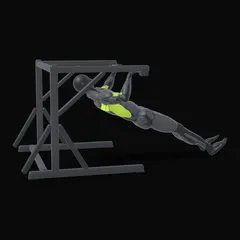
To do a pull-up, hang from a bar with your hands slightly wider than your shoulders, pull your shoulder blades down, then drive your elbows toward your ribs until your chin clears the bar, and lower under control to a full hang. If you can’t do one yet, build up with inverted rows, slow negatives and band-assisted pull-ups two or three times a week; most people get their first rep within a couple of months. Once you have a few reps, a simple program takes you to 10 and beyond.
Perfect pull-up form
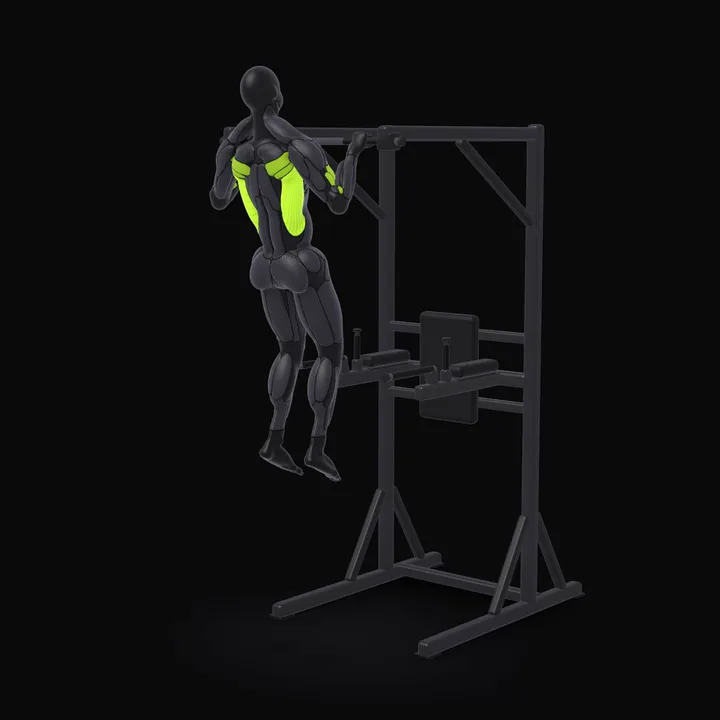 Pull-upGrab the bar with palms facing forward, hands slightly wider than your shoulders. Hang with straight arms and brace your core.How to do the Pull-up →
- Grip: hands slightly wider than shoulder-width, palms facing away, thumbs around the bar.
- Hang: start from straight arms. Let your shoulders rise slightly, but keep some tension.
- Start the pull with your shoulder blades: pull them down and slightly back. Your body rises a few centimetres without bending your elbows.
- Drive your elbows down toward your ribs and back pockets. Think about pulling the bar to your chest.
- Top: chin over the bar, chest toward the bar. Don’t crane your neck to get there.
- Lower under control in about 2 seconds to a full hang.
Keep your legs still: either straight and slightly in front of you with your glutes tight, or knees bent and crossed. Swinging and kicking (kipping) is a different exercise.
Warm up before you pull
Your elbows and shoulders take most of the load, so give them a few minutes: 10 arm circles each way, 15 band pull-aparts, a 20–30 second dead hang, then 8 scapular pull-ups. Finish with one easier set, such as an inverted row or a band-assisted set, at about half your usual reps. Cold, maximal pull-ups are how elbows start to complain.
Step 1: getting your first pull-up
If you can’t do a pull-up yet, use these four exercises. Do this plan two or three times a week, on non-consecutive days:
| Exercise | Sets × reps | Rest | Progress when… |
|---|---|---|---|
| Dead hang | 3 × max time | 60 s | You reach 45–60 s |
| Scapular pull-up | 3 × 8–10 | 60 s | Smooth, controlled reps |
| Inverted row | 3 × 8–12 | 90 s | 3 × 12: lower the bar or straighten legs |
| Negative pull-up | 3 × 3–5 | 2 min | 5 negatives of 5+ seconds |
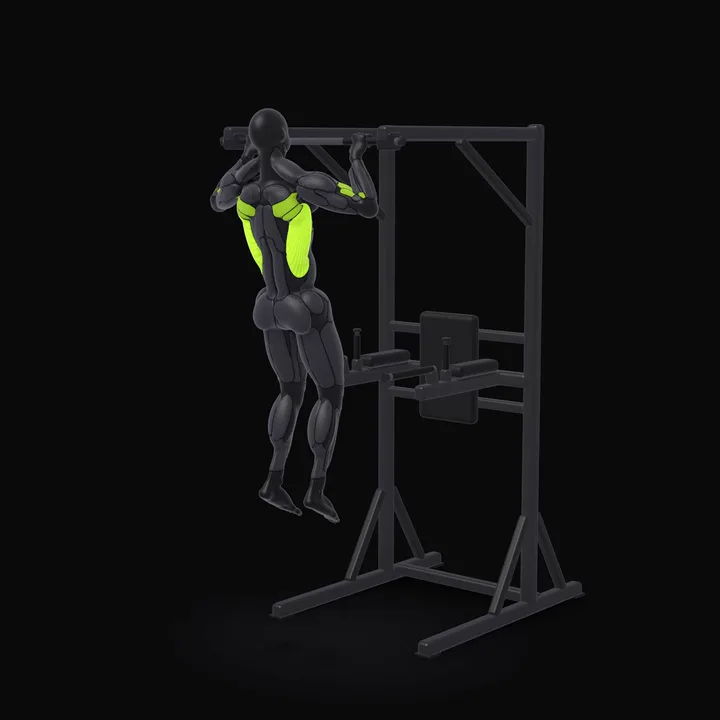 Negative Pull-upStep onto a box or bench so your chin is already above the bar. Grip the bar overhand slightly wider than your shoulders and lift your feet off.How to do the Negative Pull-up →
Negatives are the key exercise. Jump or step up so your chin is over the bar, then lower yourself as slowly as you can, aiming for 3–5 seconds, all the way to a dead hang. Your muscles are stronger lowering than lifting, so negatives let you train the exact movement before you can do it upward.
Assisted pull-ups come next. A resistance band looped over the bar under your knee or foot, or an assisted pull-up machine, takes off part of your body weight. Do 3 × 5–8 and use a lighter band over time.
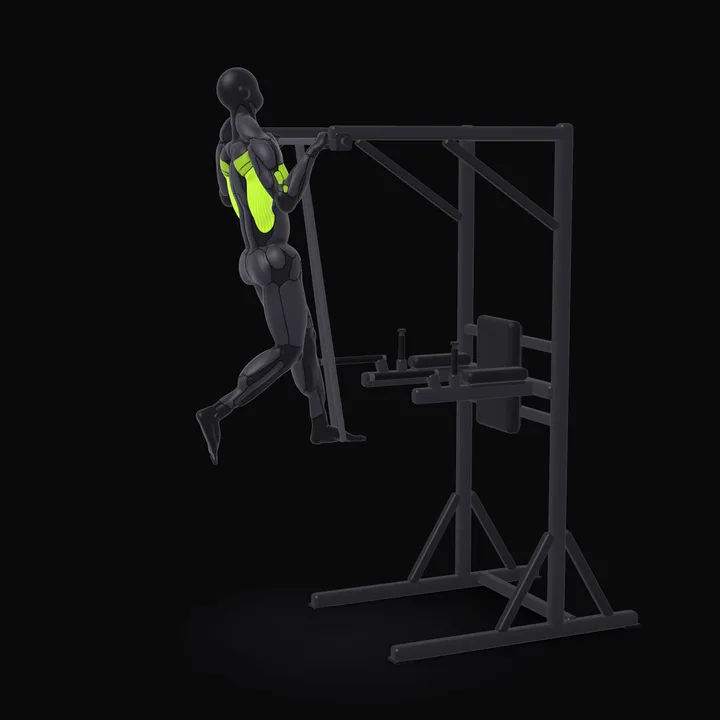 Band-assisted Pull-upLoop a band over the bar and place one knee or foot in it. Grip the bar slightly wider than your shoulders and hang with straight arms.How to do the Band-assisted Pull-up →
Lat pulldowns help too, especially if you can’t do bodyweight exercises yet. Work up to pulling about your body weight for a few reps on the lat pulldown (machine numbers vary, so use it as a rough guide).
Every two weeks, test: after a warm-up, try a full pull-up. When you get one, celebrate, then move on to step 2.
Step 2: from 1 to 5 reps
When you can do 1–3 pull-ups, don’t test your max every session. Do several sets of low reps with perfect form:
| Week | Sets × reps | Then |
|---|---|---|
| 1–2 | 5 × 1–2 | 2 × 5 slow negatives |
| 3–4 | 5 × 2–3 | 2 × 5 slow negatives |
| 5–6 | 4 × 3–4 | 2 × 8 band-assisted |
Rest 2 minutes between sets. Two or three sessions a week. Keep doing inverted rows on the side.
Step 3: from 5 to 10+ reps
Once you can do 5 strict reps, the goal is total weekly reps without grinding to failure every set.
| Session | Sets × reps |
|---|---|
| Day 1 | 5 sets of about half your max (5 max → 5 × 3) |
| Day 2 | 3 sets of max minus 1 rep |
| Day 3 | Ladder: 1, 2, 3, rest, repeat 3–4 times |
Each week, add one rep to one or two sets. Retest your max every 3–4 weeks. Most people add 1–2 reps to their max per month this way. That’s progressive overload with your body as the weight, and it only works if you write the reps down.
Where do you get stuck?
Most people fail a pull-up at one specific point. Train that point directly for a few weeks:
| Sticking point | Likely cause | Fix |
|---|---|---|
| Can’t leave the dead hang | Weak start, shoulder blades not engaging | Scapular pull-ups, pauses 5 cm above the hang |
| Stalls halfway, elbows at 90° | Lats and upper back not strong enough yet | Slow negatives with a 2-second pause at halfway, heavier lat pulldowns |
| Chin won’t clear the bar | Weak top range, grip slipping | Flexed-arm hangs at the top for 10–20 s, chin-ups, dead hangs for grip |
| Reps fall apart after the first few | Low work capacity | More sets of fewer reps, like the ladder on Day 3 |
When you miss reps
A session with fewer reps than last time usually means poor sleep, a heavy back day elsewhere in the week or sore elbows. Repeat the same targets next time. If your max stays flat for four weeks, take an easy week (half the sets, no max attempts), then run Step 3 again starting from your current max.
Step 4: weighted pull-ups
Once you can do 12–15 strict reps, adding weight is usually more productive than going to 20+. Use a dip belt with a plate or a dumbbell between your feet. Start with 2.5–5 kg (5–10 lb) for 3–5 sets of 5–8 reps and add weight in small steps. Strong weighted pull-ups are one of the best signs of a well-built back.
Pull-ups vs chin-ups and other grips
| Grip | What changes |
|---|---|
| Pull-up (overhand, slightly wide) | Lats and upper back; biceps less involved |
| Chin-up (underhand, shoulder-width) | Usually a bit easier; more biceps |
| Neutral grip (palms facing each other) | Often the most comfortable for shoulders and elbows |
| Very wide grip | Shorter range, harder on the shoulders; not needed |
All of them train the lats well. Use the grip that feels best on your joints, and rotate between them if you train pull-ups often. For how pull-ups fit with rows and pulldowns, see the back workout for width and thickness. Chin-ups also make a great biceps exercise, as explained in how to grow biceps.
How to program pull-ups by goal
| Goal | Sets × reps | Frequency |
|---|---|---|
| First rep | Step 1 plan | 2–3 times a week |
| More reps | 4–6 sets of 50–70 % of your max | 2–3 times a week |
| Back size | 3–4 × 6–12 (assisted or weighted to stay in range) | 2 times a week |
| Strength | Weighted, 4–5 × 3–6 | 1–2 times a week |
If you also do rows and pulldowns, count the pull-ups as part of your back volume rather than adding them on top. Two or three hard back exercises per session is enough for most people.
Pull-ups at home
A doorway bar is one of the best pieces of home equipment you can buy, but check the fit: the frame needs to be solid, and the bar should sit on the moulding rather than relying on pressure alone. Test it with a short hang, feet barely off the floor, before your first real set. If your ceiling is low, bend your knees and cross your feet. No bar at all? Inverted rows under a sturdy table and slow towel rows on a closed door build the same muscles until you get one. The home workout without equipment has a full plan around them.
Common pull-up mistakes
- Half reps. Stopping short of a full hang or of chin over bar. Count only full reps.
- Kicking and swinging. Strict reps build strength; kipping is a separate skill.
- Shrugging up to the bar. Shoulders end near your ears. Start each rep by pulling your shoulder blades down.
- Training to failure every set. Leads to sloppy reps and sore elbows. Leave a rep in the tank most of the time.
- Grip giving out. Add dead hangs; see grip strength exercises.
If you’re working toward pull-ups as part of bodyweight training, calisthenics for beginners shows how they fit with push-ups, dips and squats.
Frequently asked questions
How long does it take to do a first pull-up?
It depends on your starting strength and body weight. Many beginners get there in 4 to 12 weeks of training two or three times a week; heavier or weaker beginners can take a few months. Consistent negatives, rows and assisted pull-ups get almost everyone there.
Are chin-ups easier than pull-ups?
Usually, yes. The underhand grip lets your biceps help more, so most people can do a couple more chin-ups than pull-ups. Both are excellent back exercises; start with whichever you can do.
How many pull-ups should I be able to do?
There's no single standard, but 1 to 5 good reps is a solid start, 10 is a strong intermediate level for most people, and 15 or more strict reps is very good. Once you can do 12 to 15, adding weight is often more useful than chasing higher reps.
Why can I do lat pulldowns but not pull-ups?
Machine weights don't match body weight exactly, and on a pulldown your body is braced, so you don't need to control a hanging, swinging body. Pulldowns still help, but add negatives and assisted pull-ups to practise the real movement.
Should I do pull-ups every day?
Not hard sets. Two or three pull-up sessions a week with a day between them works best for most people. Some people practise a few easy submaximal reps on extra days, which is fine if your elbows feel good.
Do I need to lose weight to do pull-ups?
Not necessarily, but body weight matters. Getting stronger and losing some fat both make pull-ups easier. You can build toward pull-ups at any weight with rows, pulldowns and assisted variations.