To build muscle, most people do well with 10 to 20 hard sets per muscle per week, in roughly 6 to 15 reps per set, stopped 1 to 3 reps short of failure, and split over at least two sessions. Beginners grow on less, around 6 to 10 sets. More volume keeps paying off, but each extra set brings a little less than the one before, so the best number is the highest one you can recover from and still progress.
How many sets per muscle per week?
Volume, the number of hard sets you do for a muscle each week, is the training variable with the clearest link to muscle growth. Three bodies of research point in the same direction.
- The original dose-response meta-analysis (15 studies) found that each extra weekly set was associated with a little more growth, about 0.37 % per set. Programs with 10 or more sets per muscle per week tended to beat lower volumes (Schoenfeld et al., 2017).
- A review focused on trained men grouped studies into low (under 12 sets), moderate (12 to 20) and high (over 20) volume. Moderate and high volume gave similar quadriceps and biceps growth, while high volume came out ahead for the triceps. The authors suggest 12 to 20 weekly sets as a sound default for trained lifters (Baz-Valle et al., 2022).
- The largest analysis to date, 67 studies and over 2,000 participants, confirmed that growth increases with volume, but with diminishing returns. For strength the curve flattens much sooner (Pelland et al., 2025).
The 2026 ACSM position stand, which pooled 137 systematic reviews, sums it up: hypertrophy was enhanced by higher volumes of 10 or more sets per week (Currier et al., 2026).
Practical ranges by training level
Research gives a dose-response curve, not a magic number per person. These ranges are a sensible starting point, to adjust with how you actually respond.
| Your level | Hard sets per muscle per week | Notes |
|---|---|---|
| Beginner (under 1 year) | 6–10 | Almost anything works. Spend your energy on technique and adding weight. |
| Intermediate (1–3 years) | 10–16 | The sweet spot for most people. Add sets when progress stalls. |
| Advanced (3+ years) | 12–20+ | Push 1 or 2 priority muscles higher for a few weeks, keep the rest at maintenance. |
Two caveats. Most studies last 8 to 12 weeks and use young adults, so long-term numbers are less certain. And volume only counts if the sets are hard, which is the next point.
What counts as a “hard set”?
A set counts toward your weekly volume when it ends close to failure (more on that in our guide to training to failure), roughly within 4 reps of the point where you couldn’t do another clean rep. Warm-up sets don’t count. A set of 10 that you could have taken to 20 doesn’t count either: it’s practice, not a growth signal.
That’s why “sets per week” only works as a measure if your effort is consistent. Twelve sets stopped 6 reps short can stimulate less than eight sets stopped 1 or 2 reps short.
How to count indirect sets (fractional sets)
Compound lifts train more than one muscle. The bench press works your chest first, but your triceps and front delts also do real work. Should those sets count for the triceps?
The 2025 meta-regressions tested three ways of counting: indirect sets count fully (1), count as half (0.5), or don’t count at all (0). The “fractional” method, counting indirect sets as half, predicted results best (Pelland et al., 2025). In practice:
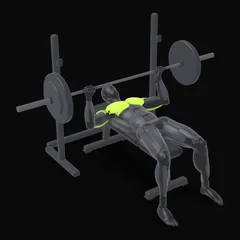
- 4 sets of bench press = 4 sets for the chest, 2 for the triceps, 2 for the front delts.
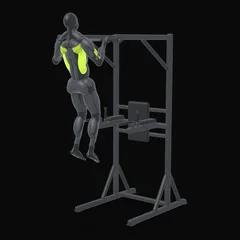
- 3 sets of pull-ups = 3 sets for the lats, 1.5 for the biceps, 1.5 for the upper back.
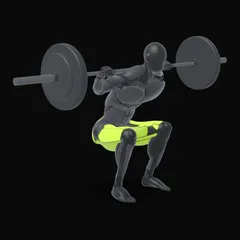
- 3 sets of squats = 3 sets for the quads, 1.5 for the glutes.
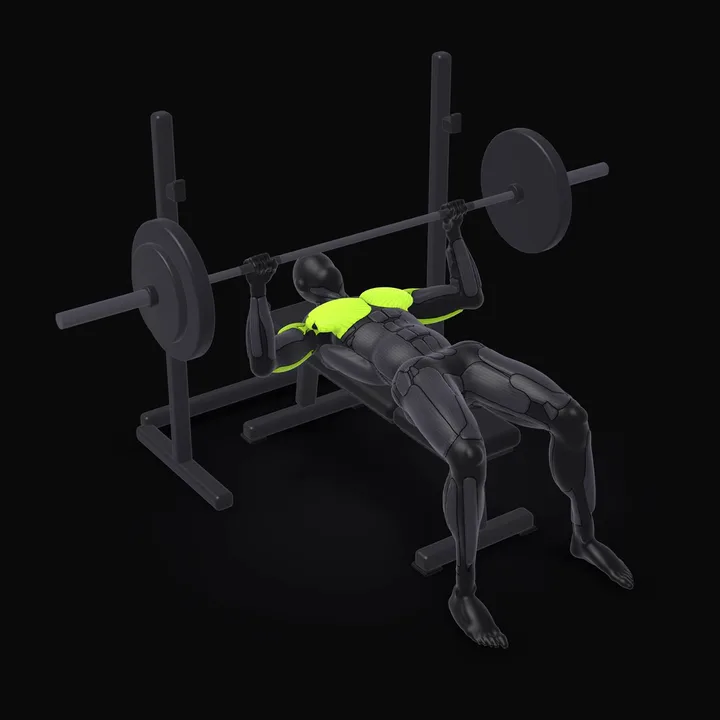 Barbell Bench PressLie on the bench with your eyes under the bar and your feet planted on the floor. Grip the bar slightly wider than shoulder width and pull your shoulder blades back and down.How to do the Barbell Bench Press →
Here’s what a week of triceps volume looks like when you count this way:
| Exercise | Weekly sets | Counts for triceps |
|---|---|---|
| Barbell Bench Press | 6 | 3 |
| Barbell Overhead Press | 3 | 1.5 |
| Cable Triceps Pushdown | 3 | 3 |
| Cable Overhead Triceps Extension | 3 | 3 |
| Total | 10.5 |
Without counting the presses, you’d think you were doing 6 sets and add more triceps work you don’t need. Counting them fully, you’d think you were at 15 and maybe stop short. Brick’s muscle map uses the same logic: it shows your weekly sets per muscle, with secondary muscles counted as half a set, so you can see at a glance which muscles are behind.
How many reps to build muscle?
Less than you’d think depends on the rep range. When sets are taken close to failure, muscle grows about equally with light, moderate and heavy loads. A network meta-analysis of 28 studies found no difference in hypertrophy between loads, but clearly better strength gains with heavier loads (Lopez et al., 2021). A review of the “repetition continuum” reached the same conclusion: hypertrophy happens across a wide range of loading zones, while maximal strength needs heavy work (Schoenfeld et al., 2021).
| Goal | Reps per set | Load | When to use it |
|---|---|---|---|
| Maximal strength | 1–6 | Heavy, about 80 % of 1RM or more | First lift of the day on squat, bench, deadlift, press |
| Hypertrophy, main zone | 6–15 | Moderate | Most of your work, on compounds and isolation |
| Hypertrophy, high reps | 15–30 | Light | Isolation, machines, joint-friendly options |
So why not do everything in sets of 30? Because very light sets are long, painful and harder to judge: it’s easy to stop well short of failure because of the burn. Very heavy sets of 3 to 5 are hard on joints and add a lot of fatigue for few reps. 6 to 15 reps is simply the most efficient zone for most exercises. Use the lower end on big compounds like the squat, the higher end on exercises like the dumbbell lateral raise.
If strength matters to you, keep a few sets in the 3 to 6 rep range on your main lifts. The ACSM reports that strength improves most with loads of 80 % of your max or more, trained at least twice a week (Currier et al., 2026).
How close to failure should you go? (RIR)
RIR, reps in reserve, is how many more clean reps you could have done when you stop the set. 0 RIR means failure, 2 RIR means you had two reps left. Researchers built an effort scale around this idea because it’s more concrete than “how hard did that feel” (Zourdos et al., 2016).
What the research shows:
- Failure isn’t required. A meta-analysis of 15 studies found no evidence that going to momentary failure builds more muscle than stopping short (Refalo et al., 2023). The ACSM review agrees that training to failure doesn’t consistently change outcomes (Currier et al., 2026).
- But closer is better, up to a point. Meta-regressions found that hypertrophy increased as sets ended closer to failure, while strength gains were similar across a wide range of RIR. The authors stress that their RIR values were estimated, so the exact curve is uncertain (Robinson et al., 2024).
The practical rule: aim for 1 to 3 RIR on most sets. Go to 0 RIR on the last set of safe isolation exercises, like curls, lateral raises or machine work. Stay at 2 to 3 RIR on heavy squats, deadlifts and barbell presses, where grinding reps with broken form is where injuries happen.
How to split your weekly volume across sessions
Once you know your weekly target, spread it out. When weekly volume is matched, training a muscle more often doesn’t add meaningful growth on its own (Schoenfeld et al., 2019), and the 2025 meta-regressions found frequency had a clear effect on strength but a negligible one on size (Pelland et al., 2025). Frequency is a tool to make volume manageable, not a goal.
And it is a useful tool. Your last sets for a muscle in a session are done fatigued, with fewer reps and worse technique. Here’s what 16 weekly sets for the chest look like:
| Frequency | Sets per session | In practice |
|---|---|---|
| 1× per week | 16 | The last 6 to 8 sets are low quality. Hard to sustain. |
| 2× per week | 8 + 8 | Two exercises of 4 sets. Works well. |
| 3× per week | 5 + 5 + 6 | Easy sessions, a lot of practice on each lift. |
As a working rule, 6 to 10 hard sets for one muscle in a session is plenty. Past that, add a session rather than more sets. That’s why two sessions per muscle per week, with an upper/lower or full-body split, is the default for most people.
Signs you’re doing too much or too little
Volume is personal: sleep, stress, nutrition, age and training history all change how much you can recover from. The research gives you a range; your logbook tells you where you sit in it.
Signs you could do more:
- Your weights and reps haven’t moved in 3 to 4 weeks, yet you feel fresh at every session.
- A muscle is never sore or tired, even after a new exercise.
- You’re at the bottom of the range (under 10 sets) for a muscle you want to grow.
Signs you’re doing too much:
- Your performance drops from one session to the next on the same lifts.
- A muscle is still sore when you train it again.
- Joints ache, sleep gets worse, and motivation to train fades.
- Your last sets turn sloppy because you’re just getting through them.
How to adjust: change one thing at a time, and by small steps. If you’re stalling and recovering well, add 1 or 2 sets per week to that muscle and watch for 2 to 3 weeks. If you’re showing signs of too much, cut that muscle’s sets by about a third for a week, then build back up from a lower level. Sets are only one lever of progressive overload; reps and load count too.
This is the loop the weekly review in Brick Coach runs for you. It compares your performance on each muscle’s exercises with previous weeks, takes an optional quick check-in on soreness into account, and suggests adding or removing sets muscle by muscle. You accept the changes or not, and the “Why?” button shows the research behind each one.
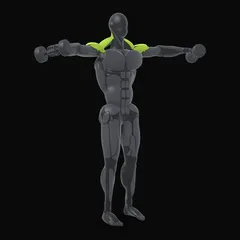
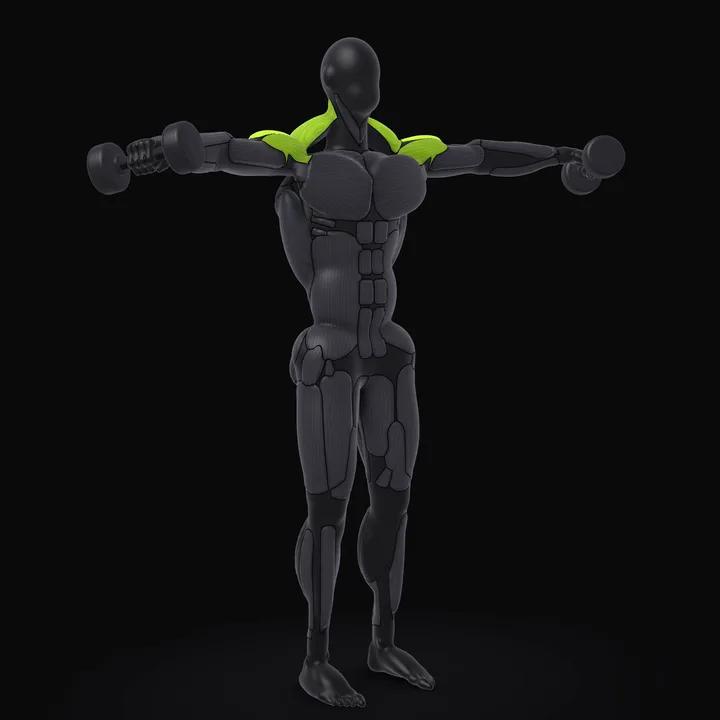 Dumbbell Lateral RaiseStand with a dumbbell in each hand at your sides and your elbows slightly bent. Raise the dumbbells out to the sides to shoulder height, leading with your elbows.How to do the Dumbbell Lateral Raise →
A simple plan to apply all this
- Pick a target for each muscle from the table above: 10 sets is a good start if you’re unsure.
- Count indirect sets as half, so your presses and rows count for your arms and shoulders.
- Train in the 6 to 15 rep range for most sets, with a few heavier sets if strength matters to you.
- Stop 1 to 3 reps short of failure, and calibrate with an occasional set to failure on a safe exercise.
- Split each muscle over two sessions or more, with no more than 6 to 10 hard sets per muscle per session.
- Review every few weeks and add or remove 1 or 2 sets per muscle based on your progress and recovery.
The right volume isn’t the one in the latest study. It’s the one where your numbers keep going up.
Frequently asked questions
Is 10 sets per muscle per week enough?
Yes, for most people it's a solid amount. The 2026 ACSM position stand names 10 or more sets per week as the volume that improves muscle growth. If you've trained for a few years and your progress has stalled at 10, adding a few sets is a reasonable next step.
Are more than 20 sets per muscle per week a waste?
Not a waste, but the return per set keeps shrinking. A 2025 meta-regression found that growth kept rising with volume, with diminishing returns. Above 20 sets, the extra fatigue often costs more than it brings, so keep it for one or two muscles you want to prioritize, for a few weeks at a time.
Do warm-up sets count toward weekly volume?
No. Only count working sets that end within about 4 reps of failure. Light warm-up sets prepare your joints and groove the movement, but they're too easy to drive growth.
Should every set go to failure?
No. Hypertrophy improves as sets end closer to failure, but training to failure isn't clearly better than stopping 1 to 3 reps short. Keep most sets at 1 to 3 reps in reserve and save true failure for the last set of safe exercises like curls or lateral raises.
Should I count sets differently for strength?
For strength, a few heavy sets per lift go a long way: strength gains level off at much lower volumes than muscle growth. What matters most is lifting heavy loads (around 80% of your max or more) and practicing the lift at least twice a week.
Sources
- Schoenfeld BJ, Ogborn D, Krieger JW (2017). Dose-response relationship between weekly resistance training volume and increases in muscle mass: A systematic review and meta-analysis. Journal of Sports Sciences
- Pelland JC, Remmert JF, Robinson ZP, Hinson SR, Zourdos MC (2025). The Resistance Training Dose Response: Meta-Regressions Exploring the Effects of Weekly Volume and Frequency on Muscle Hypertrophy and Strength Gains. Sports Medicine
- Baz-Valle E, Balsalobre-Fernández C, Alix-Fages C, Santos-Concejero J (2022). A Systematic Review of the Effects of Different Resistance Training Volumes on Muscle Hypertrophy. Journal of Human Kinetics
- Currier BS, D'Souza AC, Fiatarone Singh MA, et al. (2026). American College of Sports Medicine Position Stand. Resistance Training Prescription for Muscle Function, Hypertrophy, and Physical Performance in Healthy Adults: An Overview of Reviews. Medicine & Science in Sports & Exercise
- Lopez P, Radaelli R, Taaffe DR, et al. (2021). Resistance Training Load Effects on Muscle Hypertrophy and Strength Gain: Systematic Review and Network Meta-analysis. Medicine & Science in Sports & Exercise
- Schoenfeld BJ, Grgic J, Van Every DW, Plotkin DL (2021). Loading Recommendations for Muscle Strength, Hypertrophy, and Local Endurance: A Re-Examination of the Repetition Continuum. Sports
- Zourdos MC, Klemp A, Dolan C, et al. (2016). Novel Resistance Training-Specific Rating of Perceived Exertion Scale Measuring Repetitions in Reserve. Journal of Strength and Conditioning Research
- Refalo MC, Helms ER, Trexler ET, Hamilton DL, Fyfe JJ (2023). Influence of Resistance Training Proximity-to-Failure on Skeletal Muscle Hypertrophy: A Systematic Review with Meta-analysis. Sports Medicine
- Robinson ZP, Pelland JC, Remmert JF, Refalo MC, Jukic I, Steele J, Zourdos MC (2024). Exploring the Dose-Response Relationship Between Estimated Resistance Training Proximity to Failure, Strength Gain, and Muscle Hypertrophy: A Series of Meta-Regressions. Sports Medicine
- Schoenfeld BJ, Grgic J, Krieger J (2019). How many times per week should a muscle be trained to maximize muscle hypertrophy? A systematic review and meta-analysis of studies examining the effects of resistance training frequency. Journal of Sports Sciences