The best gym program for a beginner is a simple full-body routine, three days a week, built on a handful of big exercises that you get a little stronger at every week. Below is exactly that: two workouts, A and B, that you alternate on non-consecutive days, with the sets, reps and rest written out. Follow it for 8 to 12 weeks, log every set, and add weight when the plan tells you to.
Why a full-body program is the right start
As a beginner, you respond to almost any reasonable training. What matters most is that you train each muscle regularly, use good technique, and slowly add load. Full-body sessions three days a week give you all three.
The research lines up with this. The American College of Sports Medicine’s 2009 position stand recommends 2–3 sessions a week for novices, with loads you can lift for about 8–12 reps (Ratamess et al., 2009). A large meta-analysis on strength found that untrained people gained the most when each muscle group was trained about three days a week (Rhea et al., 2003), and a meta-analysis on muscle growth found that training a muscle twice a week beat once a week (Schoenfeld et al., 2016).
The ACSM’s 2026 update, an overview of 137 systematic reviews, keeps the message simple: train all major muscle groups at least twice a week, and favor a plan you can stick to over a “perfect” one (Currier et al., 2026). A full-body A/B split hits every muscle 3 times a week with just three gym visits.
The program: Workout A and Workout B
Train on three non-consecutive days. Alternate the workouts, so one week is A–B–A and the next is B–A–B.
| Week | Monday | Wednesday | Friday |
|---|---|---|---|
| 1, 3, 5… | A | B | A |
| 2, 4, 6… | B | A | B |
Workout A
| Exercise | Sets × reps | Rest |
|---|---|---|
| Barbell squat | 3 × 6–10 | 2–3 min |
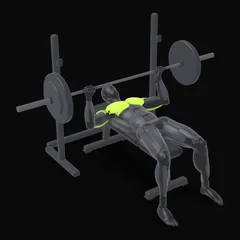
| Barbell bench press | 3 × 6–10 | 2–3 min |
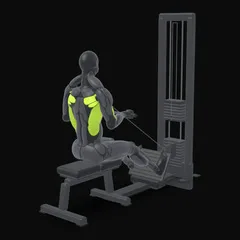
| Seated cable row | 3 × 8–12 | 90 s–2 min |
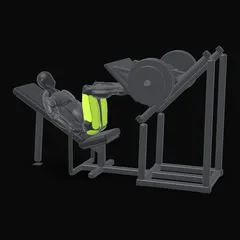
| Leg press | 2 × 10–12 | 2 min |
| Dead bug | 2 × 8 per side | 60 s |
Workout B
| Exercise | Sets × reps | Rest |
|---|---|---|
| Romanian deadlift | 3 × 8–10 | 2–3 min |
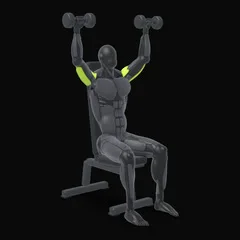
| Dumbbell shoulder press | 3 × 8–12 | 90 s–2 min |
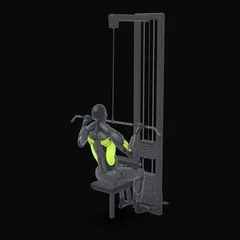
| Lat pulldown | 3 × 8–12 | 90 s–2 min |
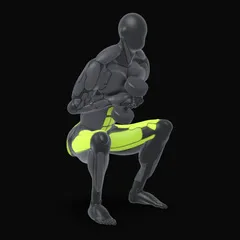
| Goblet squat | 2 × 10–12 | 90 s |
| Plank | 2 × 20–40 s | 60 s |
That is 13 hard sets per session, which fits in 45–60 minutes. Each workout covers a squat or hip hinge, a push, a pull and some trunk work, so nothing gets left behind.
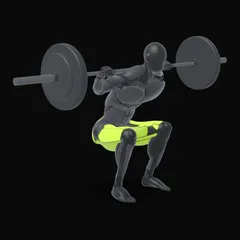
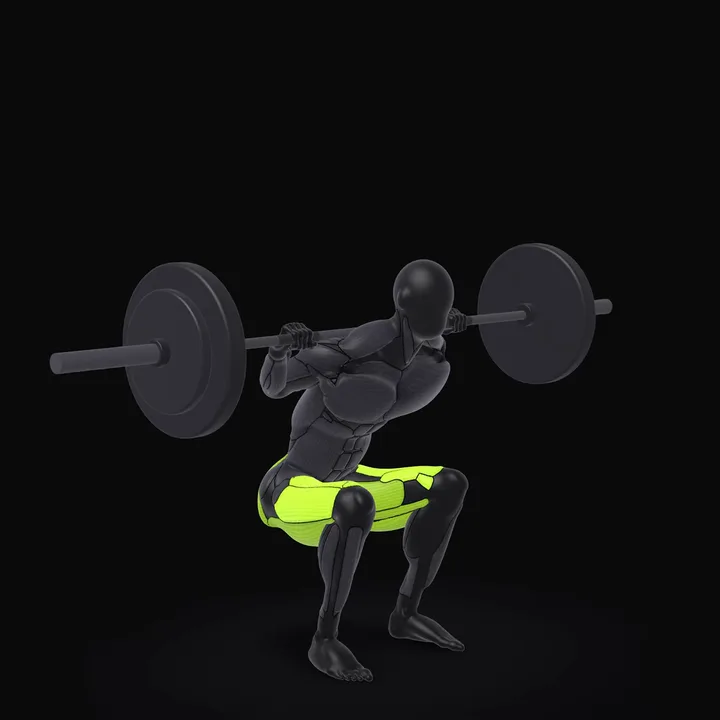 Barbell SquatPlace the bar on your upper back, not on your neck, and step out of the rack. Stand with feet slightly wider than shoulder width, toes turned out a little.How to do the Barbell Squat →
Swaps if your gym (or your body) needs them
- No squat rack yet, or the barbell squat feels awkward: do Dumbbell Goblet Squat in Workout A as well and come back to the bar later.
- Bench without a spotter: Dumbbell Bench Press is just as good for building muscle and easier to bail out of.
- Romanian deadlift with a barbell feels too heavy at the start: use Dumbbell Romanian Deadlift.
- No cable station: Dumbbell Single-arm Row replaces the seated row.
Keep the swap for at least the full block. Changing exercises every week makes it impossible to tell whether you are progressing.
How to pick your starting weights
Start lighter than your ego wants. The first two weeks are for learning the movements and finding your numbers, not for testing yourself.
- Begin with the empty bar or light dumbbells. A standard Olympic bar weighs 20 kg; on the squat, bench and Romanian deadlift, do a set of 8–10 with just the bar first.
- Add weight in small jumps (5–10 kg on the bar, 2 kg per dumbbell) and do another set of 5–8.
- Stop when the reps start to slow down or your form changes. Your working weight for the day is the last one where every rep looked the same and you felt you could have done about 3 more.
- Write it down. That number is your baseline for next time.
The “reps in reserve” idea (how many more reps you could have done) comes from a rating scale built for lifting (Zourdos et al., 2016). In that study, novices rated a true maximum lift as easier than experienced lifters did. In other words, beginners are not great at judging how close to failure they are, which is one more reason to stay conservative early on.
How to progress over the first 8–12 weeks
The method is double progression: you progress reps first, then weight. It is the simplest way to apply progressive overload.
- Pick a weight that lets you hit the bottom of the rep range on all sets.
- Each session, try to add a rep or two somewhere.
- When you reach the top of the range on every set with good form, add the smallest weight step next time and drop back to the bottom of the range.
This matches the classic ACSM guideline of raising the load by about 2–10% once you can do one or two reps more than your target (Ratamess et al., 2009).
| Exercise type | Typical weight jump |
|---|---|
| Squat, Romanian deadlift, leg press | +5 kg |
| Bench press, row, pulldown | +2.5 kg |
| Dumbbell exercises | next pair (usually +1–2 kg per hand) |
Here is how a 12-week block usually goes:
| Weeks | Focus | Effort |
|---|---|---|
| 1–2 | Learn the lifts, find your working weights | about 3–4 reps in reserve |
| 3–8 | Add reps or weight almost every session | about 1–3 reps in reserve |
| 9–12 | Progress slows on some lifts; keep pushing, fix stalls | about 1–2 reps in reserve on the last set |
You do not need to train to failure. Stopping one to three reps short on the big lifts keeps your form clean and your recovery manageable, and it still gives you plenty of stimulus at this stage.
What to do when a lift stalls
If you fail to add a rep or weight on an exercise for two sessions in a row:
- Check the basics first: sleep, food, and whether you actually rested 2–3 minutes.
- Repeat the same weight one more time.
- Still stuck? Drop the weight by about 10%, build back up with double progression, and you will usually pass your old best within two or three weeks.
How to warm up
A good warm-up takes 5–10 minutes and gets more specific as it goes.
- 3–5 minutes of easy cardio (bike, rower, brisk incline walk) until you feel warm.
- Warm-up sets for the first lift, for example on a 60 kg squat: empty bar × 10, 40 kg × 5, 50 kg × 3, then your work sets.
- One lighter set before each of the other exercises, since you are already warm.
Long stretching routines before lifting are not needed. If a joint feels stiff, a few slow reps through the range with the empty bar usually fix it.
Technique priorities for each lift
Do not try to fix ten cues at once. Pick one or two per exercise:
- Squat: feet flat, knees track over your toes, go as deep as you can while keeping your back position. Brace your midsection before each rep.
- Bench press: shoulder blades pulled back and down, feet on the floor, bar touches your lower chest, wrists stacked over elbows.
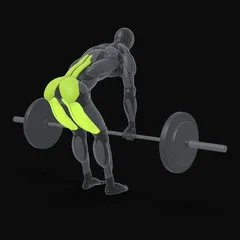
- Romanian deadlift: push your hips back with a slight knee bend, keep the bar close to your legs, stop when you feel a strong stretch in your hamstrings, not when your back rounds.
- Rows and pulldowns: lead with your elbows, pause for a moment at the end, control the way back.
- Shoulder press: squeeze your glutes so your lower back does not arch, press straight up.
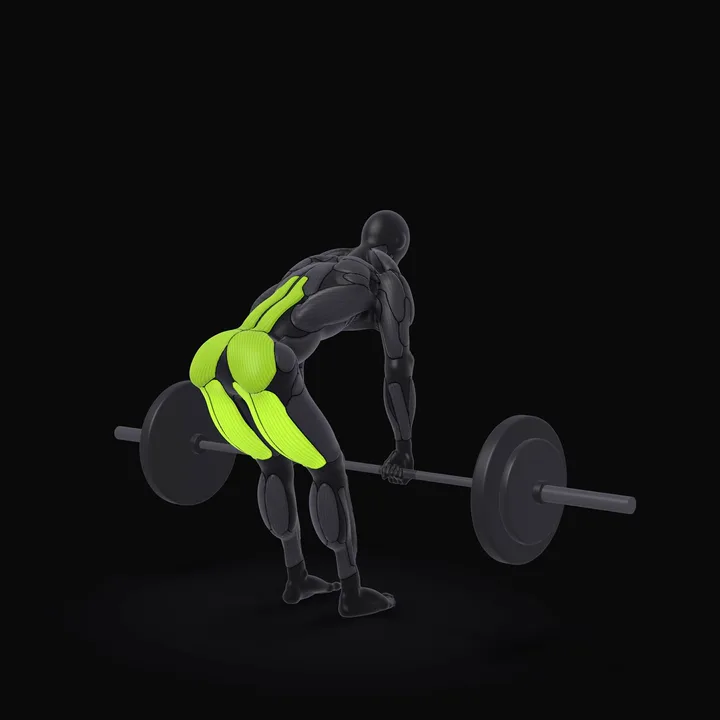 Barbell Romanian DeadliftStand holding the bar in front of your thighs with your knees slightly bent. Push your hips back and lower the bar close to your legs with a flat back.How to do the Barbell Romanian Deadlift →
Filming one set from the side every couple of weeks is the cheapest coaching you will ever get. Compare it with a reference animation and you will spot most problems yourself.
How to log your workouts
Logging is not optional in a beginner program; it is the program. Without records, double progression turns into guesswork.
For each exercise, write down:
- the weight,
- the reps of every set,
- a quick note if something felt off (form, pain, an easy or a grinding set).
Before each session, look at what you did last time on that workout and set yourself a target: one more rep, or a little more weight. Over 12 weeks those small wins add up to dozens of kilos on your main lifts.
Common beginner mistakes
- Going too heavy too soon. It feels productive for two weeks, then form breaks down and progress stops. Starting light costs you nothing.
- Program hopping. Switching every two weeks because a video promised better results means you never get to the part where things work.
- Adding extra exercises. The plan is short on purpose. If you want more, add a set of curls or push-ups at the end, not three more chest exercises.
- Skimping on rest. For beginners, 60–120 seconds between sets is enough to maximize strength gains (Grgic et al., 2018); on squats and deadlifts, taking 2–3 minutes makes it easier to hit your reps. Here is how long to rest between sets for every type of exercise.
- Not tracking anything. If you cannot tell what you lifted last Wednesday, you cannot beat it.
- Neglecting sleep and protein. Training is the signal; recovery is where you adapt. Aim for consistent sleep and some protein at every meal.
When to switch to another program
Stay on this plan as long as it works. Signs it is time to move on:
- You have run it for at least 8–12 weeks.
- Several main lifts have stalled for 3 weeks or more, even after a weight reset and with decent sleep and food.
- Your schedule changes (you can now train four days a week, for example, and an upper/lower split makes sense).
- You have a specific goal, such as a powerlifting meet, that needs a more specialized plan.
Being bored is not on the list. The basics stay the same at every level: the ACSM’s 2026 review pushes back on the idea that beginners need a completely different kind of training from more advanced lifters (Currier et al., 2026). What changes over time is how much volume you need and how slowly you progress.
Frequently asked questions
How long should a beginner gym workout last?
About 45 to 60 minutes including the warm-up. Each workout in this plan has four main exercises plus one core move, and most of the time is rest between sets. If you are regularly past 75 minutes, you are probably resting too long or doing extra exercises.
Can I do this beginner program with dumbbells only?
Yes. Use goblet squats instead of barbell squats, dumbbell bench press, single-arm dumbbell rows, dumbbell Romanian deadlifts and dumbbell shoulder presses. Progress the same way: reach the top of the rep range on every set, then move up to the next pair of dumbbells.
How soon will I see results from strength training?
Most beginners add weight to their lifts almost every week for the first two to three months, a lot of it from learning the movements. Visible changes in muscle size usually take longer, often a couple of months of consistent training with enough protein and sleep.
What if I miss a workout?
Just do the next workout in the sequence when you are back. If you were meant to do A on Friday and missed it, do A on Monday and continue alternating. Missing a session now and then changes nothing; missing weeks is what stalls progress.
Should I do cardio on the same days?
You can. Easy cardio after lifting or on rest days is fine and good for your health. Keep hard intervals or long runs away from leg days if you notice they make your squats and deadlifts worse.
Sources
- Currier BS, D'Souza AC, Fiatarone Singh MA, et al. (2026). American College of Sports Medicine Position Stand. Resistance Training Prescription for Muscle Function, Hypertrophy, and Physical Performance in Healthy Adults: An Overview of Reviews. Medicine & Science in Sports & Exercise
- Ratamess NA, Alvar BA, Evetoch TK, et al. (2009). American College of Sports Medicine position stand. Progression models in resistance training for healthy adults. Medicine & Science in Sports & Exercise
- Rhea MR, Alvar BA, Burkett LN, Ball SD (2003). A meta-analysis to determine the dose response for strength development. Medicine & Science in Sports & Exercise
- Schoenfeld BJ, Ogborn D, Krieger JW (2016). Effects of Resistance Training Frequency on Measures of Muscle Hypertrophy: A Systematic Review and Meta-Analysis. Sports Medicine
- Grgic J, Schoenfeld BJ, Skrepnik M, Davies TB, Mikulic P (2018). Effects of Rest Interval Duration in Resistance Training on Measures of Muscular Strength: A Systematic Review. Sports Medicine
- Zourdos MC, Klemp A, Dolan C, et al. (2016). Novel Resistance Training-Specific Rating of Perceived Exertion Scale Measuring Repetitions in Reserve. Journal of Strength and Conditioning Research