For muscle growth, rest about 2 minutes between sets of big compound lifts and 60 to 90 seconds between sets of isolation exercises. For maximal strength, rest 2 to 3 minutes or more on heavy compounds, up to 5 minutes before near-maximal sets. The rule behind all of it is simple: rest long enough to repeat a quality set, and no longer than you need.
Why rest time matters at all
Rest between sets isn’t wasted time. It’s when your muscles restore the energy (mainly phosphocreatine) they need for the next hard effort, and when the fatigue in your nervous system settles down. Rest too little and your next set loses reps: you planned 3 sets of 10 and end up with 10, 7, 5.
Those lost reps are the real cost. Muscle growth is driven by enough hard sets taken close to failure, and strength by heavy, high-quality reps. Rest time is mostly a tool to protect those reps.
How long to rest between sets for hypertrophy
For years, the standard advice for building muscle was 30 to 90 seconds of rest, on the idea that short rest boosts “metabolic stress” and hormones. The research since then has mostly gone the other way.
- In a 2016 trial, Schoenfeld and colleagues had trained men follow the same program for 8 weeks, resting either 1 or 3 minutes between sets. The 3-minute group gained more squat and bench strength and more thigh muscle thickness.
- A 2017 systematic review by Grgic and colleagues concluded that both short and long rest can build muscle, with a possible advantage for longer rest in trained lifters.
- The most recent meta-analysis (Singer et al., 2024, 9 studies) found a small advantage for resting more than 60 seconds, but no appreciable difference beyond 90 seconds. The authors think the benefit mainly comes from preserving volume.
That last point is confirmed by a clever study by Longo and colleagues (2022). Each leg of the participants trained knee extensions with a different protocol. With 1 minute of rest, the leg grew about half as much as with 3 minutes, unless it did extra sets to reach the same total load: then it grew just as much. Rest time matters mostly because of how much work it lets you do.
In practice for hypertrophy:
- Big compound lifts (squat, deadlift, bench, rows): about 2 minutes, up to 3 if your reps drop off a lot.
- Dumbbell, machine and cable compounds: 90 seconds to 2 minutes.
- Isolation exercises (curls, raises, extensions): 60 to 90 seconds.
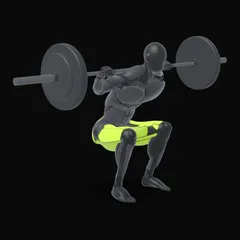
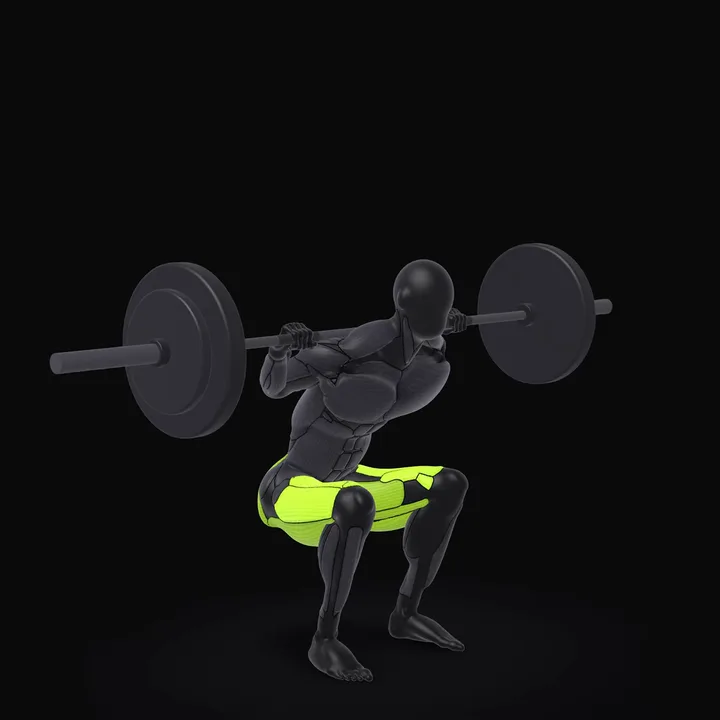 Barbell SquatPlace the bar on your upper back, not on your neck, and step out of the rack. Stand with feet slightly wider than shoulder width, toes turned out a little.How to do the Barbell Squat →
How long to rest between sets for strength
Strength work uses heavier loads (roughly 1 to 6 reps) and puts more demand on your nervous system. Rest becomes more important.
The 2018 systematic review by Grgic and colleagues on strength (23 studies, 491 participants) concluded that you can gain strength with short rest, but that trained lifters need more than 2 minutes to maximize their gains. In beginners, 60 to 120 seconds was enough. The ACSM’s 2009 position stand recommended at least 2 to 3 minutes for main exercises with heavy loads and 1 to 2 minutes for assistance exercises.
In practice for strength:
- Main lifts in the 3 to 6 rep range: 3 minutes.
- Very heavy singles, doubles and triples: 3 to 5 minutes.
- Accessory work after the main lift: 1 to 2 minutes.
If you’re new to lifting, your loads are still light compared to what your body will handle in a year. Two minutes on your main lifts will do the job.
Compound vs isolation: why the difference
A squat or a deadlift involves a lot of muscle mass, a heavy load and a heart rate that climbs fast. You need time to catch your breath, recover your legs and your back, and get ready mentally. A lateral raise involves one small muscle at a time: it recovers fast, and your cardiovascular system barely notices.
In practice, that means short rest costs you far more reps on a heavy compound than on an isolation exercise. That’s why a good program doesn’t give every exercise the same rest.
Rest time table by exercise type
Here’s a practical guide. The last column shows the default rest Brick uses for these exercises, which you can change.
| Exercise type | Examples | For muscle | For strength | Brick default |
|---|---|---|---|---|
| Heavy barbell lower-body compounds | Barbell Squat, Barbell Deadlift | 2–3 min | 3–5 min | 3:00 |
| Heavy barbell upper-body compounds | Barbell Bench Press, Barbell Overhead Press | 2–3 min | 3–4 min | 2:30 |
| Other big compounds | Barbell Bent-over Row, Pull-up, Barbell Romanian Deadlift, Leg Press, Barbell Hip Thrust | 2 min | 2–3 min | 2:00 |
| Dumbbell, cable and machine compounds | Dumbbell Bench Press, Cable Lat Pulldown, Cable Seated Row, Dumbbell Bulgarian Split Squat, Dip | 1:30–2 min | 2 min | 1:30 |
| Isolation | Dumbbell Lateral Raise, Dumbbell Biceps Curl, Cable Triceps Pushdown, Leg Extension, Machine Lying Leg Curl, Standing Calf Raise | 1–1:30 min | — | 1:00 |
| Core | Plank, Cable Crunch | 45–60 s | — | 1:00 |
| Warm-up sets | Light sets before your working sets | 30–60 s | 1–2 min as loads get heavy | — |
Treat these as starting points, not rules. The right rest is the one that lets you hit your target reps at the effort you planned.
Supersets and time-efficient training
Short on time? Cutting your rest to 30 seconds is the worst way to save it: you lose reps, so you lose volume. Better options:
- Antagonist supersets. Pair two exercises that don’t use the same muscles, for example bench press and barbell row, or curls and triceps pushdowns. Do a set of the first, go straight to the second, then rest 90 seconds to 2 minutes before the next round. Each muscle still gets a few minutes off.
- Keep supersets for the right exercises. Iversen and colleagues’ 2021 review estimates that supersets, drop sets and rest-pause can roughly halve session time while keeping similar volume, and that they seem better suited to muscle growth than to maximal strength. Do your heavy squats and deadlifts with full rest, then superset the accessory work.
- Expect more fatigue. Weakley and colleagues (2017) found supersets and tri-sets more time-efficient than traditional sets, but they also produced more lactate and more next-day muscle damage markers, and tri-sets felt harder. That’s fine, just plan for it.
- If you do shorten rest, add a set. That’s what the Longo study suggests: you can recover the lost volume with an extra set.
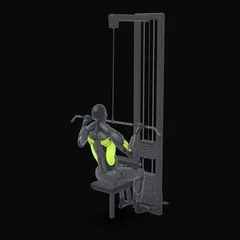
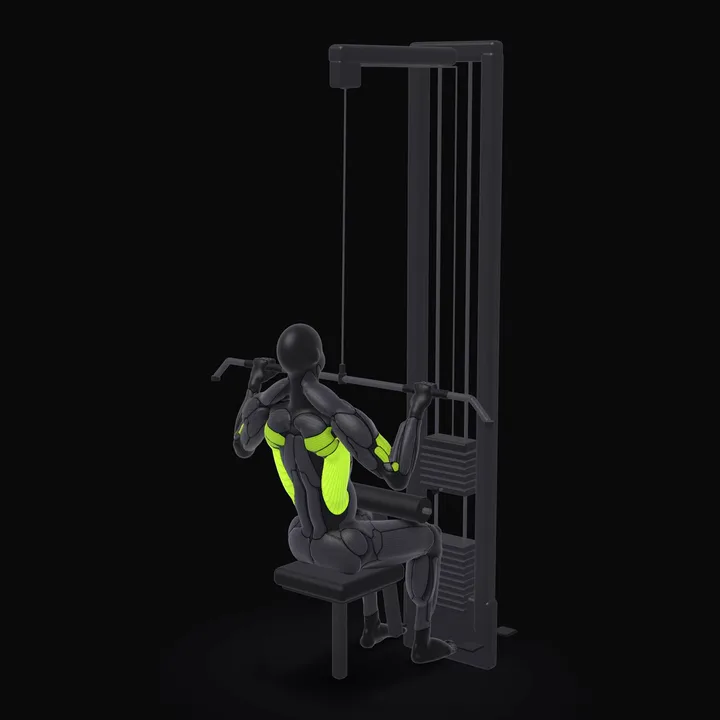 Cable Lat PulldownAdjust the thigh pad to lock your legs in and grab the wide bar slightly wider than your shoulders. Sit with your chest up and lean back slightly.How to do the Cable Lat Pulldown →
What to do during your rest
Rest time is active in the good sense: you’re preparing the next set.
- Log your set. Weight, reps, and if you use it, how hard it was (RPE or reps in reserve). It takes five seconds and it’s what lets you progress next week.
- Breathe and walk a few steps. Calm, slow breathing helps your heart rate come down. Staying lightly on your feet is better than sitting slumped, especially between heavy leg sets.
- Drink a sip of water and get your next weight ready.
- Think about one technique cue for the next set: brace before you descend, keep your elbows tucked, control the lowering.
- Avoid what extends your rest without you noticing. Two minutes of scrolling easily turns into five. That’s not dangerous, but it makes your session longer and your sets inconsistent.
Light mobility for a muscle you’re not training (shoulders between leg sets, for example) is fine if you enjoy it. Hard stretching or cardio between sets isn’t useful: you’d be adding fatigue during the time meant to remove it.
Why timing your rest helps you progress
Progressive overload means doing a little more over time: one more rep, a bit more weight. To compare one week with the next, the conditions need to be similar. If you rested 4 minutes last week and 90 seconds today, your numbers don’t mean much.
That’s where a rest timer helps, ideally one you don’t have to think about. In Brick, the timer starts by itself as soon as you check off a set, with a default rest for each exercise (3 minutes on a squat, 1 minute on a lateral raise), which you can change per exercise in your routines. You can add or remove 15 seconds or skip it. When the rest is over, a notification tells you, the countdown stays visible on your Lock Screen as a Live Activity, and it also runs on your Apple Watch, so you can leave your phone in your bag.
Common rest mistakes
- Same rest for everything. One minute after a heavy squat is too short; three minutes after a curl is too long.
- Cutting rest to “make it harder”. The session feels tougher, but you do less useful work. Effort should come from the sets, not from the clock.
- Rest that changes every week. It hides your real progress.
- Ignoring warning signs. Some breathlessness after a hard set is normal. Dizziness, chest pain or palpitations that don’t settle are not: stop and see a doctor. If you have a heart condition or high blood pressure, talk to a professional before doing very heavy sets or very short rest.
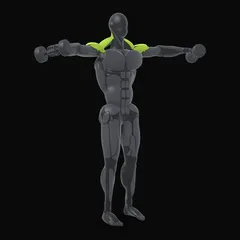
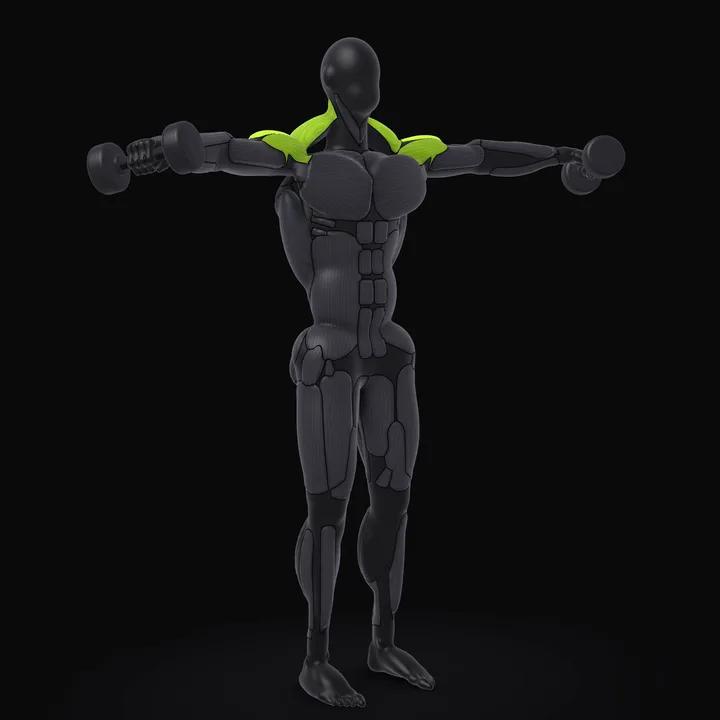 Dumbbell Lateral RaiseStand with a dumbbell in each hand at your sides and your elbows slightly bent. Raise the dumbbells out to the sides to shoulder height, leading with your elbows.How to do the Dumbbell Lateral Raise →
Example: a push session with the right rests
Here’s what this looks like in a real hypertrophy session, the push day of a push pull legs split:
| Exercise | Sets × reps | Rest |
|---|---|---|
| Barbell Bench Press | 3 × 6–8 | 2:30 |
| Dumbbell Bench Press | 3 × 8–12 | 1:30–2:00 |
| Barbell Overhead Press | 3 × 6–10 | 2:00–2:30 |
| Dumbbell Lateral Raise + Cable Triceps Pushdown (superset) | 3 × 12–15 each | 1:30 after each pair |
About 12 hard sets in under an hour, with every set done in good condition. If you only have 40 minutes, keep the bench press as it is and superset the rest, rather than squeezing every rest down to 45 seconds.
Frequently asked questions
Is 60 seconds of rest enough to build muscle?
It works, but it's usually not ideal. A 2024 meta-analysis found a small advantage for resting longer than 60 seconds, most likely because you keep more reps in the following sets. If you stick to 60 seconds, add a set to make up the lost volume.
Can you rest too long between sets?
Not in a way that hurts your gains. Beyond about 90 seconds to 2 minutes for most exercises, extra rest doesn't seem to add muscle, it just makes the session longer. Five minutes before a heavy squat is fine; five minutes before a curl is wasted time.
Should I rest the same amount after every set?
Roughly, yes, so your numbers are comparable from week to week. It's normal to take 30 seconds more before a hard top set or the last set of a heavy compound. What you want to avoid is rest that drifts randomly because you got lost in your phone.
How long should I rest between warm-up sets?
Warm-up sets are light, so 30 to 60 seconds is enough, just the time to change plates. Take your full rest before the first working set.
How long should I rest in a superset?
Go straight from the first exercise to the second, then rest about 90 seconds to 2 minutes before starting the pair again. Each muscle still gets a few minutes off, so you keep your performance while saving time.
Sources
- Schoenfeld BJ, Pope ZK, Benik FM, Hester GM, Sellers J, Nooner JL, et al. (2016). Longer interset rest periods enhance muscle strength and hypertrophy in resistance-trained men. Journal of Strength and Conditioning Research
- Singer A, Wolf M, Generoso L, et al., Schoenfeld BJ (2024). Give it a rest: a systematic review with Bayesian meta-analysis on the effect of inter-set rest interval duration on muscle hypertrophy. Frontiers in Sports and Active Living
- Grgic J, Lazinica B, Mikulic P, Krieger JW, Schoenfeld BJ (2017). The effects of short versus long inter-set rest intervals in resistance training on measures of muscle hypertrophy: A systematic review. European Journal of Sport Science
- Grgic J, Schoenfeld BJ, Skrepnik M, Davies TB, Mikulic P (2018). Effects of rest interval duration in resistance training on measures of muscular strength: a systematic review. Sports Medicine
- Longo AR, Silva-Batista C, Pedroso K, de Salles Painelli V, Lasevicius T, Schoenfeld BJ, et al. (2022). Volume load rather than resting interval influences muscle hypertrophy during high-intensity resistance training. Journal of Strength and Conditioning Research
- American College of Sports Medicine (2009). American College of Sports Medicine position stand. Progression models in resistance training for healthy adults. Medicine & Science in Sports & Exercise
- Iversen VM, Norum M, Schoenfeld BJ, Fimland MS (2021). No time to lift? Designing time-efficient training programs for strength and hypertrophy: a narrative review. Sports Medicine
- Weakley JJS, Till K, Read DB, Roe GAB, Darrall-Jones J, Phibbs PJ, Jones B (2017). The effects of traditional, superset, and tri-set resistance training structures on perceived intensity and physiological responses. European Journal of Applied Physiology