A good rear delt workout uses light-to-moderate weights for 12–20 reps on exercises that move your arms out and back without letting your traps and lats take over: the reverse pec deck, bent-over rear delt flyes, cable reverse flyes and face pulls. Do 6–12 hard sets a week, spread over two to four sessions. The rear delts are small, easy to neglect and make a visible difference to how round and full your shoulders look from the side.
Why rear delts matter
The deltoid has three heads. The front delts get hammered by every bench press and overhead press. The side delts get lateral raises if you’re paying attention. The rear delts often get nothing but the leftover work from rows.
That shows up in two ways:
- Looks. Underdeveloped rear delts make shoulders look flat from the side and from behind. Full shoulders need all three heads.
- Balance. A lot of pressing with little rear shoulder work can leave the shoulders pulled forward. Strong rear delts and upper back muscles counterbalance pressing and help the shoulder joint move well.
The rear delts also help you stay tight on the bench press and keep the bar in place on squats.
What the rear delts do
The posterior deltoid pulls your upper arm backward when it’s raised in front of you or out to the side (horizontal abduction), and helps rotate your arm outward. Any exercise where your arm moves out and back in a wide arc, with your elbow roughly at shoulder height, trains them.
Rotation changes which part of the shoulder does the work. In an EMG study on lateral raises, turning the arm inward shifted more activity to the rear delts, triceps and upper traps (Coratella et al., 2020). On rear delt flyes, though, a neutral or slightly inward grip (thumbs forward or slightly down) usually lets you feel the rear delts best, while a strong squeeze of the shoulder blades brings in the traps.
The best rear delt exercises
Reverse pec deck
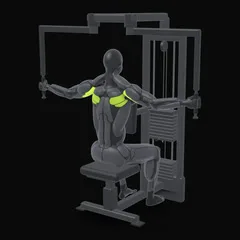
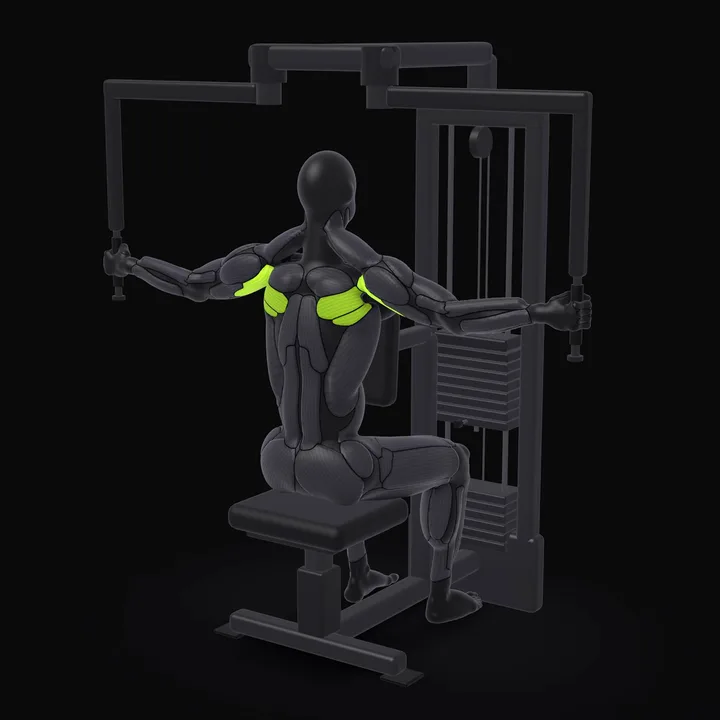 Reverse Pec DeckSit facing the machine with your chest on the pad and the handles set at shoulder height. Grab the handles with your arms almost straight.How to do the Reverse Pec Deck →
The reverse pec deck is the easiest way to train rear delts hard. Sit facing the pad, handles at shoulder height, arms nearly straight. Sweep your arms out and back in a wide arc until they’re in line with your body. Think about pushing the handles out to the walls rather than pulling them back. Keep your chest on the pad.
Bent-over rear delt fly
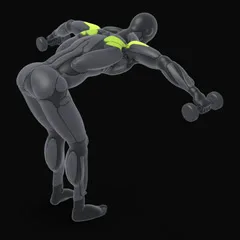
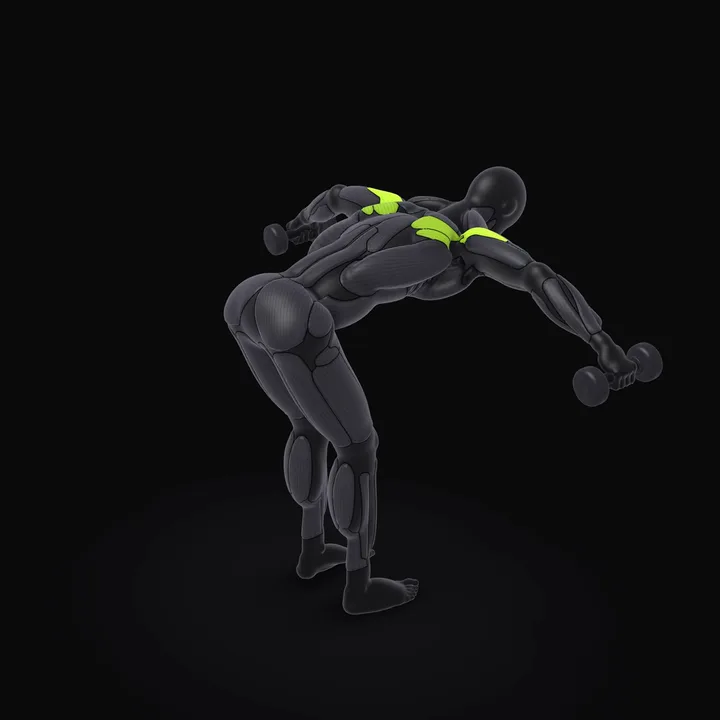 Dumbbell Rear Delt FlyHinge at the hips with a flat back until your torso is nearly parallel to the floor, dumbbells below your chest. Bend your elbows slightly.How to do the Dumbbell Rear Delt Fly →
The bent-over dumbbell rear delt fly needs no machine. Hinge forward until your torso is nearly parallel to the floor (or rest your head on an incline bench to stop body swing, as in the head-supported version). Slight bend in the elbows, raise the dumbbells out to the sides until your arms are level with your torso, then lower slowly.
Cable reverse fly
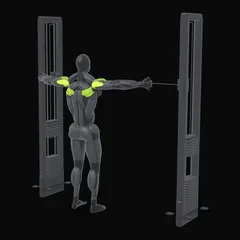
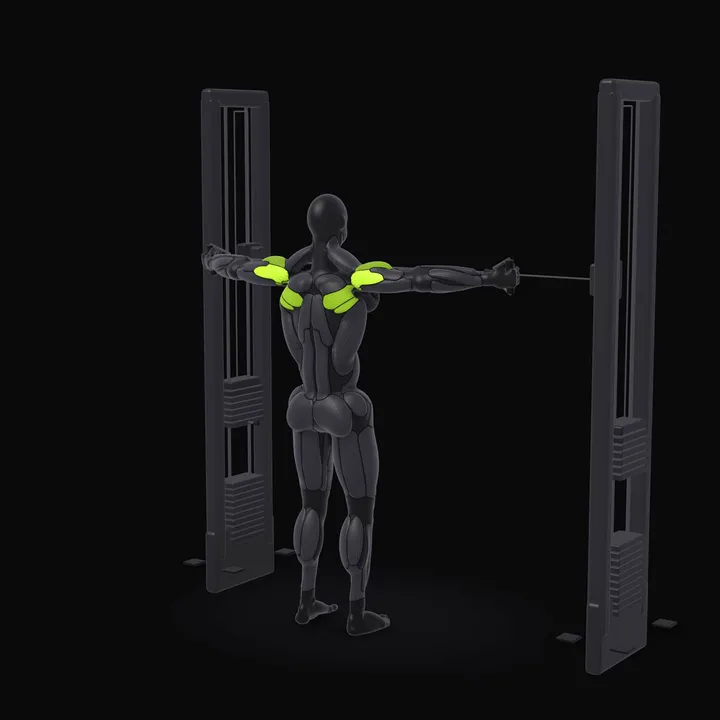 Cable Reverse FlySet the pulleys at shoulder height and cross the cables: right cable in your left hand and vice versa. Stand in the middle with your arms extended in front of you.How to do the Cable Reverse Fly →
The cable reverse fly keeps tension through the whole range. Set two pulleys at shoulder height, cross the cables (left hand holds the right cable), and pull your arms out and back. Single-arm versions let you go deeper.
Face pull
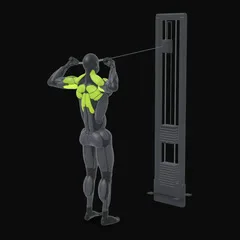
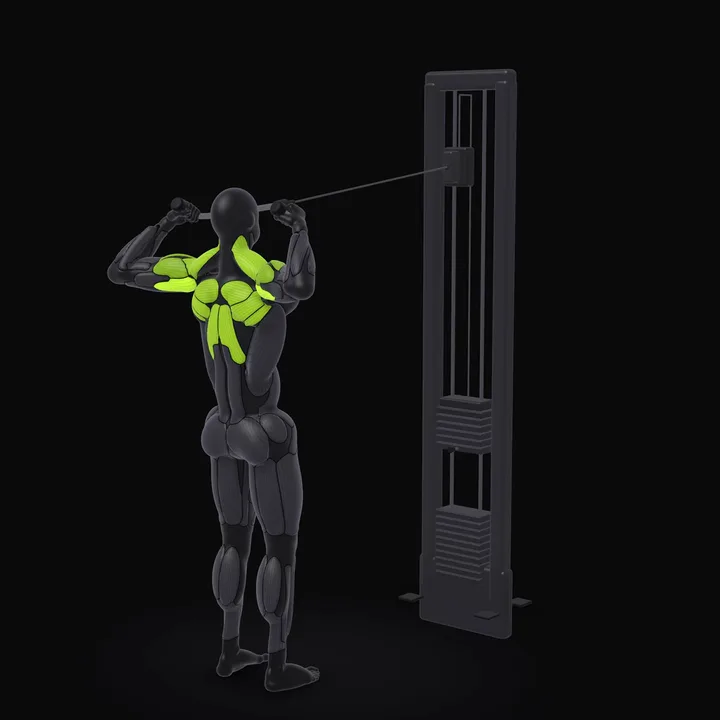 Cable Face PullSet the pulley slightly above head height and grab the rope with your thumbs pointing back. Step back one or two steps so your arms are extended in front of you.How to do the Cable Face Pull →
The face pull trains the rear delts along with the middle and lower traps and the external rotators. Use a rope at upper chest to face height, pull toward your forehead with your elbows high, and finish by rotating your hands back so your knuckles point behind you. It’s a great shoulder health exercise even though it’s not the most targeted rear delt builder.
Wide rows
Rear delt rows and chest-supported rows with your elbows out wide at about 70–90° bring in more rear delts than a standard row. Use them as a heavier option; they also build the upper back.
Technique fixes that make rear delts work
- Go lighter. Rear delts are small. Most people use too much weight and end up shrugging and swinging.
- Keep your arms long. A slight elbow bend is fine; a big bend turns the movement into a row.
- Move out, not back. Think about making your wingspan as wide as possible.
- Don’t crush your shoulder blades together. Let them move a little, but if the squeeze dominates, the traps take over.
- Control the lowering. Two seconds down, no dropping.
How many sets for rear delts?
More weekly volume tends to mean more growth (Schoenfeld et al., 2017). Rows contribute some rear delt work, so direct work can sit a little lower than for bigger muscles:
| Level | Direct rear delt sets per week |
|---|---|
| Beginner | 3–6 |
| Intermediate | 6–12 |
| Rear delts as a priority | 10–16 |
Reps: 12–20, with the last few genuinely hard. Rest 45–90 seconds. Rear delts recover quickly, so two to four short doses a week works well.
A rear delt workout plan
Add these blocks to your existing sessions:
Upper or pull day 1
| Exercise | Sets × reps | Rest |
|---|---|---|
| Reverse pec deck | 3 × 12–20 | 60 s |
| Face pull | 2 × 15–20 | 60 s |
Upper or push day 2
| Exercise | Sets × reps | Rest |
|---|---|---|
| Cable reverse fly | 3 × 12–15 | 60 s |
Optional day 3
| Exercise | Sets × reps | Rest |
|---|---|---|
| Head-supported rear delt fly | 2 × 15–20 | 45 s |
That’s 8–10 sets a week. Rear delt work fits nicely after pressing on a push day too, as a “balancing” block. For the other two delt heads, see how to get bigger shoulders and lateral raise form.
How to progress rear delt exercises
Progress slowly and in small steps. Use machines and cables when you can, because they offer small jumps. Use double progression with a 12–20 range: when every set reaches 20 clean reps, add the smallest weight step and start again at 12. Keeping a log stops you from using the same weight for a year without noticing.
Rear delts and the rest of your back
Rear delts work alongside the middle traps and rhomboids. A program with plenty of rows, face pulls and reverse flyes builds the whole upper back together; the back workout for width and thickness and how to build traps show how they fit together.
Common rear delt mistakes
- Too heavy. The number one problem.
- Turning flyes into rows. Bent elbows, hands near the ribs: that’s a row.
- Only doing face pulls. Great exercise, but add a dedicated fly.
- Doing them once a week. Small muscles benefit from frequent, short sessions.
Frequently asked questions
Do rows work the rear delts?
Yes, especially rows with the elbows flared out to about 45 to 70 degrees. But the lats and middle back usually do most of the work, so most people still need direct rear delt exercises like reverse flyes and face pulls.
How often should I train rear delts?
Two to four times a week. They're small, recover quickly and don't cause much fatigue, so a few sets at the end of several sessions works better than one big rear delt day.
Why can't I feel my rear delts?
Usually the weight is too heavy and your traps and lats take over. Use a lighter weight, keep your arms long, move them out to the sides rather than back, and avoid squeezing your shoulder blades hard together.
Will training rear delts fix my posture?
Stronger rear delts and upper back muscles help balance a lot of pressing, and many people feel their shoulders sit better. But posture depends on many things and isn't a simple matter of one muscle. Train them for balanced, healthy shoulders and fuller-looking delts.
Sources
- Coratella G, Tornatore G, Longo S, Esposito F, Cè E (2020). An Electromyographic Analysis of Lateral Raise Variations and Frontal Raise in Competitive Bodybuilders. International Journal of Environmental Research and Public Health
- Schoenfeld BJ, Ogborn D, Krieger JW (2017). Dose-response relationship between weekly resistance training volume and increases in muscle mass: A systematic review and meta-analysis. Journal of Sports Sciences