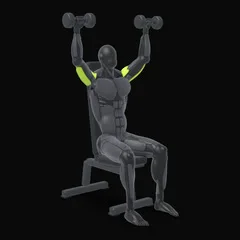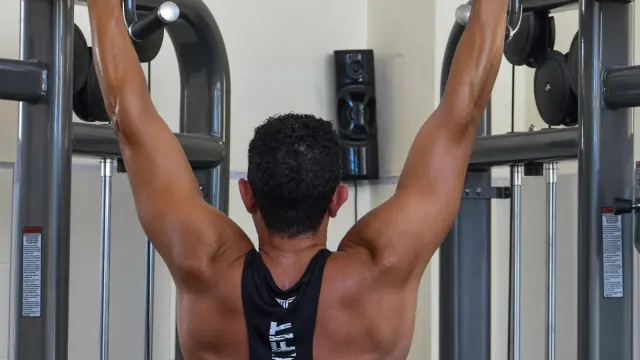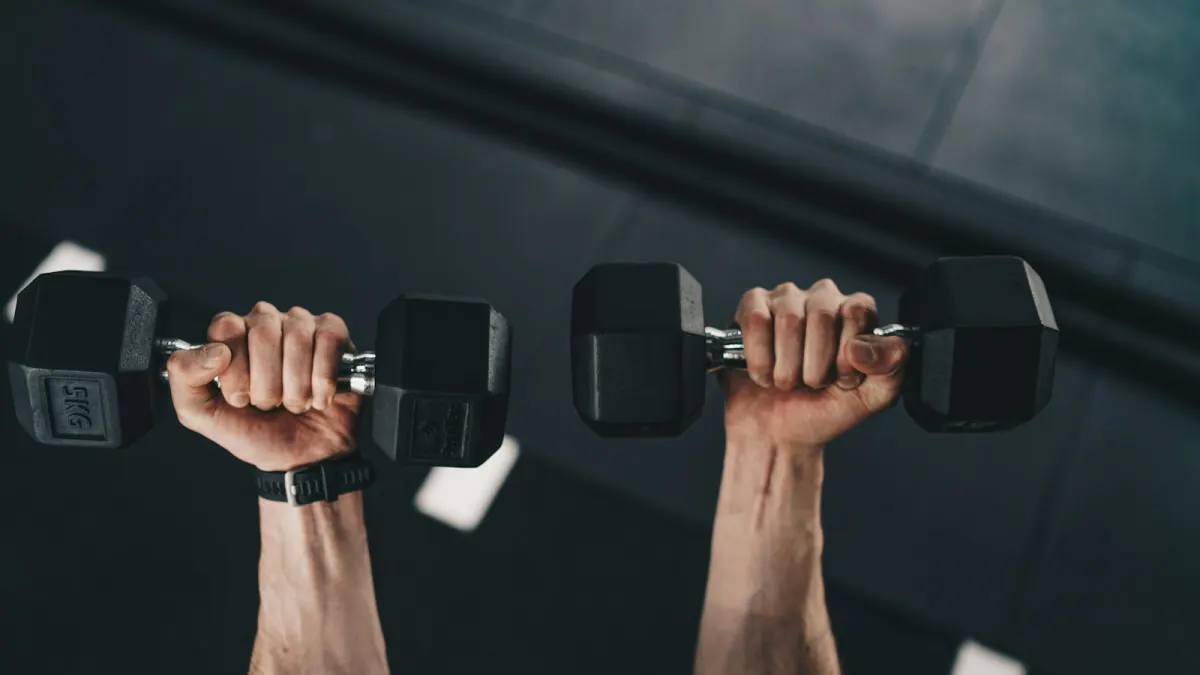
To get bigger shoulders, train all three heads of the deltoid on purpose: one overhead press for the front delts and overall strength, lots of lateral raises for the side delts (they create shoulder width), and rear delt work to fill out the back. In practice that’s about 8–16 hard sets of side delt work and 6–12 of rear delt work per week, spread over two or three sessions, on top of your pressing. Here’s how to do each part well, plus a weekly plan.
The three heads of the deltoid
| Head | What it does | Trained by | Needs direct work? |
|---|---|---|---|
| Front (anterior) | Lifts your arm forward, helps every press | Bench, incline, overhead press | Rarely |
| Side (lateral) | Lifts your arm out to the side | Lateral raises, upright rows | Yes: this is width |
| Rear (posterior) | Pulls your arm back and out | Reverse flyes, face pulls, wide rows | Yes |
The side delts are what make shoulders look broad from the front. The rear delts make them look round from the side and help your posture. The front delts usually get plenty of stimulus already.
Side delts: the key to width
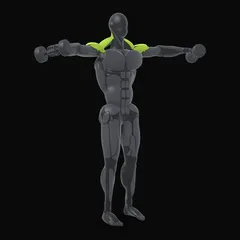
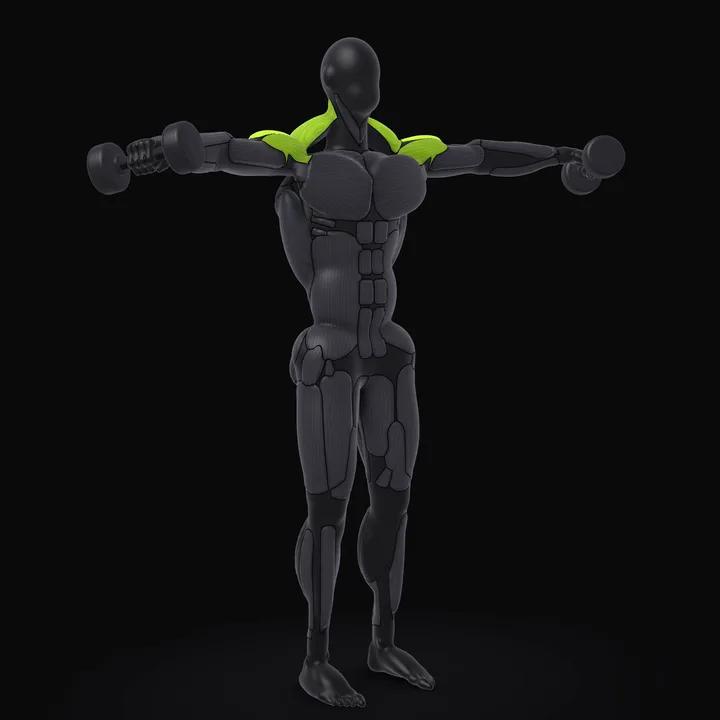 Dumbbell Lateral RaiseStand with a dumbbell in each hand at your sides and your elbows slightly bent. Raise the dumbbells out to the sides to shoulder height, leading with your elbows.How to do the Dumbbell Lateral Raise →
The lateral raise is the main side delt exercise. In an EMG study on competitive bodybuilders, the standard lateral raise with a neutral arm position activated the side delts more than variations with the arm rotated out, raised with a bent elbow, or a front raise (Coratella et al., 2020). The same study found that rotating the arm inward (“pouring the jug”) shifted more work to the rear delts, triceps and upper traps.
So keep it simple:
- Stand tall, slight bend in the elbows, dumbbells at your sides.
- Raise your arms out to the side until they’re about shoulder height, leading with your elbows.
- Keep your thumbs roughly level with your little fingers, not tipped down.
- Lower in two to three seconds. No pause at the bottom; keep tension on.
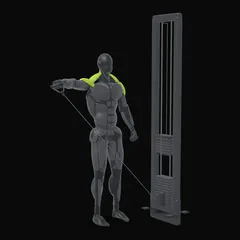
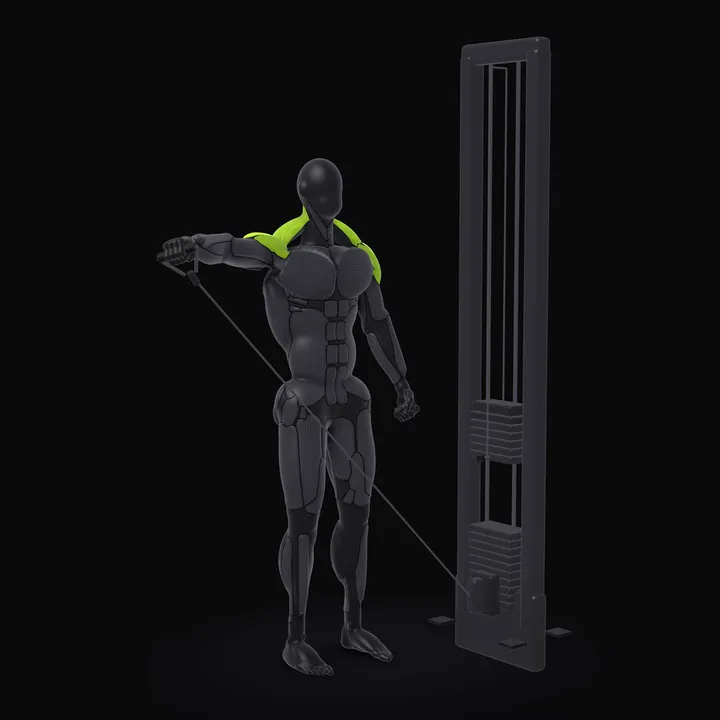 Cable Lateral RaiseStand side-on to a low pulley and grab the handle with your far hand. Raise your arm out to the side to shoulder height, elbow slightly bent.How to do the Cable Lateral Raise →
The cable lateral raise is the best variation to add. A low cable loads the bottom of the movement, where dumbbells feel almost weightless. Machine lateral raises are excellent for taking sets close to failure safely. The full technique breakdown is in lateral raise form.
Reps and load for side delts
Side delts respond to moderate loads taken close to failure. Muscle growth is similar across a wide range of loads when sets are hard (Lopez et al., 2021), and lateral raises with heavy dumbbells turn into a swing almost immediately. Use 10–20 reps, with the last two or three really hard. Partial reps at the bottom after you reach failure on the last set are a reasonable way to extend it.
Rear delts: the overlooked third
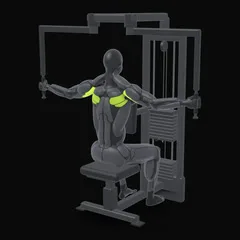
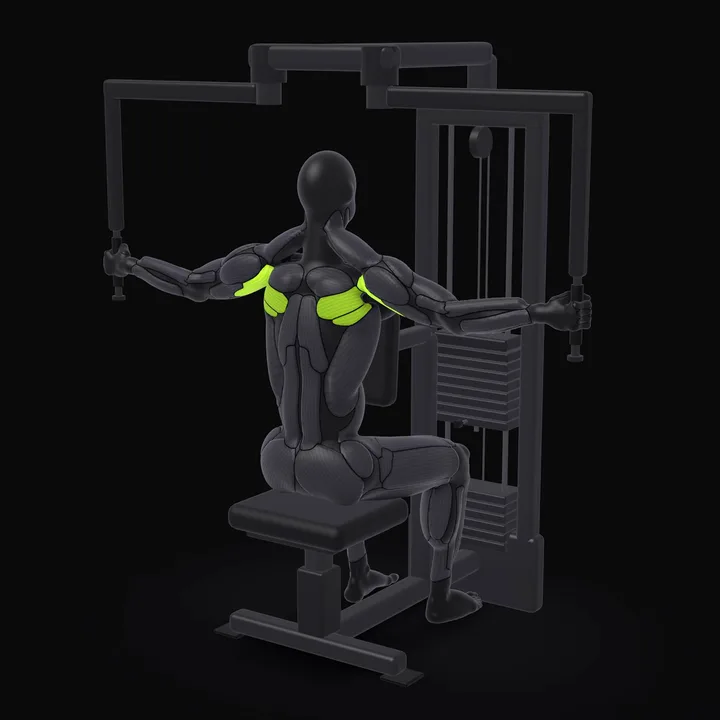 Reverse Pec DeckSit facing the machine with your chest on the pad and the handles set at shoulder height. Grab the handles with your arms almost straight.How to do the Reverse Pec Deck →
Rear delts get some work from rows, but rarely enough. Add direct work:
- Reverse pec deck: the easiest way to train them hard. Arms nearly straight, pull the handles out and back, not down.
- Bent-over rear delt fly: same idea with dumbbells.
- Face pull: rear delts plus the muscles that rotate your shoulder outward. Great for shoulder health.
- Cable reverse fly: constant tension through the whole range.
Use light to moderate weights for 12–20 reps. The rear delts are small; if your traps and lower back are doing the work, the weight is too heavy. More in the rear delt workout guide.
Front delts and the overhead press
Overhead presses (dumbbell or barbell) are worth keeping even though your front delts get work from benching. They build pressing strength, train the shoulders through a long range and contribute to upper chest and triceps. One press per week, or one per upper session, is plenty. See overhead press form for technique.
Front raises are optional. If you bench and press regularly, your sets are better spent on side and rear delts.
How many sets for shoulders?
Weekly volume is a key driver of growth, with 10 or more sets per muscle a week producing more growth than lower volumes (Schoenfeld et al., 2017). For shoulders, count each head separately:
| Head | Direct sets per week (intermediate) | Notes |
|---|---|---|
| Front | 0–6 | Pressing covers most of it |
| Side | 8–16 | Recovers fast; spread over 2–3 sessions |
| Rear | 6–12 | Rows add a little extra |
For more on how to count sets and when to add more, see how many sets per muscle per week.
A weekly shoulder plan
Add these blocks to your existing training. They fit an upper/lower split, push/pull/legs or full body.
Session 1 (with an upper or push day)
| Exercise | Sets × reps | Rest |
|---|---|---|
| Seated dumbbell press | 3 × 6–10 | 2 min |
| Lateral raise | 4 × 12–20 | 60 s |
| Reverse pec deck | 3 × 12–20 | 60 s |
Session 2 (with a pull or second upper day)
| Exercise | Sets × reps | Rest |
|---|---|---|
| Cable lateral raise | 3 × 12–15 per arm | 45–60 s |
| Face pull | 3 × 12–20 | 60 s |
| Machine lateral raise | 2 × 15–20 | 60 s |
That’s 9 side delt sets, 6 rear delt sets and 3 pressing sets a week, a solid intermediate dose. Want more? Add a third short session of 3 sets of lateral raises.
How to progress raises and flyes
Small muscles mean small weight jumps. Going from 10 kg to 12 kg dumbbells on lateral raises is a 20 % jump. So:
- Work up to the top of your rep range first (say 20 reps) before going heavier.
- Use cables or machines with small weight steps when you can.
- Count clean reps only. When you start swinging, the set is over.
Logging your raises sounds like overkill until you notice you’ve used the same 10 kg dumbbells for six months.
Keeping your shoulders healthy
Shoulders are involved in nearly every upper-body exercise, which makes them easy to overuse.
- Balance pushing and pulling. At least as many sets of rows and rear delt work as pressing.
- Warm up before pressing. A few sets of band pull-aparts and light face pulls go a long way.
- Don’t press through pinching pain. Adjust your grip, range of motion or angle. A neutral grip and a slight incline (not fully vertical) suit many people.
- Upright rows to chest height only, and only if they feel fine.
If you get shoulder pain specifically while benching, shoulder pain when bench pressing walks through the common causes.
Frequently asked questions
How often should I train shoulders to make them bigger?
Side and rear delts recover quickly, so two or three sessions a week work well. Many people do lateral raises and rear delt work at the end of every upper-body or push and pull session.
Do I need front raises?
Most people don't. Bench pressing, incline pressing and overhead pressing already train the front delts hard. Spend those sets on side and rear delts instead.
Why aren't my shoulders growing even though my press goes up?
Pressing mostly grows the front delts. The width of your shoulders comes from the side delts, which need direct work like lateral raises. Add 8 to 16 hard sets of lateral raises a week and give it a few months.
Are heavy lateral raises better?
Not really. Side delts respond well to moderate weights for 10 to 20 reps, taken close to failure. Heavy lateral raises usually turn into swinging, which shifts the work to your traps and momentum.
Sources
- Coratella G, Tornatore G, Longo S, Esposito F, Cè E (2020). An Electromyographic Analysis of Lateral Raise Variations and Frontal Raise in Competitive Bodybuilders. International Journal of Environmental Research and Public Health
- Schoenfeld BJ, Ogborn D, Krieger JW (2017). Dose-response relationship between weekly resistance training volume and increases in muscle mass: A systematic review and meta-analysis. Journal of Sports Sciences
- Lopez P, Radaelli R, Taaffe DR, et al. (2021). Resistance Training Load Effects on Muscle Hypertrophy and Strength Gain: Systematic Review and Network Meta-analysis. Medicine & Science in Sports & Exercise