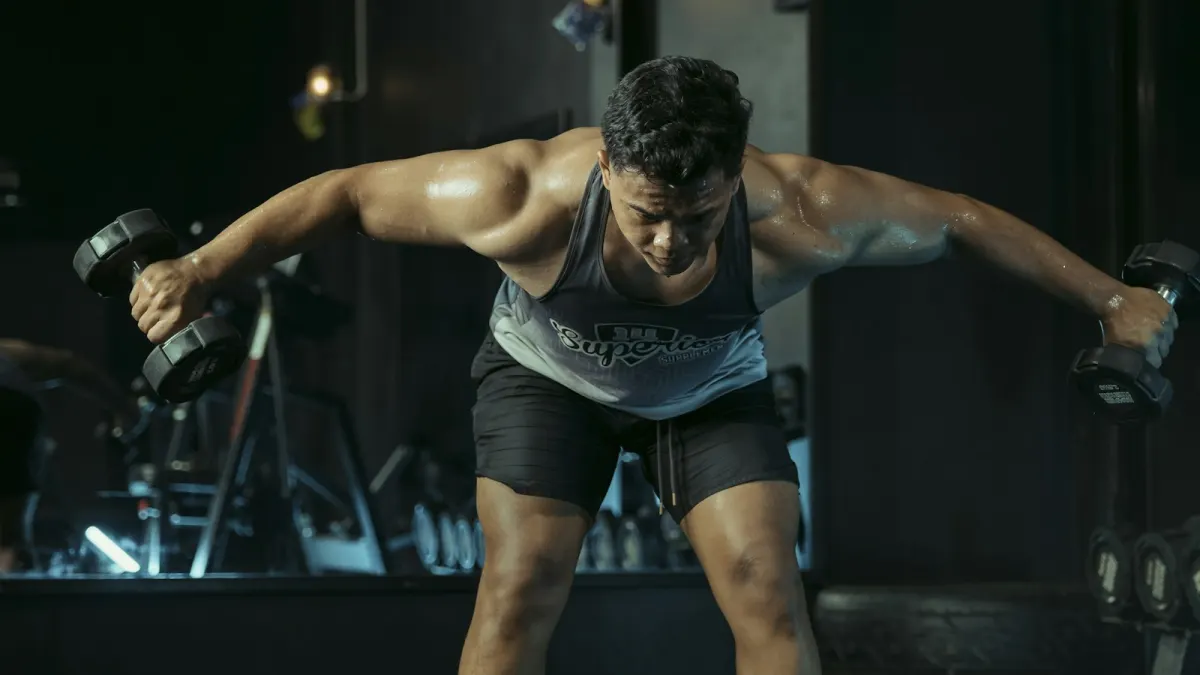
Good lateral raise form means lifting your arms out to the sides, slightly in front of your body, until they’re about level with your shoulders, leading with your elbows, with your hands roughly level and your shoulders pushed down. Use a light weight for 10–20 controlled reps, lower slowly, and don’t swing. Done this way, the side delts (the part of the shoulder that makes it look wide) do the work instead of your traps and momentum. Below is the technique, the variations worth using, and the most common mistakes.
Step-by-step dumbbell lateral raise
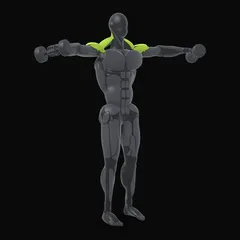
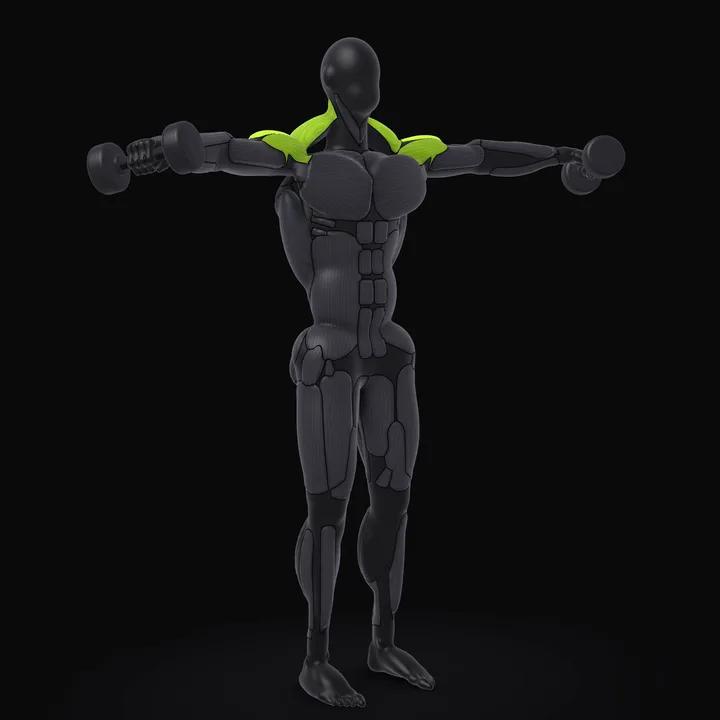 Dumbbell Lateral RaiseStand with a dumbbell in each hand at your sides and your elbows slightly bent. Raise the dumbbells out to the sides to shoulder height, leading with your elbows.How to do the Dumbbell Lateral Raise →
- Stand tall with feet hip-width apart, a dumbbell in each hand at your sides, palms facing in. A slight forward lean of the torso (5–10°) is fine.
- Bend your elbows slightly and keep that bend fixed for the whole set.
- Push your shoulders down, away from your ears.
- Raise your arms out to the sides and slightly forward, in the “scapular plane”, leading with your elbows. Think about pushing the dumbbells out toward the walls rather than lifting them up.
- Stop at about shoulder height, upper arms roughly parallel to the floor. Keep your hands about level with or slightly below your elbows.
- Lower slowly, over 2–3 seconds, to just in front of your thighs. Don’t rest at the bottom; start the next rep.
Cues that fix most sets
- “Push the dumbbells to the walls.” Width, not height, is the goal.
- “Elbows lead, hands follow.” If your hands rise above your elbows, the front delts and biceps start helping.
- “Long neck.” Keep space between your shoulders and ears for the whole set.
- “Slow down, not drop.” The lowering is half the rep.
One warm-up set is usually enough: 15 easy reps with about half your working weight, ideally after you’ve already pressed that day.
Arm position and hand angle
The old advice was to “pour the jug”: tip the front of the dumbbell down as if pouring water at the top. Research suggests that’s not ideal. In an EMG study on competitive bodybuilders, the side delts were most active in a lateral raise with a neutral arm position, and rotating the arm inward shifted more activity to the rear delts, triceps and upper traps (Coratella et al., 2020). The same study found front raises and bent-elbow variations activated the side delts much less.
So: hands roughly level, thumbs neither tipped down hard nor turned up. Raising slightly in front of your body (rather than directly out to the sides) feels more natural for most shoulders and lets you lift through a full range comfortably.
Cables, machines and other variations
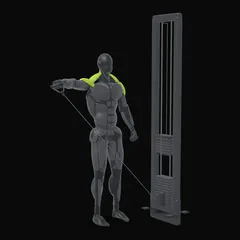
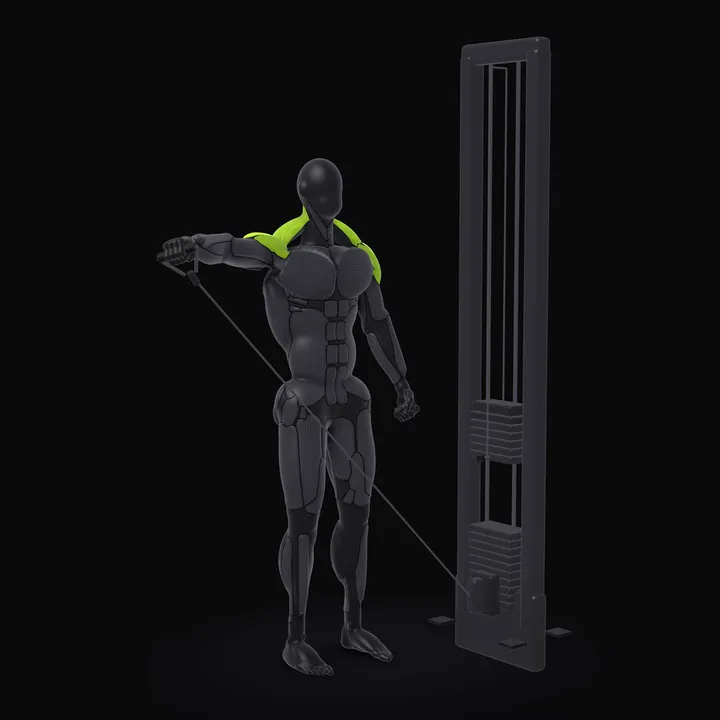 Cable Lateral RaiseStand side-on to a low pulley and grab the handle with your far hand. Raise your arm out to the side to shoulder height, elbow slightly bent.How to do the Cable Lateral Raise →
Cable lateral raise. Stand side-on to a low pulley, handle in the far hand, cable crossing in front of your body or behind it. Cables keep tension at the bottom of the movement, where dumbbells are nearly weightless, and come in smaller weight jumps. Do one arm at a time.
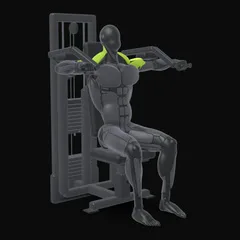
Machine lateral raise. Very stable and easy to take close to failure. Great for the last set or for high-rep work.
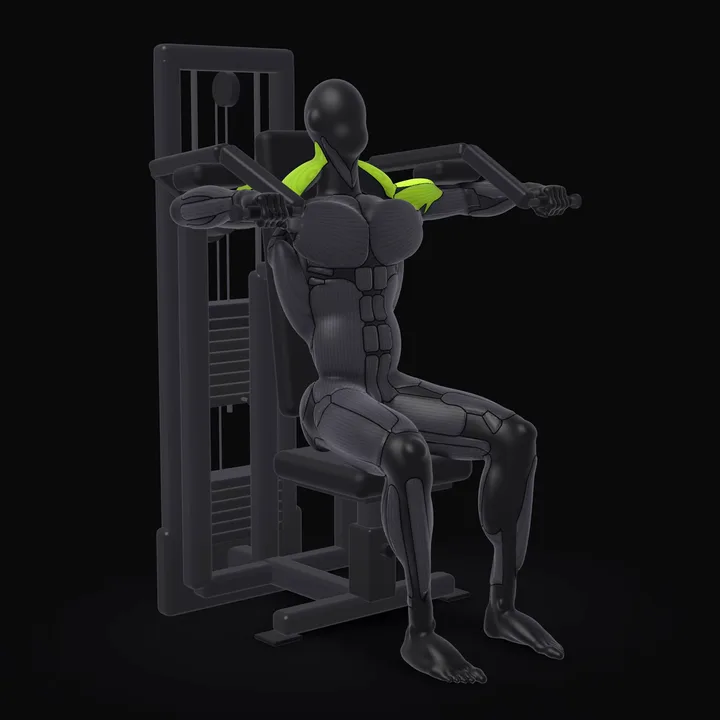 Machine Lateral RaiseAdjust the seat so your shoulders line up with the machine's pivot. Rest your upper arms against the pads and grab the handles.How to do the Machine Lateral Raise →
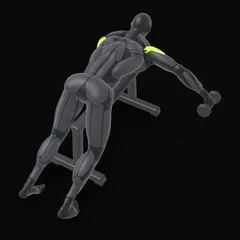
Lying or incline side raise. Lie on your side on an incline bench and raise one dumbbell. This loads the bottom of the movement harder, the stretched position for the side delt.
Seated lateral raise. Sitting removes leg drive and body swing, which makes cheating harder.
Which variation suits you
| Variation | Best for |
|---|---|
| Dumbbell lateral raise | Default choice, any gym or home |
| Seated lateral raise | Lifters who can’t stop swinging |
| Cable lateral raise | Tension at the bottom, small weight jumps |
| Machine lateral raise | Safe sets close to failure, drop sets |
| Lying side raise | Extra work in the stretched position |
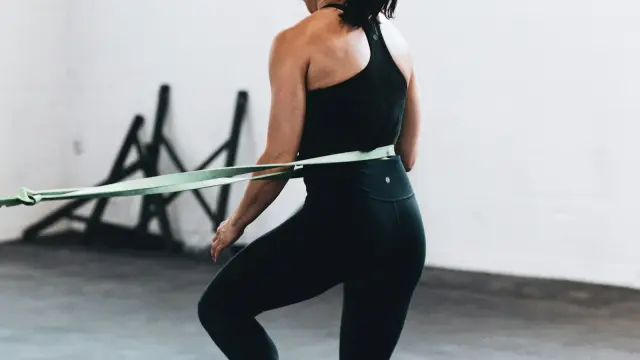
| Band lateral raise | Home training, travel, high reps |
The most common lateral raise mistakes
| Mistake | What happens | Fix |
|---|---|---|
| Too heavy | Swinging, shrugging, short range | Go lighter; most people overestimate here |
| Shrugging | Traps take over | Shoulders down before and during each rep |
| Raising too high | More trap work | Stop at shoulder height |
| Pouring the jug hard | Shifts work to rear delts and traps, can irritate the shoulder | Keep hands level |
| Bent elbows changing during the rep | Turns into an upright row | Fix the elbow bend at the start |
| Dropping the weight | Misses the lowering | 2–3 seconds down |
Sets, reps and how to progress
Side delts respond well to moderate weights taken close to failure. A good dose is 8–16 hard sets a week, spread across 2–3 sessions, mostly in the 10–20 rep range. The full weekly plan for all three delt heads is in how to get bigger shoulders.
Progression is the tricky part, because the jumps between dumbbells are big relative to the load. Going from 8 to 10 kg is a 25 % increase. So:
- Add reps first. Use a wide range like 12–20. Move up only when you hit 20 on every set.
- Use cables or machines for smaller weight jumps.
- Add partial reps at the end of the last set: when you can’t reach shoulder height, keep going with half reps in the bottom range.
- Write it down. Lateral raises are the exercise people do with the same dumbbells for years.
How to pick your starting weight
Pick a pair of dumbbells you think is too light and do one set. If you reach 20 reps with perfect form and no swing, go up one pair. Your working weight is the one where reps 12–15 are hard, your torso stays still and you still stop at shoulder height. For most beginners that’s 3–6 kg per hand; for many intermediates it’s 6–10 kg. If you’re above that and the movement looks clean on video, great, but check the video first.
A worked example
| Week | Dumbbells | Reps (3 sets) |
|---|---|---|
| 1 | 2 × 8 kg | 15, 13, 12 |
| 2 | 2 × 8 kg | 17, 15, 14 |
| 3 | 2 × 8 kg | 19, 17, 16 |
| 4 | 2 × 8 kg | 20, 20, 18 |
| 5 | 2 × 8 kg | 20, 20, 20, so next session: 2 × 10 kg for about 12–14 reps |
Five weeks on the same dumbbells is normal for lateral raises. If the jump to the next pair is too big, do the first set with the heavier dumbbells and the rest with the lighter ones until all sets reach 12 or more.
Intensity techniques that suit lateral raises
Because they’re low-fatigue, lateral raises are one of the best exercises for drop sets and partials. On the last set, take the set to failure, grab dumbbells 2–4 kg lighter and keep going for as many clean reps as you can. Or use the machine and drop the pin twice. Keep it to the last set of the session; more than that adds soreness without much extra benefit. Supersets and drop sets explains when these techniques are worth using.
Where to put lateral raises in your week
Lateral raises are low-fatigue: they don’t tire your legs or lower back and barely affect your other lifts. That makes them easy to slot in almost anywhere:
- After pressing on a push or upper day, when your shoulders are already warm.
- At the end of a leg day, as a short block of 2–3 sets, if you want a third weekly session.
- As a superset with a pulling exercise or a triceps exercise to save time.
A practical setup for an intermediate: 3–4 sets of dumbbell raises on one day, 3 sets of cable raises on another, and optionally 2 sets on the machine on a third. That covers the full range of the movement across the week: cables for the bottom, dumbbells for the top, the machine for safe sets to failure.
How to tell your form is working
You know your lateral raises are hitting the right muscle when:
- the burn sits on the outside of your shoulder, not the top of your neck,
- your torso stays still from the first rep to the last,
- the last two reps of each set are a real struggle with a light weight,
- your side delts feel noticeably pumped after three sets.
If instead your traps are on fire and you’re rocking back and forth by rep 8, go down a dumbbell and slow everything down. Most people get far better results with lighter weights and stricter reps than they expect.
Lateral raises and shoulder health
Done with a sensible weight, lateral raises are kind to the shoulder. If you feel pinching at the top, raise your arms a bit further in front of your body, lower the height slightly, and keep your hands level. Balancing your pressing with lateral raises and rear delt work also helps overall shoulder balance; see the rear delt workout for the back of the shoulder and overhead press form for the front.
Frequently asked questions
How high should I raise my arms on lateral raises?
To about shoulder height, where your upper arm is roughly parallel to the floor. Going higher shifts more of the work to your upper traps. Going much lower cuts out the top of the range.
Should I tilt my pinky up on lateral raises?
Not dramatically. In an EMG study, a neutral arm position activated the side delts most. Tipping the dumbbell down hard (internally rotating) shifted work to the rear delts, triceps and traps. Keep your hands roughly level.
Why do I feel lateral raises in my traps?
Usually the weight is too heavy, you're shrugging as you lift, or you're raising above shoulder height. Go lighter, push your shoulders down, think about pushing the dumbbells out to the walls, and stop at shoulder height.
How heavy should lateral raises be?
Light enough to control 10 to 20 reps with no body swing. That's often 5 to 12 kg (10 to 25 lb) dumbbells for intermediate lifters. Heavier usually just means more momentum.
Cables or dumbbells for lateral raises?
Both work. Cables keep tension at the bottom, where dumbbells feel weightless, and offer smaller weight jumps. Dumbbells need no setup. Many people use one of each in their week.
Sources
- Coratella G, Tornatore G, Longo S, Esposito F, Cè E (2020). An Electromyographic Analysis of Lateral Raise Variations and Frontal Raise in Competitive Bodybuilders. International Journal of Environmental Research and Public Health