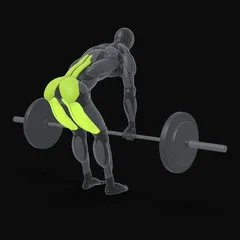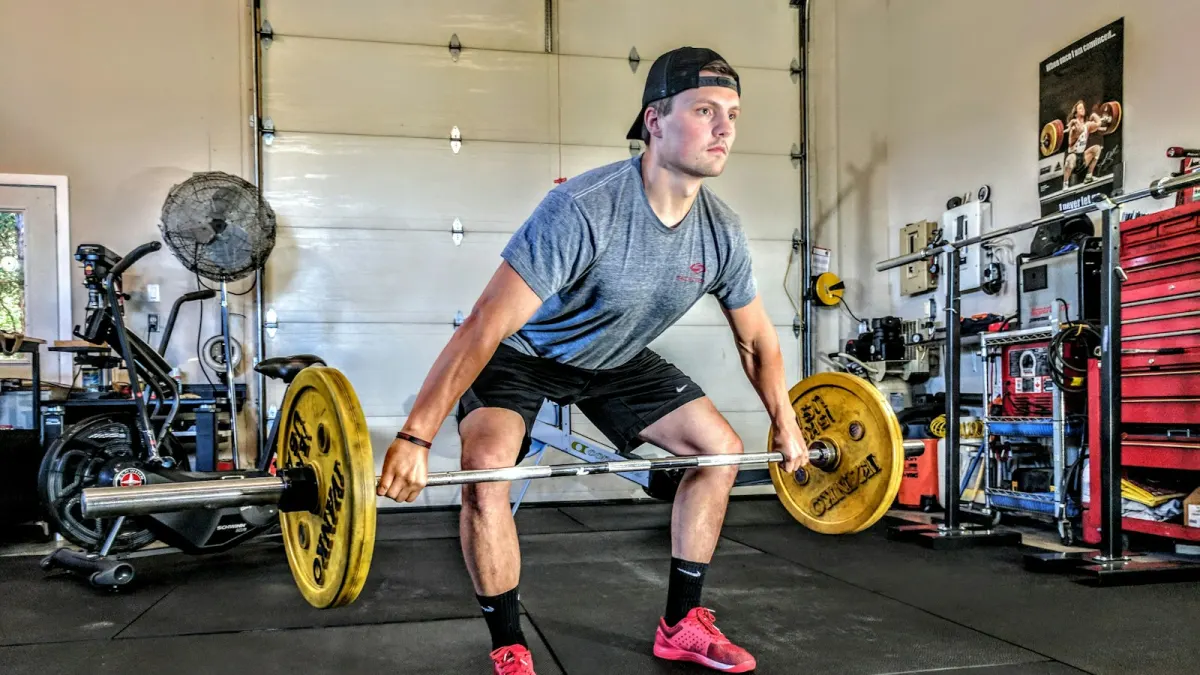
A good Romanian deadlift (RDL) is a hip hinge: stand tall with the bar, unlock your knees slightly, then push your hips straight back while the bar slides down your thighs, keeping your back neutral, until you feel a strong stretch in your hamstrings. Then drive your hips forward to stand back up. You don’t touch the floor between reps, and you don’t round your back to go lower. Below is the technique in detail, how deep to go, how it differs from a regular deadlift, and the best variations.
Step-by-step Romanian deadlift
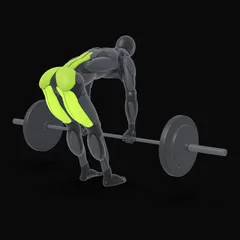
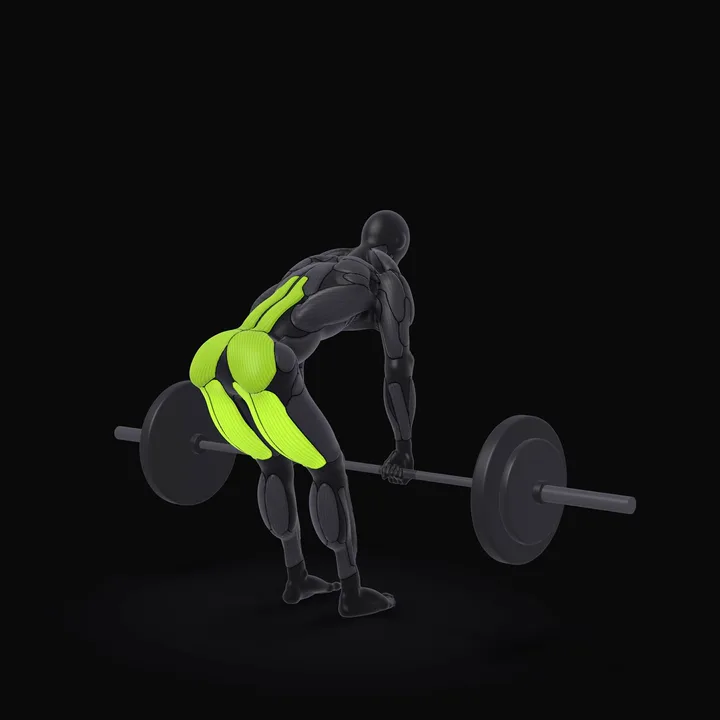 Barbell Romanian DeadliftStand holding the bar in front of your thighs with your knees slightly bent. Push your hips back and lower the bar close to your legs with a flat back.How to do the Barbell Romanian Deadlift →
1. Start standing
Take the bar from a rack at about mid-thigh height (or deadlift it from the floor for the first rep). Hold it with a double overhand grip just outside your thighs. Feet hip-width apart, toes forward.
2. Set your position
Stand tall, shoulder blades slightly back, chest up. Unlock your knees with a small bend, about 15–20°. That bend stays nearly the same for the whole rep.
3. Brace
Breathe into your belly and brace your midsection, as you would for a squat or deadlift.
4. Hinge
Push your hips straight back, as if closing a car door behind you with your backside. Let your torso tip forward as a result. The bar slides down your thighs, close to your body. Keep your neck in line with your back, eyes on the floor a couple of metres ahead.
5. Stop at the stretch
When your hamstrings are fully stretched and your hips can’t go further back without your back rounding, stop. For most people that’s around the knees to mid-shin. Take about 2–3 seconds to get there.
6. Drive back up
Push your hips forward and squeeze your glutes to stand tall. Don’t lean back at the top. Exhale, re-brace, repeat.
Learn the hinge before you load it
If the movement feels strange, two drills teach it in a few minutes:
- Wall touch. Stand about a foot-length away from a wall, facing away from it. Soft knees, hands on your hips, push your hips back until your backside touches the wall. Step a few centimetres further away and repeat. When you can reach the wall while your shins stay nearly vertical, you’re hinging.
- Stick drill. Hold a broomstick along your spine so it touches the back of your head, your upper back and your tailbone. Hinge until you feel the hamstring stretch. If any of the three contact points leaves the stick, your back has changed shape.
Do a set of each as part of your warm-up for the first few weeks, then a couple of light sets with the empty bar or light dumbbells before your work sets.
How low should you go?
Depth on an RDL is set by your hamstrings, not the floor. The moment your pelvis stops rotating and your lower back starts to round, you’ve reached your current range. Going lower from there just moves the stretch from your hamstrings to your spine.
The stretch is the point of the exercise. Hamstrings trained in a long, stretched position grew more than those trained in a shorter position in a 12-week study comparing seated and lying leg curls (Maeo et al., 2021). The RDL loads the hamstrings in exactly that stretched position at the hip, which is why it’s such a strong hamstring builder.
Your range usually improves over a few weeks of training. A test: stand side-on to a mirror. Your back should look the same at the bottom as at the top.
Romanian deadlift vs deadlift vs stiff-leg
| Romanian deadlift | Conventional deadlift | Stiff-leg deadlift | |
|---|---|---|---|
| Start | Standing | From the floor | From the floor |
| Knees | Soft bend, nearly fixed | Bend and straighten a lot | Nearly straight |
| Hips | Push back | Start low, rise with shoulders | Hinge with straight legs |
| Bottom | Hamstring stretch, no floor touch | Floor | Floor or close |
| Main muscles | Hamstrings, glutes | Glutes, quads, back, hamstrings | Hamstrings, lower back |
| Typical reps | 6–12 | 3–6 | 6–10 |
The regular deadlift is a strength lift that starts from a dead stop on the floor; see how to deadlift. The RDL is a hamstring and glute builder that keeps tension on the muscles the whole set. The stiff-leg deadlift sits in between and puts a bit more stress on the lower back.
Common RDL mistakes and fixes
| Mistake | Fix |
|---|---|
| Squatting down instead of hinging | Keep the knee bend small and fixed; think hips back, not down |
| Bar drifting away from the legs | Keep it touching your thighs; pull your lats tight (“bend the bar”) |
| Rounding the back to go lower | Stop at the stretch; reduce the weight |
| Locking the knees straight | Keep a soft bend to protect the back of the knee and load the hamstrings |
| Hyperextending at the top | Stand tall and squeeze glutes; don’t lean back |
| Looking up | Neutral neck; eyes a couple of metres ahead on the floor |
RDL variations
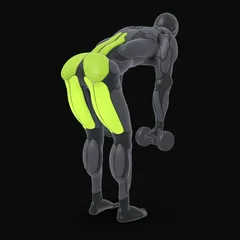
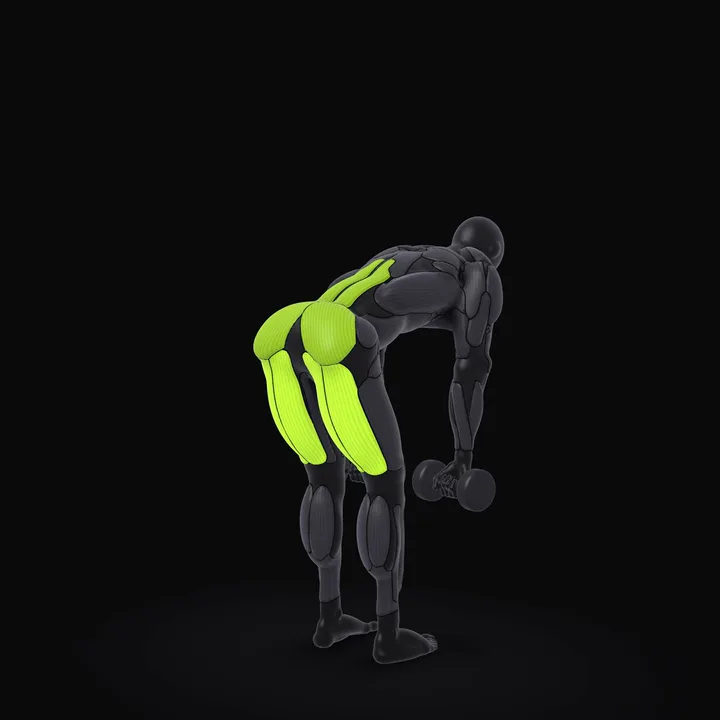 Dumbbell Romanian DeadliftStand with a dumbbell in each hand in front of your thighs, knees slightly bent. Push your hips back and lower the dumbbells close to your legs with a flat back.How to do the Dumbbell Romanian Deadlift →
- Dumbbell RDL: easier to learn, great for home training. Dumbbells slide down the front or sides of your legs.
- Single-leg RDL: one leg at a time, more glute and balance demand, much less load needed. Hold onto something for balance at first.
- Deficit RDL: standing on a plate for a longer range, once your hamstrings allow it.
- Kettlebell single-leg deadlift: a home-friendly single-leg option.
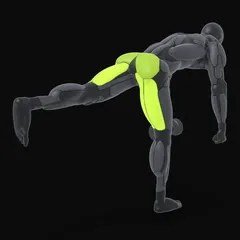
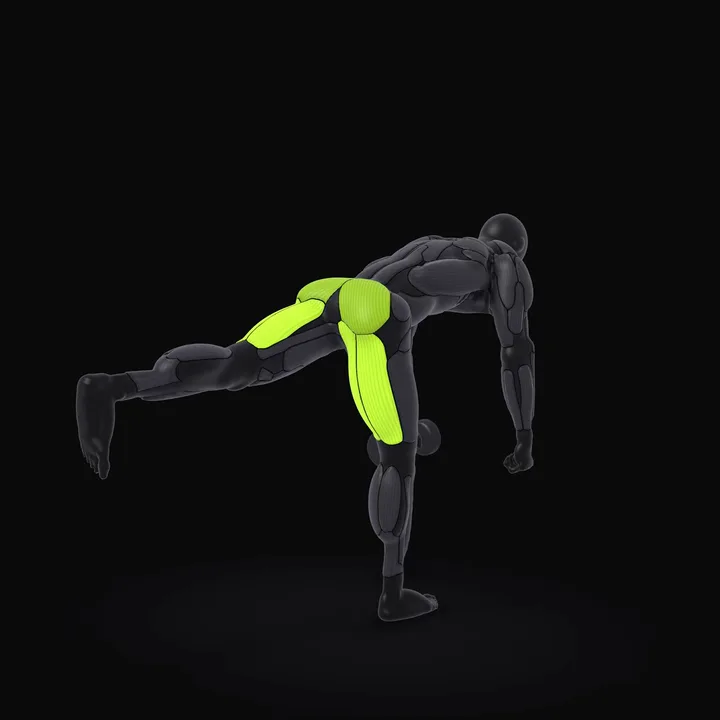 Dumbbell Single-leg Romanian DeadliftStand on one leg holding a dumbbell in the opposite hand, knee slightly bent. Hinge at the hip while raising your free leg behind you so your torso and leg form a line.How to do the Dumbbell Single-leg Romanian Deadlift →
Sets, reps and programming
| Goal | Sets × reps | Rest | Effort |
|---|---|---|---|
| Learning the lift | 2–3 × 10 with a light weight | 90 s | Easy, focus on depth and back position |
| Hamstring and glute size | 3–4 × 8–12 | 2 min | 1–3 reps in reserve |
| Strength (as a deadlift helper) | 3–4 × 5–8 | 2–3 min | 2–3 reps in reserve |
- Reps: 6–12 for most people. Very high reps tend to break down your position before your hamstrings tire.
- Sets: 2–4 per session.
- Frequency: once or twice a week, often on a leg or lower day. RDLs cause plenty of soreness at first, so start with 2 sets.
- Tempo: 2–3 seconds down, no bounce at the bottom, strong drive up.
- Pair with a leg curl: the RDL trains the hamstrings at the hip, a curl trains them at the knee. Both belong in a complete leg week; leg day workout shows how.
Progress with double progression: hit the top of your rep range on every set with the same depth, then add 2.5–5 kg (5–10 lb). If your depth shrinks as the weight goes up, the extra weight isn’t worth it. Logging a quick note on depth helps you catch that.
How to pick your starting weight
If you can already deadlift, start your RDL at about 50–60 % of your deadlift working weight; the stretched position makes it much harder than it looks. New to hinging? Start with the empty bar or two light dumbbells (for example 2 × 10 kg, 20 kg total) for 3 sets of 10. If every rep reaches the same depth with a flat back and you could have done 4–5 more, go up next session. Stop increasing when the last two reps of each set slow down but still look like the first.
What four weeks of progress looks like
A lifter starting at 60 kg for 3 × 8–12:
| Week | Weight | Reps | Note |
|---|---|---|---|
| 1 | 60 kg | 10, 9, 8 | Bar just below the knee |
| 2 | 60 kg | 11, 10, 10 | Same depth |
| 3 | 60 kg | 12, 12, 11 | |
| 4 | 60 kg | 12, 12, 12 | Next session: 65 kg |
If the 65 kg sets only reach mid-thigh instead of below the knee, go back to 60 kg for another week. Depth is part of the target, not a bonus.
Tight hamstrings?
Most people’s hamstrings limit their depth at first, and that’s fine: stop where your back stops staying flat. Range usually improves within a few weeks of regular RDLs. Elevating the bar isn’t necessary because you never touch the floor anyway. If you can’t get below mid-thigh without rounding, use dumbbells, slightly more knee bend, and the stick drill above until it opens up.
Grip and straps
Grip often fails first on RDLs, especially in sets of 10–12. Use lifting straps for your work sets and train grip separately; the RDL is about your hamstrings and glutes. RDLs also build the glutes well; see how to grow glutes for how they fit with hip thrusts and squats.
Frequently asked questions
Where should I feel Romanian deadlifts?
Mainly in your hamstrings, with a strong stretch at the bottom, and in your glutes as you stand up. Your lower back works to hold your position but shouldn't be the main thing you feel. If it is, push your hips back further and reduce the weight.
How low should I go on a Romanian deadlift?
Until your hamstrings are fully stretched while your back stays neutral. For most people that's somewhere around mid-shin to just below the knee. Going lower by rounding your back doesn't stretch the hamstrings more.
What's the difference between a Romanian deadlift and a stiff-leg deadlift?
In a Romanian deadlift you push your hips back with a soft knee bend and stop when the hamstrings are stretched, usually without touching the floor. A stiff-leg deadlift keeps the knees straighter and usually starts from the floor each rep. Both train the hamstrings; the RDL is easier to do well.
Can I do Romanian deadlifts and regular deadlifts in the same week?
Yes, many programs do. Put them on different days, keep the RDL a little lighter and in higher reps, and watch your lower back's recovery. If both start to feel like grinding, drop a set from each.
Should I use straps for Romanian deadlifts?
Yes, if your grip gives out before your hamstrings. The RDL is a hamstring and glute exercise; straps let you finish the set with your legs rather than your hands.
Sources
- Maeo S, Huang M, Wu Y, Sakurai H, Kusagawa Y, Sugiyama T, Kanehisa H, Isaka T (2021). Greater Hamstrings Muscle Hypertrophy but Similar Damage Protection after Training at Long versus Short Muscle Lengths. Medicine & Science in Sports & Exercise