The dips exercise is a bodyweight press on parallel bars that trains your chest, triceps and front shoulders at once. Lean forward with your elbows slightly out to bias the chest, or stay upright with your elbows tucked to bias the triceps. Lower yourself under control until your upper arms are about parallel to the floor, then press back up to straight arms. Below is the technique, how deep to go to protect your shoulders, the progressions to your first dip, and how to add weight.
How to do a dip
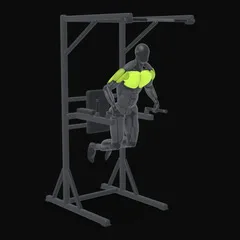
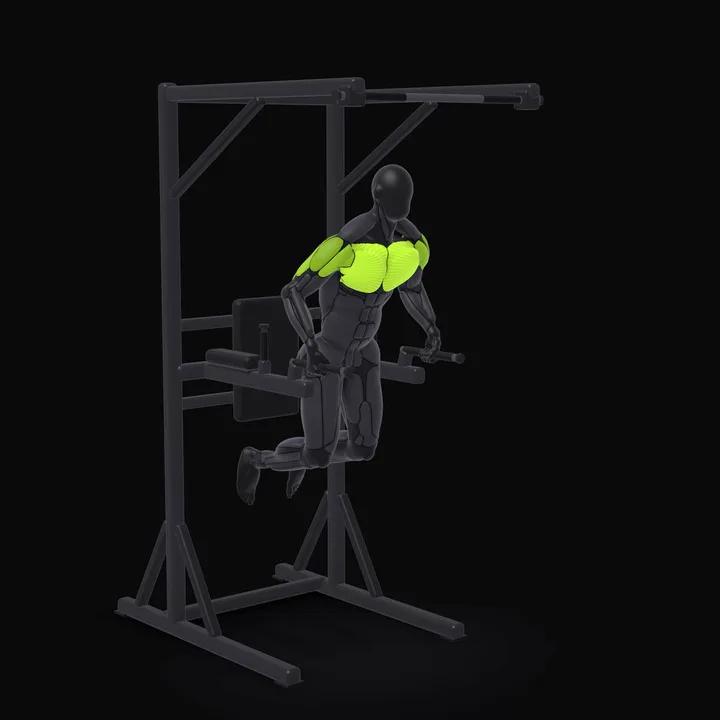 DipGrip the parallel bars and lift yourself up with straight arms. Lean your torso slightly forward and keep your shoulders away from your ears.How to do the Dip →
- Grip: stand between parallel bars, hands on the bars about shoulder-width apart, neutral grip (palms facing each other).
- Support: jump or step up to straight arms. Push your shoulders down away from your ears; your chest should feel proud, not collapsed.
- Legs: cross your ankles and bend your knees slightly, or keep legs straight and slightly in front for a more upright dip.
- Lower: bend your elbows and lower yourself under control, about 2 seconds, until your upper arms are about parallel to the floor.
- Press: push back up to straight arms without swinging. Keep your shoulders down.
Setup checklist and cues
Before each set:
- Bars stable and at a height where your feet clear the floor at the bottom.
- Hands centred on the bars, wrists straight over the bars, not bent back.
- Lock out at the top, shoulders pushed down, chest up.
- Legs still: ankles crossed or legs straight and tight.
During the set, one or two cues are enough: “Shoulders away from the ears” at the top, “Chest up, elbows back” on the way down, and “Push the bars into the floor” to come back up. If your elbows drift far out to the sides, think “elbows back toward the wall behind you”.
Warm-up
Dips stretch the front of your shoulders under load, so warm them gradually: 10 arm circles each way, 15 band pull-aparts, 10 push-ups, a 20-second support hold on the bars, then a set of assisted or shallow dips at about half your usual reps. On weighted days, add a bodyweight set and one set with half your working weight before the work sets.
Chest dips vs triceps dips
| Chest-focused dip | Triceps-focused dip | |
|---|---|---|
| Torso | Leaning forward 20–30° | Upright |
| Elbows | Slightly out | Tucked close to the body |
| Legs | Bent, behind you | Straight, under or slightly in front |
| Bars | Slightly wider if available | Shoulder-width |
| Feel it in | Lower chest, front delts | Back of the arms |
Both versions work all three muscle groups; you’re shifting the balance, not isolating. For where dips fit into chest or triceps training, see how to build chest muscle and how to grow triceps.
How deep should you dip?
Depth is where dips get their reputation. As you go lower, the front of your shoulder is stretched under your full body weight. That stretch is part of what makes dips effective, but too much, too soon, is what irritates shoulders.
- Start at about parallel (upper arm level with the floor).
- Go deeper only if it feels completely fine and your shoulders stay down, not rolled forward.
- Stop higher if you feel pinching or pain at the front of the shoulder.
Keeping your shoulder blades pulled down and your chest up at the bottom makes a big difference. If your shoulders roll forward as you descend, you’ve gone too deep for now.
Progressions to your first dip
| Level | Exercise | Move on when you can do… |
|---|---|---|
| 1 | Bench dip, feet on the floor, knees bent (short range) | 3 × 15 |
| 2 | Support hold on parallel bars, arms straight, shoulders down | 3 × 30 s |
| 3 | Negative dips: jump to the top, lower in 3–5 seconds | 3 × 5 |
| 4 | Assisted dip (machine or band under the knees) | 3 × 8–10 with little assistance |
| 5 | Parallel bar dip | 3 × 10–15 |
| 6 | Weighted dip | Ongoing |
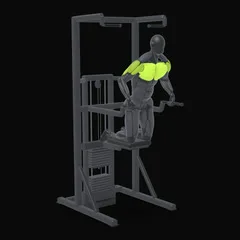
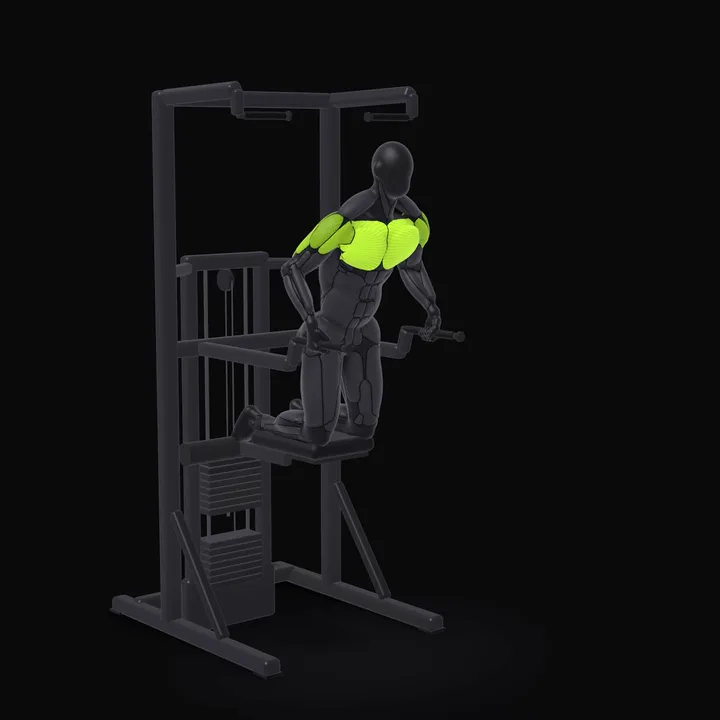 Machine Assisted DipSelect the assistance weight and kneel or stand on the platform. Grip the handles with straight arms and your torso leaning slightly forward.How to do the Machine Assisted Dip →
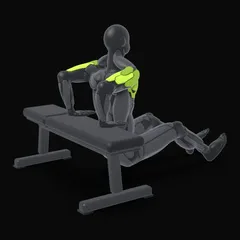
Bench dips are listed as a starting point, but keep the range short. With your hands behind you, the shoulder is in a more stressful position, which is why many coaches skip them in favour of the assisted machine.
Weighted dips
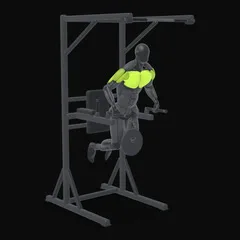
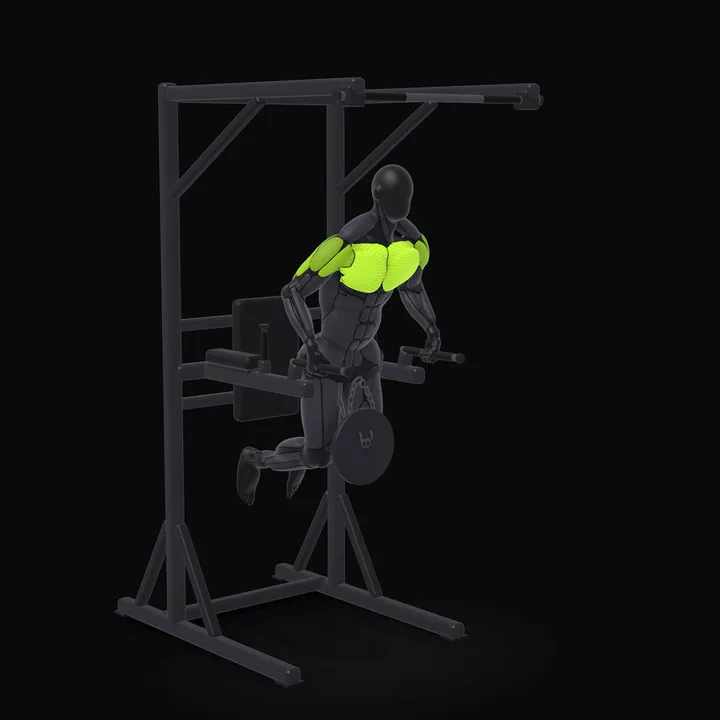 Weighted DipWear a dip belt with a plate or hold a dumbbell between your feet. Get up on the bars with straight arms and lean slightly forward.How to do the Weighted Dip →
Once you can do 12–15 clean dips, adding weight builds more muscle than doing 30. Use a dip belt with a plate or dumbbell hanging between your legs, or hold a dumbbell between your feet. Start with 5 kg (10 lb) for 3–4 sets of 6–10 reps and add small amounts as you progress. Weighted dips are a classic strength builder for the chest and triceps, and a strong weighted dip tends to carry over well to the bench press.
Other dip variations and who they suit
| Variation | What changes | Good for |
|---|---|---|
| Ring dips | The rings move, so your shoulders have to stabilise | Advanced lifters with solid bar dips (15+) |
| Machine dip | Seated, fixed path, easy to load | Triceps size, anyone who finds bars uncomfortable |
| Upright triceps dip | Torso vertical, elbows tucked | Triceps emphasis |
| Weighted bench dip | Plate on the lap | Not recommended for most: the shoulder position gets worse with load |
What muscles do dips work?
Dips are a compound pressing movement, so several muscles share the load:
- Pectoralis major, especially the lower (sternal) part, which pulls your upper arm down and forward as you press out of the bottom.
- Triceps, which straighten your elbows. They take over more of the work the more upright you stay.
- Front deltoids, which help at every angle and are stretched at the bottom.
- Lower traps and serratus, which hold your shoulder blades down and stable on the bars.
That’s why dips sit somewhere between a chest press and a triceps exercise, and why they make such a useful accessory after bench pressing: they hit the same muscles from a different angle, with your body moving around fixed hands rather than a bar moving over a fixed body.
Dips vs bench press
You don’t have to choose. The bench press is easier to load in small steps and safer to take heavy with safeties. Dips need no equipment beyond bars, train your shoulder blades to stay stable as your body moves, and load the lower chest and triceps hard. Many lifters use the bench press as their main press and dips as their second exercise of the session. If shoulder comfort decides it, use the one that feels better, and keep the other as an occasional variation.
Programming dips
| Goal | Sets × reps | Rest |
|---|---|---|
| First dip | Support holds, negatives and assisted dips (see the progression table) | 90 s–2 min |
| Muscle, main press | 3–4 × 6–12, weighted when possible | 2 min |
| Muscle, after bench press | 2–3 × 8–15 | 90 s |
| Strength | Weighted, 4–5 × 4–6 | 2–3 min |
- Frequency: once or twice a week. Dips and heavy pressing both load the front of the shoulder, so balance them with plenty of rows and rear delt work.
Use double progression: reach the top of your rep range on every set, then add weight (or reduce assistance). For bodyweight dips, log the assistance level or added weight with every set so you can see the trend.
Picking your starting load
On the assisted machine, choose the assistance that lets you do 8 clean reps with 2 left in the tank, then take away about 5 kg of assistance each time you hit 3 × 10. For weighted dips, start with 5 kg once you can do 12 bodyweight reps, and aim for 3 × 8. A typical run: 5 kg for 8, 7, 7 in week 1, 8, 8, 8 by week 3, then 7.5 kg. If your shoulders feel beaten up after a jump, go back to the previous weight for a week rather than shortening the range.
Common dip mistakes
| Mistake | Fix |
|---|---|
| Shoulders shrugging up to the ears | Push your shoulders down at the top and keep them down |
| Shoulders rolling forward at the bottom | Reduce depth; keep chest up |
| Swinging and kipping | Cross your ankles and brace; control every rep |
| Half reps at the top | Go to about parallel on every rep |
| Too much too soon | Build volume over weeks; dips can make shoulders sore at first |
Safety on the bars
- Get on and off under control. Step up from a box or the machine platform rather than jumping into a deep first rep, and step down at the end instead of dropping from the bottom position.
- Never bounce at the bottom. The stretch is where shoulders get irritated; control the turnaround.
- Check the dip belt. Make sure the chain is closed and the plate hangs between your legs, not swinging into the bars.
- Stop a set when your shoulders start rolling forward. That’s the point where the rep quality, and the shoulder position, falls apart.
Dips at home
If you don’t have parallel bars, two sturdy chairs placed back-to-back, a corner of a solid kitchen counter, or a stable dip station work. Test the setup carefully before putting your full weight on it. For a bodyweight plan around dips, push-ups and pull-ups, see calisthenics for beginners.
Frequently asked questions
Do dips work chest or triceps?
Both. Leaning forward with elbows slightly out shifts more work to the lower chest; staying upright with elbows tucked shifts it to the triceps. Your front delts work in every version.
Are dips bad for your shoulders?
Not for most people, if you control the depth. Going too deep stretches the front of the shoulder under load. Stop when your upper arms are about parallel to the floor or slightly below, and build up gradually.
How many dips should I be able to do?
As a rough guide, 5 to 10 clean dips is a solid start for most adults, 15 to 20 is strong. Beyond that, adding weight with a dip belt is a better way to keep building muscle than doing ever more reps.
Why do dips hurt my sternum?
Usually because you're going deeper or doing more volume than your chest and the joints around your breastbone are used to. Reduce depth and sets for a couple of weeks and build back up slowly. If it persists, or comes with other symptoms, get it checked by a doctor.
Are bench dips as good as parallel bar dips?
No. Bench dips with your hands behind you put the shoulders in an awkward position and limit loading. They're fine as a beginner step for some people, but parallel bar dips or assisted dips are a better long-term choice.