To build chest muscle, press from at least two angles (flat and a roughly 30° incline), add one fly movement that stretches the pecs under load, and do 10–16 hard sets for your chest each week spread over two sessions. Then make those sets heavier over time. That’s the whole formula; the rest of this article is about doing each part well, plus a chest day you can run straight away.
Chest anatomy in plain words
The pectoralis major is a fan-shaped muscle with two main parts:
- The clavicular head (upper chest) runs from your collarbone to your upper arm. It works hardest when you press or bring your arms forward and slightly upward.
- The sternal head (middle and lower chest) runs from your breastbone and ribs. It’s the bulk of the muscle and works hardest when you press straight ahead or slightly downward.
Both heads do the same job: bring your arm across your body (horizontal adduction) and press forward. That’s why pressing and fly movements are the core of chest training. Your front delts and triceps help in every press, which is why a chest that isn’t growing often means the shoulders and triceps are taking over.
Which angles matter
You don’t need five angles. You need two.
An EMG study comparing five bench angles found that the upper chest was most active at a 30° incline, the middle and lower chest at 0° (flat), and that inclines above 45° shifted work heavily onto the front delts (Rodríguez-Ridao et al., 2020). EMG isn’t growth, but it lines up with what experienced lifters see.
| Angle | What it emphasizes | Examples |
|---|---|---|
| Flat (0°) | Middle and lower chest | Bench press, dumbbell bench, machine press |
| Low incline (about 30°) | Upper chest | Incline dumbbell press, incline barbell press |
| Steep incline (45°+) | Mostly front delts | Use sparingly for chest |
| Decline / dips | Lower chest | Dips, decline press |
Practical takeaway: one flat press and one 30° incline press per week cover most of what matters. Dips or a decline press are optional extras. On most adjustable benches, 30° is the first or second notch.
The best chest exercises (and what each one is for)
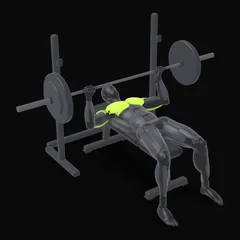
A heavy press. The barbell bench press lets you use the most weight and is easy to progress. Dumbbells give a longer range of motion and let each arm move naturally. Either works as your main lift. For technique, see how to bench press.
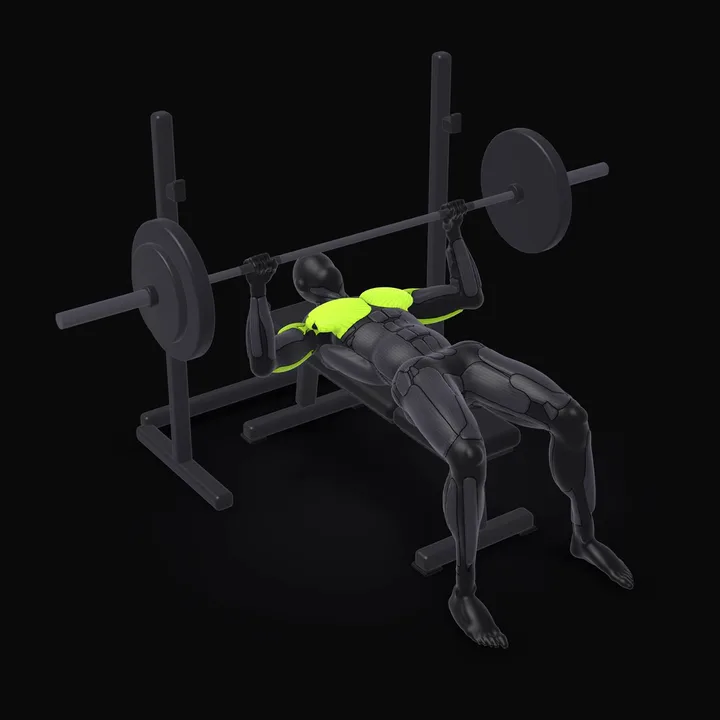 Barbell Bench PressLie on the bench with your eyes under the bar and your feet planted on the floor. Grip the bar slightly wider than shoulder width and pull your shoulder blades back and down.How to do the Barbell Bench Press →
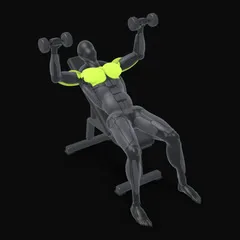
An incline press. The incline dumbbell press is the most popular upper-chest builder for good reason: deep stretch, natural path, easy on the shoulders.
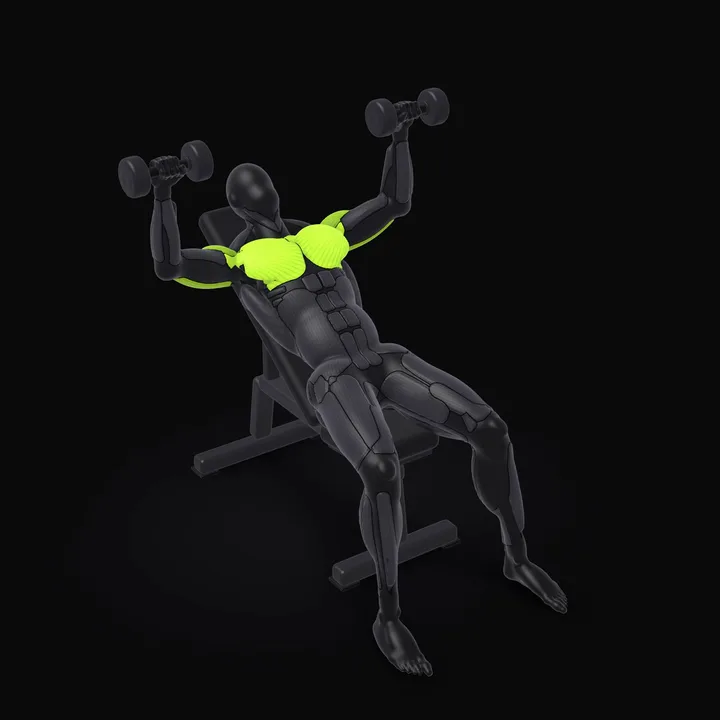 Dumbbell Incline Bench PressSet the bench to 30–45 degrees and lie back with the dumbbells at shoulder height. Keep your feet on the floor and your back against the bench.How to do the Dumbbell Incline Bench Press →
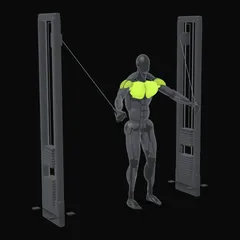
A fly. Cable flyes, the pec deck or dumbbell flyes train the chest without the triceps limiting the set. They load the pecs in a stretched position, which is where muscle tends to get a strong growth signal. Use a weight you can control for 10–15 reps.
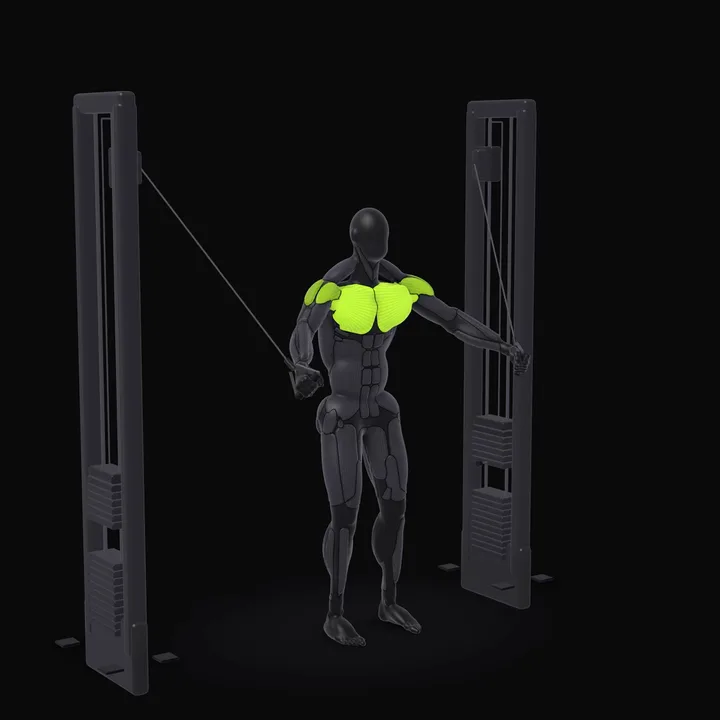 Cable FlySet the pulleys high, take a handle in each hand and step forward. Lean slightly forward with your elbows softly bent.How to do the Cable Fly →
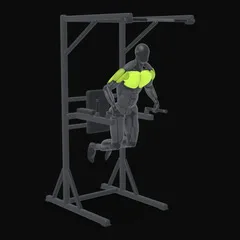
Push-ups and dips. Push-ups aren’t just for beginners. When matched for effort, band-loaded push-ups built strength similarly to the bench press (Calatayud et al., 2015). They make a great finisher or a home alternative; how to do push-ups correctly covers form and harder variations. Dips with a slight forward lean hit the lower chest hard, if your shoulders tolerate them.
How many sets for chest per week?
Research on training volume found that more weekly sets lead to more growth, with 10 or more sets per muscle per week outperforming lower volumes (Schoenfeld et al., 2017). For chest:
| Training level | Hard chest sets per week |
|---|---|
| Beginner (under 1 year) | 6–10 |
| Intermediate | 10–16 |
| Advanced | 14–20, if you recover well |
Split it over two sessions: for example 6–8 sets on Monday and 6–8 on Thursday. Count only hard sets (within about 1–3 reps of failure), not warm-ups. Triceps pushdowns don’t count toward chest, but shoulder presses count a little toward the upper chest. More on counting in how many sets per muscle per week.
A complete chest day
If you train chest twice a week, run this as session 1 and use the variation below as session 2.
Session 1: flat focus
| Exercise | Sets × reps | Rest |
|---|---|---|
| Bench press | 4 × 5–8 | 2–3 min |
| Incline dumbbell press (30°) | 3 × 8–12 | 2 min |
| Cable fly | 3 × 12–15 | 60–90 s |
Session 2: incline focus
| Exercise | Sets × reps | Rest |
|---|---|---|
| Incline barbell press | 3 × 6–10 | 2–3 min |
| Machine chest press or dips | 3 × 8–12 | 2 min |
| Pec deck or low-to-high cable fly | 2 × 12–15 | 60 s |
That’s 16 hard sets a week, at the upper end for an intermediate. Beginners can use 2 sets per exercise. These sessions slot into an upper body day or a push day; the push pull legs workout plan shows one way to build a whole week around them.
Technique that makes the chest do the work
- Shoulder blades back and down. Pinch them together and down before you unrack. This keeps your chest high and your shoulders safe.
- Elbows at roughly 45–70° from your sides, not flared straight out. Flared elbows shift stress to the shoulders.
- Control the lowering. Two to three seconds down, a light touch on the chest, then press. Bouncing robs the pecs of tension right where it matters.
- Full range on dumbbell presses and flyes. Let your elbows travel a bit below the bench level at the bottom if your shoulders are comfortable.
- Think about squeezing your arms together rather than pushing the weight up. It sounds like a gimmick; it helps many lifters feel their chest on flyes and machine presses.
Progress, or nothing happens
Your chest grows when you ask it to do more over time. Use double progression: hit the top of your rep range on every set, then add the smallest weight step (2.5 kg / 5 lb on a barbell, the next pair on dumbbells). If your bench press, incline press and fly numbers all trend up over a couple of months, your chest is growing, whatever the mirror says on a given day. If they’re flat, the article on how to increase bench press has a plan to get them moving.
Common reasons a chest won’t grow
- Only one exercise. Bench press alone leaves the upper chest under-trained and lets triceps limit your sets.
- Too few hard sets. Six easy sets a week won’t do much. Count your hard sets honestly.
- Half reps. Stopping 10 cm above your chest takes away the most productive part of the movement.
- Not eating enough. Building muscle takes protein and, for most people, enough total food. The pillar guide on how to build muscle covers the rest of the picture.
- Impatience. Chest size builds over months and years, not weeks.
Frequently asked questions
How many times a week should I train chest?
Twice a week works well for most people. Splitting 10 to 16 weekly sets across two sessions keeps each set high quality. Once a week can work if you get enough sets in, but twice is easier to recover from and usually more productive.
Is incline or flat bench better for chest growth?
Both. Flat pressing hits the middle and lower chest most, while a 30-degree incline shifts more work to the upper chest. Including at least one of each in your week covers the whole muscle.
Can I build chest with push-ups only?
Yes, up to a point. Push-ups build the chest similarly to the bench press when the effort is comparable. Once you can do more than about 25 to 30, make them harder with deficit, decline, weighted or slow-tempo variations.
Why does my bench press go up but my chest doesn't grow?
Usually because your shoulders and triceps are doing most of the work, often from pressing with a short range of motion or flared elbows. Control the lowering, touch your chest, and add a fly variation that loads the pecs in a stretch.
How long does it take to build a bigger chest?
Noticeable changes usually take two to three months of consistent training with enough protein. Real size differences build over a year or more. Track your pressing numbers; if they go up steadily, your chest is growing.
Sources
- Rodríguez-Ridao D, Antequera-Vique JA, Martín-Fuentes I, Muyor JM (2020). Effect of Five Bench Inclinations on the Electromyographic Activity of the Pectoralis Major, Anterior Deltoid, and Triceps Brachii during the Bench Press Exercise. International Journal of Environmental Research and Public Health
- Schoenfeld BJ, Ogborn D, Krieger JW (2017). Dose-response relationship between weekly resistance training volume and increases in muscle mass: A systematic review and meta-analysis. Journal of Sports Sciences
- Calatayud J, Borreani S, Colado JC, Martin F, Tella V, Andersen LL (2015). Bench press and push-up at comparable levels of muscle activity results in similar strength gains. Journal of Strength and Conditioning Research