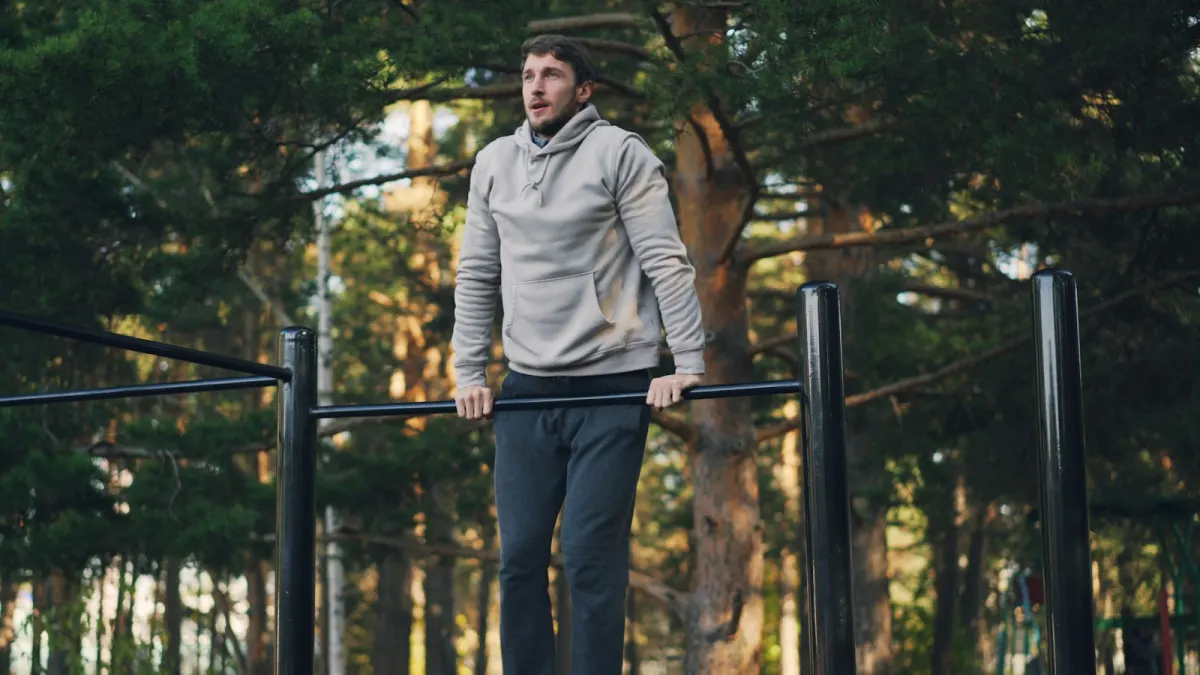
Calisthenics for beginners comes down to four movements (push-ups, pull-ups, dips and squats) and a ladder of progressions for each, from easy versions anyone can do to hard ones that build serious strength. You start at the rung that challenges you for 5–12 reps, train three times a week, and step up when you hit a clear target. Below are those ladders with the exact standards for moving on, plus a weekly plan that gets most beginners to their first pull-up.
Why calisthenics works
Your muscles respond to tension and effort, not to the kind of equipment. Push-ups are the best-studied example: band-loaded push-ups produced strength gains similar to the bench press when muscle activity was matched (Calatayud et al., 2015), and progressing through harder push-up variations improved bench press strength about as much as training the bench press itself in a four-week study (Kotarsky et al., 2018).
The trick in calisthenics is that you can’t add 2.5 kg. You make an exercise harder by changing leverage (feet higher, hands closer, one arm or one leg instead of two), range of motion or tempo. That’s why progressions are everything.
What you need
- A pull-up bar. A doorway bar at home, or a park or gym bar.
- Somewhere to dip. Parallel bars, a dip station, or the corner of a kitchen counter for the easiest version.
- Optional: a resistance band (for assisted pull-ups), gymnastic rings later.
If you have no bar at all yet, the home workout without equipment gives you a no-gear plan to start with.
The four progression ladders
For each exercise, find the hardest level you can do for at least 3 sets of 5 clean reps. That’s your starting point. Move up one level when you hit the “move on” target.
Push-up ladder
| Level | Exercise | Move on at |
|---|---|---|
| 1 | Incline push-up (hands on a bench or bar) | 3 × 15 |
| 2 | Knee push-up | 3 × 15 |
| 3 | Push-up | 3 × 20 |
| 4 | Decline push-up | 3 × 15 |
| 5 | Close-grip push-up | 3 × 15 |
| 6 | Pike push-up (shoulder focus), then toward handstand push-ups | ongoing |
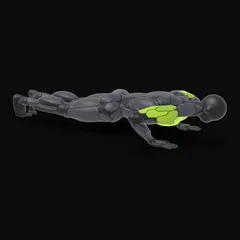
A good push-up has your body in a straight line from head to heels, elbows angled about 45° from your sides, chest touching the floor (or close to it) on every rep. More detail in how to do push-ups correctly.
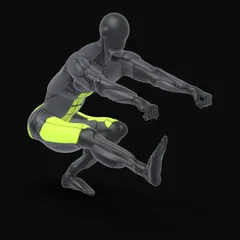
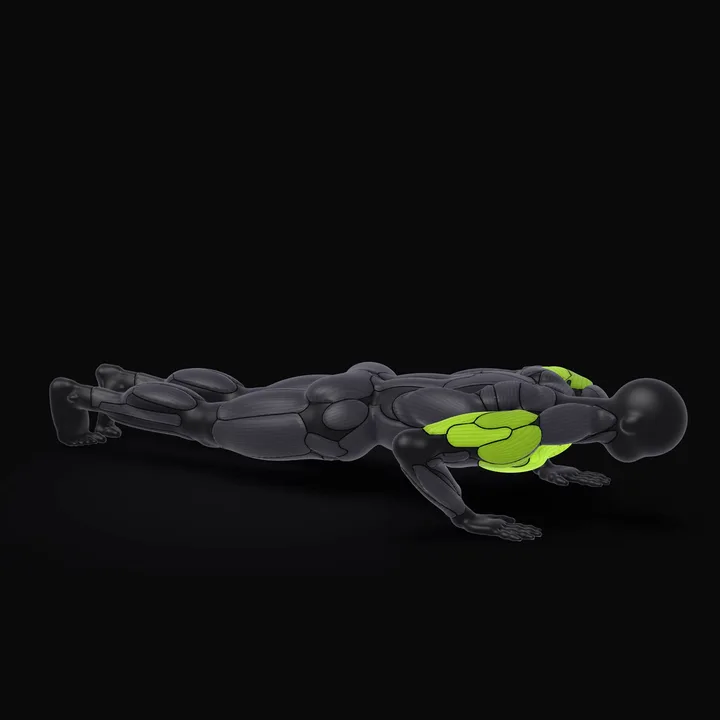 Push-upPlace your hands on the floor slightly wider than your shoulders and form a straight line with your body. Brace your abs and glutes so your lower back doesn't sag.How to do the Push-up →
Pull-up ladder
| Level | Exercise | Move on at |
|---|---|---|
| 1 | Dead hang + scapular pull-ups | 3 × 30 s hang and 3 × 10 scap pulls |
| 2 | Inverted row (bar at hip height) | 3 × 12 |
| 3 | Negative pull-up (jump up, lower in 3–5 s) | 3 × 5 slow negatives |
| 4 | Band-assisted pull-up | 3 × 8 with a light band |
| 5 | Pull-up or chin-up | 3 × 8–10 |
| 6 | Weighted pull-up or harder variations | ongoing |
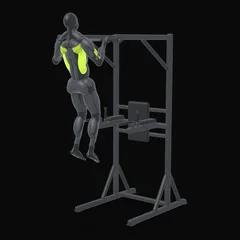
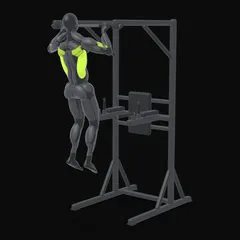
Chin-ups (palms facing you) are usually a bit easier than pull-ups, so many people get their first chin-up a few weeks before their first pull-up. Both count. The full path is in how to do pull-ups.
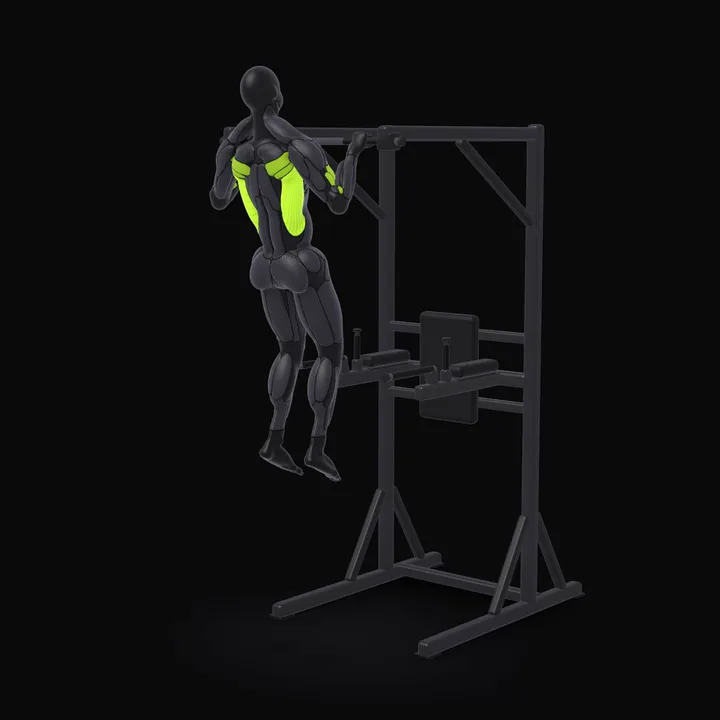 Pull-upGrab the bar with palms facing forward, hands slightly wider than your shoulders. Hang with straight arms and brace your core.How to do the Pull-up →
Dip ladder
| Level | Exercise | Move on at |
|---|---|---|
| 1 | Bench dip, feet on the floor, knees bent | 3 × 15 |
| 2 | Support hold on parallel bars (arms straight, shoulders down) | 3 × 30 s |
| 3 | Negative dips (lower in 3–5 s) | 3 × 5 |
| 4 | Parallel bar dip | 3 × 10–12 |
| 5 | Weighted dip or ring dips | ongoing |
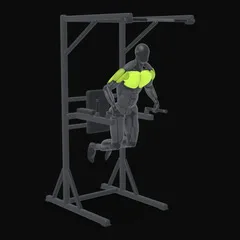
Go down until your upper arm is about parallel to the floor, not deeper at first. If the front of your shoulder complains, reduce the depth or stay on the previous level longer. See dips exercise for chest vs triceps versions.
Squat ladder
| Level | Exercise | Move on at |
|---|---|---|
| 1 | Bodyweight squat | 3 × 25 |
| 2 | Lunge | 3 × 15 per leg |
| 3 | Bulgarian split squat | 3 × 15 per leg |
| 4 | Cossack squat | 3 × 10 per side |
| 5 | Assisted pistol squat (holding a pole) | 3 × 8 per leg |
| 6 | Pistol squat | ongoing |
Legs are the weak spot of pure calisthenics: they’re strong, and two-legged exercises get easy quickly. Spend plenty of time on split squats, and add Nordic curls or single-leg glute bridges for the back of your legs.
Core: the hollow body
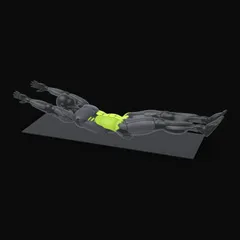
Hollow body holds teach the full-body tension every calisthenics skill needs. Start with knees bent, then legs straight, aiming for 3 × 30–45 seconds. Add hanging knee raises once your grip and shoulders are comfortable on the bar.
The beginner calisthenics plan
Three sessions a week, for example Monday, Wednesday and Friday. Use your current level on each ladder.
| Order | Exercise | Sets × reps | Rest |
|---|---|---|---|
| 1 | Pull-up ladder | 3–4 × 5–10 | 2 min |
| 2 | Push-up ladder | 3–4 × 6–15 | 90 s |
| 3 | Squat ladder | 3 × 8–15 per leg | 90 s |
| 4 | Dip ladder | 3 × 5–12 | 2 min |
| 5 | Row (inverted row, if pull-ups aren’t there yet) | 2 × 8–12 | 90 s |
| 6 | Hollow body hold | 3 × 20–45 s | 60 s |
Pulling comes first because it’s usually the weakest pattern for beginners and benefits most from fresh energy. Sessions take about 40–50 minutes.
On non-training days, 5 minutes of dead hangs and a few slow negatives speed up your first pull-up, as long as they don’t leave your elbows sore.
The 8-minute warm-up
Bodyweight work looks gentle, but hanging, dipping and pressing through your wrists put a lot of stress on small joints. Warm them up before the first working set:
- 2 minutes of easy movement: jumping jacks, skipping or a brisk walk to the bar.
- Shoulders: 15 arm circles each direction, then 15 band pull-aparts if you have a band.
- Wrists: on hands and knees, rock gently forward and back over your palms for 30 seconds, then do the same with the backs of your hands on the floor.
- Scapula: 10 scapular pull-ups on the bar and 10 scapular push-ups (keep arms straight, let your chest sink between your shoulder blades, then push away).
- One ramp-up set of your first exercise at an easier level, for about half your usual reps.
If your elbows tend to ache, add a 20-second dead hang before your first pulling set.
Swapping exercises when equipment is missing
| If you don’t have | Do this instead |
|---|---|
| A pull-up bar | Inverted rows under a sturdy table, plus towel rows around a door handle |
| Dip bars | Bench dips, then dips between two solid chairs or the corner of a kitchen counter |
| A bench for split squats | Rear foot on a sofa, a step or the bottom stair |
| A resistance band | More negatives and a 2-second pause at the top of each assisted rep with your feet on a chair |
| Anywhere to hang for core work | Planks and side planks next to your hollow holds |
How to progress, week to week
- Add reps within your target range on every session you can.
- Hit the “move on” standard, then step up one level. Your reps will drop; that’s expected.
- Use tempo when stuck between levels. A 3-second lowering and a 1-second pause at the bottom bridge big gaps, such as between knee push-ups and full push-ups.
- Mix levels in one session if needed. Do your first two sets at the new level and finish with the old one for more total reps.
This is progressive overload without plates. It only works if you write down the variation, the reps and the tempo for each set.
What your first four weeks can look like
Here is a typical start for someone who can do 6 knee push-ups, no pull-ups, a few bench dips and plenty of squats. Numbers are per set, three sessions a week.
| Week | Pull | Push | Legs | Dip |
|---|---|---|---|---|
| 1 | Inverted row 3 × 8 | Knee push-up 3 × 8 | Lunge 3 × 10 per leg | Bench dip 3 × 10 |
| 2 | Inverted row 3 × 10 | Knee push-up 3 × 11 | Lunge 3 × 13 per leg | Bench dip 3 × 13 |
| 3 | Inverted row 3 × 12, so add 3 × 3 negatives | Knee push-up 3 × 14 | Lunge 3 × 15: move on | Bench dip 3 × 15: move on |
| 4 | Negatives 3 × 4 + rows 2 × 10 | Knee push-up 3 × 15: move on | Bulgarian split squat 3 × 8 per leg | Support hold 3 × 20 s |
Reps rarely go up evenly: some sessions you add three, some none. What matters is the trend over two or three weeks.
When you miss your reps
You’ll have days where the numbers go backwards. Use these rules instead of guessing:
- One bad session: repeat the same targets next time. Sleep, food and stress explain most single off days.
- Two sessions in a row with fewer reps: drop one set from every exercise for a week, then build back up.
- Stuck at the same reps for three weeks: switch to tempo work on that exercise (3 seconds down, 1-second pause) for two weeks, or split the gap with a halfway variation, such as push-ups with your hands on a low step instead of a bench.
- A level feels impossible: go back one level, do it with a slower tempo and higher reps, and try the new level again in two weeks.
Deload every 6–8 weeks
Every 6–8 weeks, or sooner if your joints feel beaten up, take an easier week: same exercises and levels, but only 2 sets each, stopping 3–4 reps short of failure. You’ll usually come back stronger the week after. The deload week guide explains why it works and how to spot when you need one early.
Realistic milestones for year one
| Timeline | Typical milestone |
|---|---|
| 1–2 months | 10+ full push-ups, first negatives and assisted pull-ups, 30 s hollow hold |
| 3–6 months | First pull-up, first full dips, Bulgarian split squats for 15 per leg |
| 6–12 months | 8–10 pull-ups, 10–15 dips, 25+ push-ups, first assisted pistol squats |
Everyone’s timeline is different: heavier and newer lifters take longer on pull-ups and dips, lighter people often fly through them. Compare yourself with last month, not with someone online.
Adapting the plan to your week
Only two days a week? Keep the same session, but do 4 sets of the pull and push ladders and 3 of everything else. Leave at least two days between sessions. Progress will be a little slower, not stalled.
Four days a week? Split it into upper (pull, push, dip, row, core) and lower (squat ladder, Nordic curls or single-leg glute bridges, glute bridges, hollow hold), each twice a week. This works well once full-body sessions start running past an hour.
Heavier beginner? Start pull-ups and dips lower on the ladder and spend longer on inverted rows, negatives and support holds. They build the same strength with less load on your elbows and shoulders, and your first full pull-up will come.
What comes after the beginner phase
Once you can do 8–10 pull-ups, 10–15 dips and 25 push-ups, the beginner ladders stop being enough. You have three directions, and you can mix them:
- Add weight. A dip belt or a backpack with books turns pull-ups and dips into lifts you can load by 2.5 kg at a time, exactly like barbell training. This is the most reliable way to keep getting stronger and bigger.
- Harder leverage. Archer push-ups, ring work, pistol squats and L-sits keep things bodyweight-only but demand more strength and control.
- Skills. Handstands, muscle-ups and levers. Give each one its own practice slot at the start of a session, when you’re fresh, and keep your strength work after it.
If you want to add a barbell and dumbbells at some point, everything you’ve built carries over: strong pull-ups and dips make the bench press, rows and overhead work feel familiar from day one.
Beginner mistakes to avoid
- Chasing skills too early. Muscle-ups and front levers need a strength base. Kipping into them before you have it is how elbows and shoulders get hurt.
- Half reps. Partial pull-ups and shallow push-ups feel like progress but don’t build the strength the next level needs.
- Training the same muscles every day. Push-ups daily feel productive, but your muscles grow during recovery.
- Ignoring legs. Bodyweight squats forever won’t do it. Get to split squats and single-leg work.
- Never resting a sore joint. Pushing through elbow or wrist pain for weeks turns a small irritation into a long break.
Frequently asked questions
Can you build muscle with calisthenics?
Yes. Studies show push-up training can build strength similar to bench pressing when the difficulty is matched. The key is progressing to harder variations once an exercise gets easy, just as you'd add weight to a bar.
What equipment do I need to start calisthenics?
A pull-up bar and somewhere to do dips (parallel bars, a dip station, or two sturdy chairs for the easiest version). Gymnastic rings and resistance bands are useful later but not required. Many parks have both bars for free.
How long does it take to do a first pull-up?
For most beginners, somewhere between a few weeks and a few months of consistent practice, depending on starting strength and body weight. Negatives, rows and assisted pull-ups two or three times a week get almost everyone there.
How often should a beginner do calisthenics?
Three full-body sessions a week with a rest day between them. Bodyweight training is easier on the joints than heavy lifting, but your muscles and tendons still need time to adapt.
Should I learn handstands and muscle-ups as a beginner?
Build the basics first: 10 good pull-ups, 10 dips and 20 push-ups give you the strength base that makes advanced skills much easier and safer to learn. Wall-supported handstand holds are fine to practice early.
Sources
- Kotarsky CJ, Christensen BK, Miller JS, Hackney KJ (2018). Effect of Progressive Calisthenic Push-up Training on Muscle Strength and Thickness. Journal of Strength and Conditioning Research
- Calatayud J, Borreani S, Colado JC, Martin F, Tella V, Andersen LL (2015). Bench press and push-up at comparable levels of muscle activity results in similar strength gains. Journal of Strength and Conditioning Research