Most effective workouts last 45 to 75 minutes, including a short warm-up. That’s enough for 12–20 hard sets with the rest periods that heavy lifting needs. There’s nothing magical about the one-hour mark: a 40-minute session of dense, hard sets can be excellent, and a 90-minute session can be fine if it’s productive. What matters is how many good sets you do, not how long you spend in the building. Below is how to estimate your session length, where the time actually goes, and how to make workouts shorter without making them worse.
How long is a typical workout?
| Session type | Hard sets | Typical length |
|---|---|---|
| Short full body or “minimum effective” | 8–12 | 30–45 min |
| Standard full body or upper/lower | 14–20 | 50–75 min |
| Push/pull/legs or high-volume split day | 16–22 | 60–80 min |
| Powerlifting-style heavy day | 10–15 (long rests) | 75–100 min |
Where the time actually goes
Let’s do the maths for a standard session of 16 hard sets:
| Part | Time |
|---|---|
| General warm-up | 5 min |
| Warm-up sets for the first exercise | 5–8 min |
| 16 working sets, about 45 s each | 12 min |
| Rest: 6 sets × 2.5 min (compounds) + 10 sets × 1.5 min (others) | 30 min |
| Setting up, changing weights, moving between stations | 5–10 min |
| Total | about 60–65 min |
Notice that the actual lifting takes only about 12 minutes. Rest periods take more than half of the session. That’s not wasted time: longer rest between sets let lifters do more reps and produced more strength and muscle growth than very short rest in trained men (Schoenfeld et al., 2016). The detail on rest is in how long to rest between sets.
The one-hour myth
You’ve probably heard that you should never train for more than an hour because cortisol rises and testosterone drops, turning the session “catabolic”. There’s no evidence of a switch that flips at 60 minutes. Short-term hormonal ups and downs during a session aren’t what decides your muscle growth; the training stimulus and your recovery are.
Where the myth has a grain of truth: very long sessions often contain lots of low-quality sets at the end, when you’re tired and unfocused. If your last exercises are sloppy and half-hearted, cutting them or moving them to another day will help. That’s about quality, not a timer.
Why sessions run too long
- Too many exercises. Eight to ten exercises per session usually means several are low priority.
- Very long rests on isolation work. Two minutes is plenty for curls and raises.
- Unplanned workouts. Deciding what to do next takes minutes each time.
- Waiting for equipment. Peak hours in a crowded gym can add 15 minutes.
- Phone time. The three-minute rest that becomes six.
- Too much warm-up. A 25-minute warm-up routine for a 45-minute lifting session.
How to shorten your workouts without losing results
A review on time-efficient training concluded that strength and muscle can be built with relatively short sessions by prioritising compound and machine exercises, using supersets, and training close to failure (Iversen et al., 2021). Practical ways to apply that:
- Superset non-competing exercises, like a press and a row, or curls and pushdowns. You rest one muscle while working the other.
- Warm up specifically. Ramp-up sets for your first exercise only; later exercises need one lighter set at most.
- Plan the session beforehand, including target weights and reps.
- Use a timer for rest, so 2 minutes stays 2 minutes.
- Choose quick-to-load equipment (dumbbells, cables, machines) for accessories.
- Split volume across more days. Four 45-minute sessions often beat three 75-minute ones.
For ready-made short sessions, see the 30 minute gym workout and the techniques in supersets and drop sets.
Is a longer workout ever better?
Sometimes, yes:
- Heavy strength work needs longer rests (3–5 minutes) between near-maximal sets.
- Very high-volume phases for advanced lifters may need 75–90 minutes if spread over fewer days.
- Combined sessions, like lifting plus a separate conditioning block, naturally run longer.
The question to ask isn’t “is this too long?”, but “are my last sets still good?” If performance and focus fall off a cliff in the last 20 minutes, move that work elsewhere.
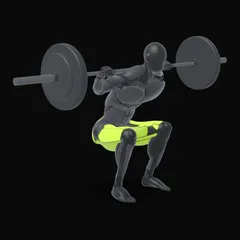
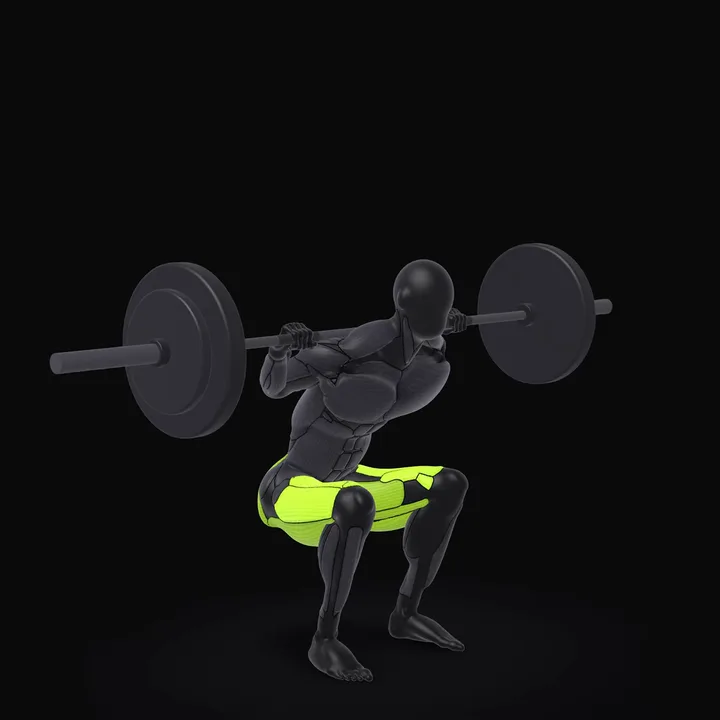 Barbell SquatPlace the bar on your upper back, not on your neck, and step out of the rack. Stand with feet slightly wider than shoulder width, toes turned out a little.How to do the Barbell Squat →
Sample session lengths by goal
| Goal | Session plan | Approximate length |
|---|---|---|
| Beginner, full body 3×/week | 5 exercises, 13–15 sets | 45–60 min |
| Muscle, upper/lower 4×/week | 6 exercises, 16–18 sets | 60–70 min |
| Strength, 3×/week | 2 main lifts + 2 accessories, 12–14 sets | 70–90 min (longer rests) |
| Busy schedule | 4–6 exercises in supersets, 12–16 sets | 30–45 min |
| Maintenance phase | 3–4 exercises, 8–10 sets | 30–40 min |
These assume you know what you’re doing next and rest with a timer. Add 10–15 minutes if your gym is crowded at the time you train.
Shorter vs more frequent sessions
If you have five hours a week, you can do three 100-minute sessions or five 60-minute sessions. The second is usually better: fresher sets, each muscle trained more often, fewer junk sets at the end. When choosing a schedule, think about total weekly time and spread it out. How many days a week to work out covers how to pick.
Common mistakes
- Cutting rest on heavy compounds to save time. Supersets save time without hurting your main lifts.
- Adding exercises “while you’re here”. Every extra exercise lengthens the session and dilutes focus.
- Treating the gym as a social hour. Fine sometimes, but know that’s why it took two hours.
Frequently asked questions
Is a 1 hour workout enough to build muscle?
Yes. An hour is enough for a full session of 15 to 20 hard sets with proper rest. Most effective programs run 45 to 75 minutes per session.
Is a 2 hour workout too long?
Usually, yes, unless it includes a long warm-up, mobility work, cardio or a lot of socialising. If your lifting alone takes two hours, you're probably doing more sets than you can do well, or resting much longer than needed.
Does testosterone drop after an hour of lifting?
There's no hard cut-off where your workout suddenly stops working at the 60-minute mark. Hormone fluctuations during a session don't decide your muscle growth. Session length matters only in terms of how many productive sets you can do with good effort.
How long should I rest between sets?
About 2 to 3 minutes for heavy compound lifts and 1 to 2 minutes for isolation exercises. Rest is often the biggest variable in session length.
Should cardio count in my workout time?
Count it separately. A 60-minute lifting session plus 20 minutes of cardio is fine; just don't let cardio squeeze out the rest periods your lifting needs.
Sources
- Iversen VM, Norum M, Schoenfeld BJ, Fimland MS (2021). No time to lift? Designing time-efficient training programs for strength and hypertrophy: a narrative review. Sports Medicine
- Schoenfeld BJ, Pope ZK, Benik FM, Hester GM, Sellers J, Nooner JL, et al. (2016). Longer interset rest periods enhance muscle strength and hypertrophy in resistance-trained men. Journal of Strength and Conditioning Research