For most people, three to four days a week of strength training is the sweet spot: enough to train every muscle at least twice a week and build muscle and strength steadily, with enough rest days to recover. Two days still works, especially for beginners or busy weeks; five or six days can help advanced lifters fit in more volume. For general health, the minimum is two days of muscle-strengthening work a week. Below are recommendations by goal and schedule, and sample weeks for every option.
The quick answer by goal
| Goal | Strength training days per week | Notes |
|---|---|---|
| General health | 2+ | Plus 150–300 min of moderate aerobic activity |
| Building muscle (beginner) | 2–3 | Full body |
| Building muscle (intermediate) | 3–5 | Full body, upper/lower or PPL |
| Getting stronger | 3–4 | Practise the main lifts 2–3 times a week |
| Fat loss | 2–4 | Lifting keeps muscle; diet does the fat loss |
| Maintaining during a busy period | 1–2 | Keep loads heavy |
For health, the World Health Organization recommends that adults do muscle-strengthening activities on two or more days a week, alongside 150–300 minutes of moderate aerobic activity (or 75–150 minutes vigorous) (Bull et al., 2020).
What the research says about frequency
For muscle growth, training a muscle twice a week has outperformed once a week (Schoenfeld et al., 2016). But when total weekly volume is equal, it doesn’t seem to matter much whether you spread it over two, three or more sessions (Schoenfeld et al., 2019). For strength, more frequent training led to bigger gains, largely because it allowed more total volume (Grgic et al., 2018).
So the number of days is mostly a tool for fitting in enough quality work. If you need 12–16 hard sets per muscle per week, that’s easier to do well over three or four sessions than crammed into one or two. The ranges are explained in how many sets per muscle per week.
Sample weeks for every schedule
2 days a week
| Mon | Tue | Wed | Thu | Fri | Sat | Sun |
|---|---|---|---|---|---|---|
| Full body A | — | — | Full body B | — | — | — |
Great for beginners and busy weeks. The 2 day workout plan has the full sessions.
3 days a week
| Mon | Tue | Wed | Thu | Fri | Sat | Sun |
|---|---|---|---|---|---|---|
| Full body | — | Full body | — | Full body | — | — |
The classic, and the best default for most people. See the beginner gym workout plan or, if you’ve been training for a while, the full body workout plan.
4 days a week
| Mon | Tue | Wed | Thu | Fri | Sat | Sun |
|---|---|---|---|---|---|---|
| Upper | Lower | — | Upper | Lower | — | — |
Ideal for intermediates. Every muscle twice a week, sessions of about an hour. The 4 day workout split has the full program.
5 days a week
| Mon | Tue | Wed | Thu | Fri | Sat | Sun |
|---|---|---|---|---|---|---|
| Upper | Lower | Push | Pull | Legs | — | — |
More volume for people who enjoy training and recover well.
6 days a week
| Mon | Tue | Wed | Thu | Fri | Sat | Sun |
|---|---|---|---|---|---|---|
| Push | Pull | Legs | Push | Pull | Legs | — |
Push/pull/legs twice. Suits experienced lifters with time and good recovery.
How to choose your number of days
Ask yourself three questions:
- How many days can I protect for the next three months? Not your best week, your normal week.
- How long can each session be? Fewer days means longer sessions to fit the same volume.
- How experienced am I? Beginners progress on 2–3 days; more advanced lifters often need more total volume.
If you’re torn between two options, pick the lower one. Hitting four out of four planned sessions every week beats hitting three out of five.
Where does cardio fit?
Cardio days are separate from strength days in the counts above. A good week for overall health and body composition might be three strength sessions plus two or three cardio sessions, or strength and cardio on the same day with the lifting first. Easy cardio (walking, cycling, swimming) barely affects your recovery from lifting; hard intervals and long runs do more, so keep those away from the day before heavy leg training.
If your time is limited and you must choose, strength training two or three days a week plus daily walking covers the basics of muscle, strength and heart health for most people.
Does age change the answer?
Not much. Lifters over 40 or 50 benefit from the same two to four sessions a week, with a rest day between hard sessions for the same muscles and a little more attention to warm-ups. Teenagers and beginners of any age do well on two or three full-body sessions. What changes with age is mainly how quickly you recover, so if you feel beaten up, choose fewer, better sessions rather than more.
Rest days
You need at least one or two full rest days a week, and some people do best with three. Rest days don’t have to be inactive: walking, easy cycling, mobility work or a sport you enjoy all help. What you want to avoid is training the same muscles hard on consecutive days. How many rest days do I need goes deeper.
Consistency is the real variable
The best number of days is the one you can keep up. Tracking your sessions on a calendar, with a weekly streak, is a simple way to see your actual frequency over months, which is often different from what you think it is.
Common mistakes
- Starting with six days as a beginner. Burnout or injury within a month is common. Start with three.
- Skipping legs on a busy week, every week. Rotate what you skip, or switch to a plan with fewer days.
- Back-to-back hard sessions for the same muscles. Space them 48–72 hours apart.
- Thinking more days means faster results. Only if the extra days add good sets you can recover from.
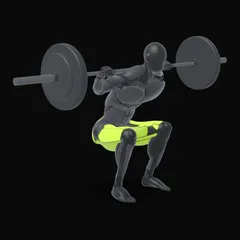
 Barbell SquatPlace the bar on your upper back, not on your neck, and step out of the rack. Stand with feet slightly wider than shoulder width, toes turned out a little.How to do the Barbell Squat →
Frequently asked questions
Is 3 days a week enough to build muscle?
Yes. Three full-body sessions a week train every muscle three times and let you reach 10 or more hard sets per muscle per week. It's enough for beginners and most intermediates to make steady progress.
Is it OK to lift weights every day?
You can train on most days if you rotate muscle groups and keep total volume sensible, as in a push/pull/legs split. But more days isn't automatically better; you need at least one or two rest days a week, and sessions should be productive, not just frequent.
How many days a week should a beginner work out?
Two to three days of strength training is ideal for beginners, with rest days in between. That's enough to progress quickly while your body adapts to training.
How many days a week should I work out to lose weight?
Fat loss depends mostly on diet. Lifting 2 to 4 days a week to keep your muscle, plus daily walking and some cardio, is a good combination. More gym days won't make up for eating more than you burn.
Do I need rest days?
Yes, at least one or two a week. Muscles adapt between sessions, not during them. Rest days can include walking, light cardio or mobility work.
Sources
- Schoenfeld BJ, Grgic J, Krieger J (2019). How many times per week should a muscle be trained to maximize muscle hypertrophy? A systematic review and meta-analysis of studies examining the effects of resistance training frequency. Journal of Sports Sciences
- Grgic J, Schoenfeld BJ, Davies TB, Lazinica B, Krieger JW, Pedisic Z (2018). Effect of Resistance Training Frequency on Gains in Muscular Strength: A Systematic Review and Meta-Analysis. Sports Medicine
- Bull FC, Al-Ansari SS, Biddle S, Borodulin K, Buman MP, Cardon G, Carty C, Chaput JP, et al. (2020). World Health Organization 2020 guidelines on physical activity and sedentary behaviour. British Journal of Sports Medicine
- Schoenfeld BJ, Ogborn D, Krieger JW (2016). Effects of Resistance Training Frequency on Measures of Muscle Hypertrophy: A Systematic Review and Meta-Analysis. Sports Medicine