Building noticeable muscle takes about 2–3 months of consistent training, and building a lot of it takes years. Beginners gain fastest: a man in his first year of good training might add roughly 0.5–1 kg (1–2 lb) of muscle per month, a woman about half that. The rate drops each year after. Below are realistic timelines by month and by year, how sex and age change them, and what speeds up or slows down your progress.
The first weeks: strength before size
In the first 2–6 weeks, most of your progress is your nervous system learning to use the muscle you already have. You get better at the movements and recruit more muscle fibres, so the weights go up fast even though your muscles haven’t grown much yet. That’s normal and a great sign: it’s the base for everything that follows.
Muscle size changes start early at the microscopic level, but they’re usually too small to see in the mirror for the first month or two. Many people also feel “fuller” quickly because trained muscles store more water and glycogen. That’s real, but it’s not new muscle tissue yet.
A realistic month-by-month timeline for beginners
| Timeframe | What you’ll typically notice |
|---|---|
| Weeks 1–4 | Strength going up almost every session; soreness fading; no visible change yet |
| Weeks 4–8 | Clothes fitting a little differently; muscles feel firmer |
| Weeks 8–12 | First visible changes in the mirror, especially shoulders, arms and chest |
| Months 3–6 | Others start noticing; photos side-by-side show clear differences |
| Months 6–12 | Substantial change if training and nutrition were consistent |
These are typical, not guaranteed. Someone training three times a week with good food and sleep will be at the faster end; someone training irregularly will be at the slower end.
How much muscle per year?
Exact rates are hard to measure, and they vary a lot between people. Coaches commonly use rules of thumb like these for men training well and eating enough:
| Training year | Approximate muscle gain per year |
|---|---|
| Year 1 | 6–12 kg (13–26 lb) |
| Year 2 | 3–6 kg (6–13 lb) |
| Year 3 | 2–3 kg (4–6 lb) |
| Year 4+ | 1–2 kg (2–4 lb) or less |
For women, divide these roughly in half. Treat them as rough expectations rather than scientific measurements; the general pattern of fast early gains that taper off is well established, the exact numbers are not.
Note that scale weight isn’t muscle. During a bulk, a sensible rate of total weight gain for beginners and intermediates is around 0.25–0.5 % of body weight per week (Iraki et al., 2019), and some of that will be fat and water. If you’re gaining much faster than that, most of the extra isn’t muscle. More on that in how to bulk.
Men vs women
Women build muscle at a similar rate to men relative to their starting point. A meta-analysis comparing men and women on the same training found similar relative gains in muscle size and lower-body strength, and larger relative gains in upper-body strength for women (Roberts et al., 2020). Because men usually start with more muscle, their absolute gains (in kilograms) are larger. This is also why the fear of “getting bulky” from lifting is mostly unfounded; see will lifting weights make me bulky.
Age
You can build muscle at any age. A meta-analysis of resistance training in adults over 50 found an average lean mass gain of about 1.1 kg over programs of around five months, with higher-volume programs producing more, and somewhat smaller gains in the oldest participants (Peterson et al., 2011). In your forties and fifties, expect gains a bit slower than at 25, and give recovery more attention. Weight training over 40 covers what to adjust.
What makes you build muscle faster (or slower)
| Factor | Faster | Slower |
|---|---|---|
| Training experience | New to lifting, or returning after a break | Many years of training |
| Effort | Sets close to failure | Easy sets, far from failure |
| Progression | Weights and reps going up | Same weights for months |
| Volume | 10–20 hard sets per muscle per week | Very few sets |
| Protein | About 1.6 g per kg body weight per day | Low protein |
| Calories | Small surplus | Large deficit |
| Sleep | 7–9 hours | 5–6 hours |
| Consistency | Rarely missing sessions | Weeks off regularly |
Returning lifters have an advantage: muscle you’ve built before comes back faster than it took to build the first time. That’s sometimes called “muscle memory”, and it’s why getting back into the gym after a break is often encouraging.
A realistic first year, in practice
Take a beginner who trains three times a week, eats around 1.6 g of protein per kg of body weight and gains weight slowly. A typical first year might look like this:
- Month 1: squat goes from the empty bar to 50–60 kg (110–130 lb) for sets of 8; bench from 30 kg to 45 kg (65 to 100 lb). Very little visible change.
- Month 3: shirts fit tighter across the shoulders and arms; friends ask if you’ve been training.
- Month 6: progress slows to small weekly jumps; photos next to month 0 show an obvious difference.
- Month 12: several kilos of new muscle, a clearly different physique, and the habit firmly in place.
Year two is slower, but by then you know how to train, how to eat and how to measure progress, which makes it far easier to keep going.
How to tell if you’re building muscle
The mirror is unreliable day to day. Better indicators:
- Your logbook. If you’re doing more reps with the same weight, or the same reps with more weight, on the same exercises, you’re very likely building muscle.
- Measurements. Arms, chest, waist and thighs, measured every 4 weeks at the same time of day.
- Photos. Same lighting, same pose, every 4 weeks.
- Body weight trend. A weekly average, not daily numbers.
Getting the most out of your time
The fundamentals are the same at every stage:
- Train each muscle about twice a week with hard sets.
- Get stronger over time.
- Eat enough protein and enough food.
- Sleep.
- Stay consistent for months and years.
All of this is laid out in the pillar guide on how to build muscle. The more consistently you apply it, the closer you’ll get to the faster end of the timelines above.
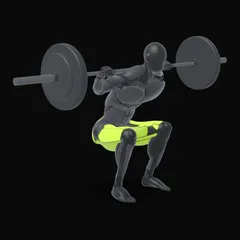
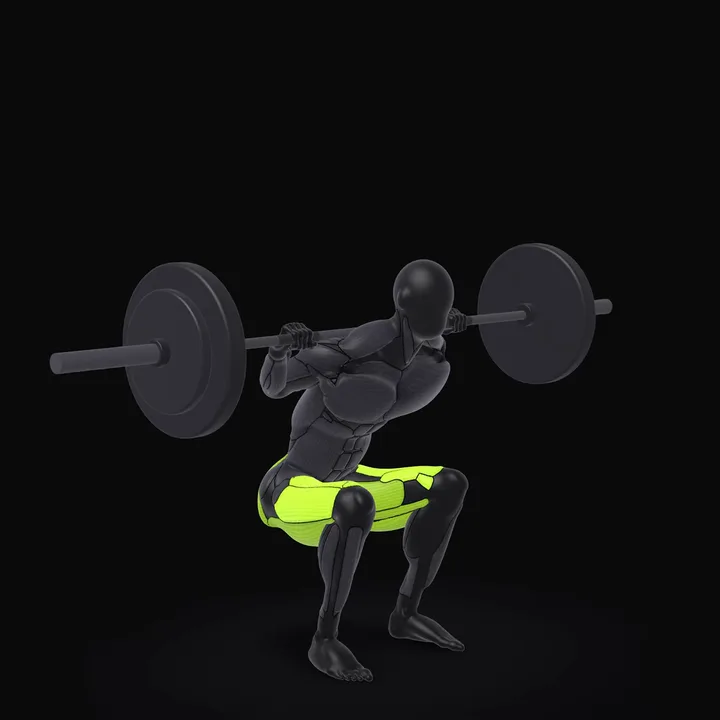 Barbell SquatPlace the bar on your upper back, not on your neck, and step out of the rack. Stand with feet slightly wider than shoulder width, toes turned out a little.How to do the Barbell Squat →
Frequently asked questions
How long until I see results from lifting?
You'll usually feel stronger within 2 to 4 weeks, mostly from your nervous system learning the movements. Visible changes in muscle size typically show up after 6 to 12 weeks of consistent training, and others tend to notice after 3 to 6 months.
How much muscle can you gain in a month?
A beginner man training and eating well might gain roughly 0.5 to 1 kg (1 to 2 lb) of muscle per month in the first year; a beginner woman about half that. After a few years, gains drop to a fraction of that. Scale weight can move faster because of water and fat.
Can you build muscle in 30 days?
You can start. A month of good training produces measurable changes in muscle size in beginners, but they're small. Think of the first month as building the habit and learning the lifts.
Why am I not building muscle after months of training?
The usual causes are sets that aren't hard enough, no progression in weights or reps, not enough protein or food, poor sleep, or inconsistent training. Check your logbook: if your numbers haven't gone up, your muscles probably haven't either.
Do women build muscle slower than men?
In absolute terms, yes, because men usually start with more muscle and have more testosterone. But relative to their starting size, women build muscle at a similar rate to men on the same programs.
Sources
- Roberts BM, Nuckols G, Krieger JW (2020). Sex Differences in Resistance Training: A Systematic Review and Meta-Analysis. Journal of Strength and Conditioning Research
- Peterson MD, Sen A, Gordon PM (2011). Influence of Resistance Exercise on Lean Body Mass in Aging Adults: A Meta-Analysis. Medicine & Science in Sports & Exercise
- Iraki J, Fitschen P, Espinar S, Helms E (2019). Nutrition Recommendations for Bodybuilders in the Off-Season: A Narrative Review. Sports