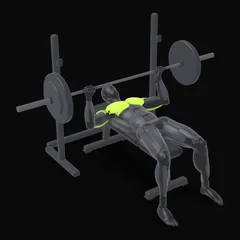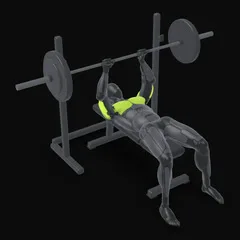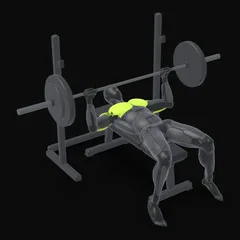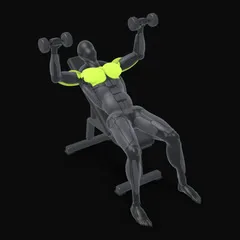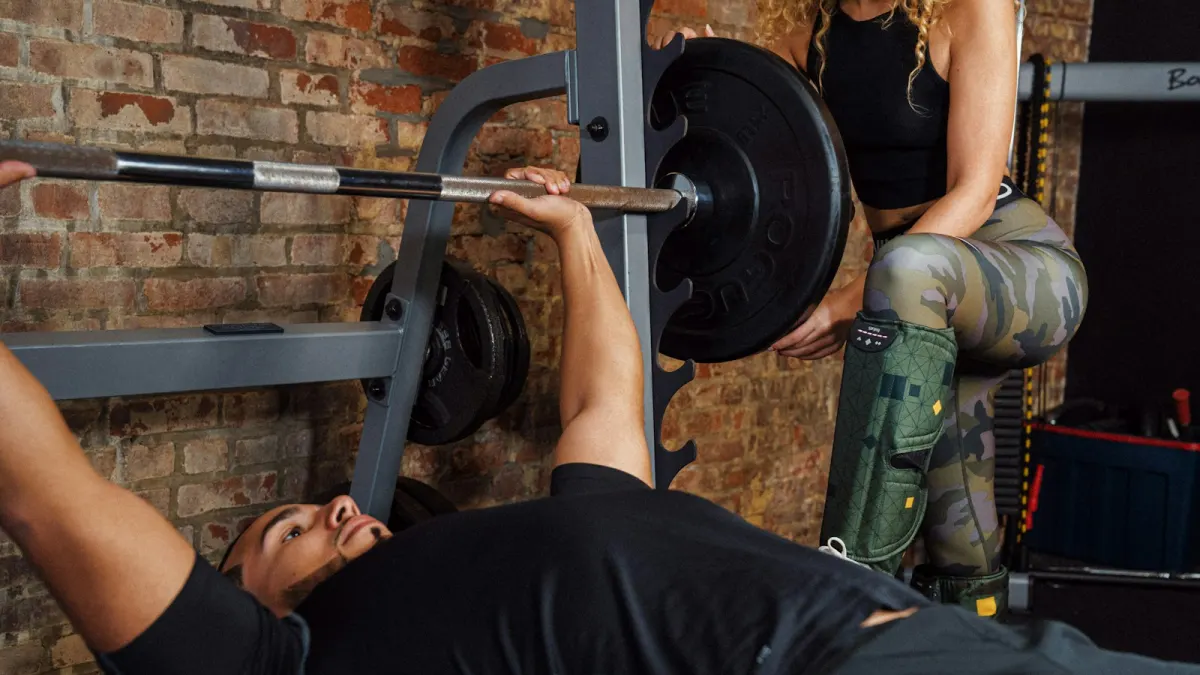
To increase your bench press, do four things: tighten your setup so every rep is the same, bench two or three times a week instead of once, include heavy sets of 3–6 alongside volume work, and strengthen whatever is holding you back (usually triceps or upper back). Then run a structured block and give it six weeks. Below is how to apply each of these, plus a complete 6-week plan with a heavy day, a volume day and a paused day.
Step 1: tighten your technique
The fastest bench gains often come from consistency, not muscle. If your setup changes from rep to rep, so does your strength. Check these:
- Shoulder blades squeezed back and down before you unrack, and kept there.
- Feet planted, driving into the floor; glutes stay on the bench.
- Grip where your forearms are vertical at the bottom.
- Bar path from over your shoulders down to your lower chest and back up in a slight arc.
- Elbows tucked to 45–70°, not flared to 90°.
- Brace with a big breath before each rep.
Full details are in how to bench press. Film a set from the side and the front; most people find one obvious fix.
Step 2: bench more often
A meta-analysis on training frequency found that more frequent training led to larger strength gains, largely because higher frequency allowed more total weekly volume (Grgic et al., 2018). For a skill-heavy lift like the bench press, frequent practice also sharpens technique.
If you currently bench once a week on “chest day”, moving to two or three sessions is often the single biggest change you can make. You don’t need to train harder each time; spread the same or slightly more sets over more days.
Step 3: use the right intensities
Strength gains are greatest with heavy loads, while muscle grows across a wide range (Schoenfeld et al., 2021). A good bench program uses both:
| Type | Reps | Effort | Purpose |
|---|---|---|---|
| Heavy | 3–6 | 1–2 reps in reserve | Strength, practice with heavy loads |
| Volume | 6–10 | 1–3 reps in reserve | Muscle, work capacity |
| Variation | 5–8 | 2 reps in reserve | Weak points, technique (pause, close grip) |
Rating how many reps you had left on each set helps you choose the right weights from day to day; that’s the idea behind the reps-in-reserve scale (Zourdos et al., 2016). See RPE and RIR explained if you’re new to it.
Step 4: fix your weak point
| Where you fail | Likely weak link | Best accessories |
|---|---|---|
| Off the chest | Chest, front delts, losing tightness | Paused bench, incline dumbbell press, dips |
| Halfway up | Triceps and shoulders | Close-grip bench, overhead press |
| At lockout | Triceps | Close-grip bench, board press, JM press, overhead extensions |
| Bar drifting, unstable | Upper back | Rows, face pulls, chest-supported rows |
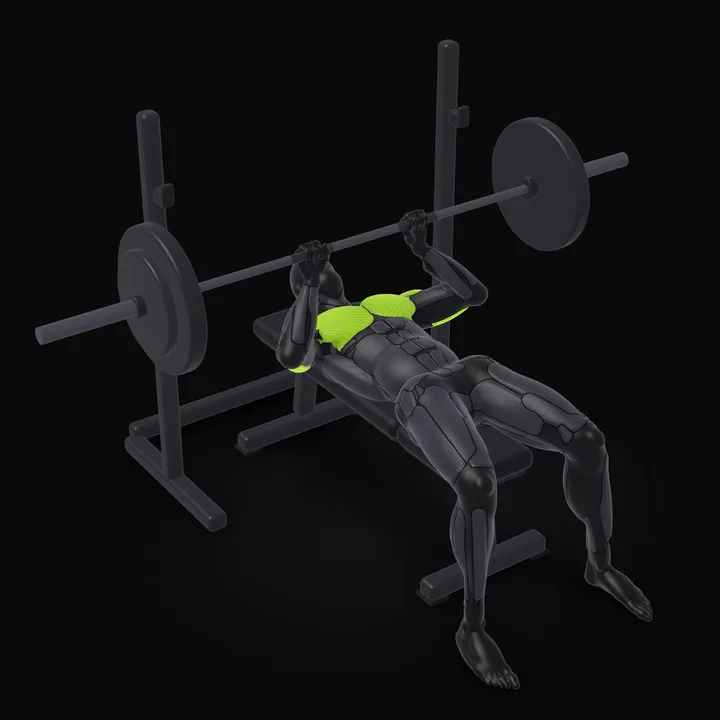 Barbell Close-grip Bench PressLie on the bench and grip the bar at shoulder width or slightly narrower. Lower the bar to your lower chest, keeping your elbows close to your body.How to do the Barbell Close-grip Bench Press →
Triceps are the most common limiter for intermediates. How to grow triceps has a full plan if that’s you.
The 6-week bench press plan
Three bench sessions a week, alongside the rest of your training (for example, Monday, Wednesday, Friday). Percentages are of your estimated one-rep max (e1RM). Not sure what your max is? Work up to a hard set of 5 and use the method in how to calculate one rep max.
Day 1: heavy
| Week | Bench press |
|---|---|
| 1 | 4 × 5 at 77.5 % |
| 2 | 4 × 4 at 80 % |
| 3 | 5 × 3 at 82.5 % |
| 4 | 4 × 4 at 82.5 % |
| 5 | 4 × 3 at 85 % |
| 6 | Work up to a heavy single at about 92–95 %, then test or stop |
Day 2: volume
| Week | Bench press | Accessory |
|---|---|---|
| 1 | 4 × 8 at 67.5 % | Incline dumbbell press 3 × 10 |
| 2 | 4 × 8 at 70 % | Incline dumbbell press 3 × 10 |
| 3 | 5 × 7 at 70 % | Incline dumbbell press 3 × 8 |
| 4 | 4 × 6 at 72.5 % | Incline dumbbell press 3 × 8 |
| 5 | 4 × 6 at 75 % | Incline dumbbell press 2 × 8 |
| 6 | 3 × 5 at 70 % (easy) | — |
Day 3: paused and close-grip
| Week | Paused bench (2 s on chest) | Close-grip bench |
|---|---|---|
| 1 | 3 × 4 at 70 % | 3 × 8 |
| 2 | 3 × 4 at 72.5 % | 3 × 8 |
| 3 | 4 × 3 at 75 % | 3 × 6 |
| 4 | 3 × 4 at 75 % | 3 × 6 |
| 5 | 3 × 3 at 77.5 % | 3 × 5 |
| 6 | Rest, or light technique work | — |
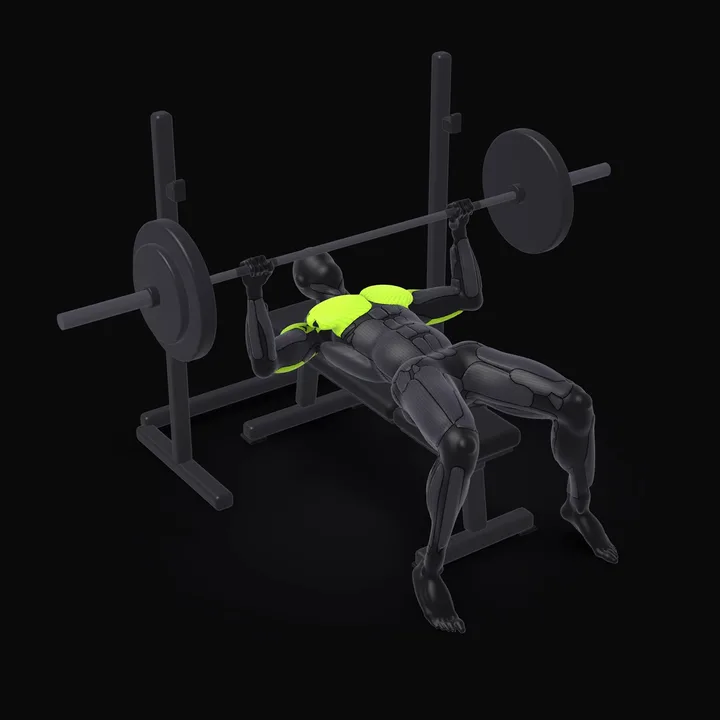 Barbell Powerlifting Bench PressBegin by lying on the bench, getting your head beyond the bar if possible. Tuck your feet underneath you and arch your back. Using the bar to help support your weight, lift your shoulder off the bench and retract them, squeezing the shoulder blades together. Use your feet to drive your traps into the bench. Maintain this tight body position throughout the movement. However wide your grip, it should cover the ring on the bar. Pull the bar out of the rack without protracting your shoulders. Focus on squeezing the bar and trying to pull it apart.How to do the Barbell Powerlifting Bench Press →
Add 3 sets of rows or face pulls to at least two of these days. Rest 3 minutes between heavy sets and 2 minutes on volume sets.
Warming up for heavy days
Use the same ramp every time so your heavy sets feel routine: 5 minutes of light cardio and 15 band pull-aparts, then the empty bar × 10, about 40 % × 5, 55 % × 3, 65 % × 2 and 75 % × 1 before your first set at 77.5 % or more. On volume days, stop the ramp at 55 %. Rest a minute between warm-up sets and longer before the first work set.
What it looks like with real numbers
Take a lifter with an estimated max of 100 kg. Round every load to the nearest 2.5 kg:
| Week | Day 1 (heavy) | Day 2 (volume) | Day 3 (paused) |
|---|---|---|---|
| 1 | 4 × 5 at 77.5 kg | 4 × 8 at 67.5 kg | 3 × 4 at 70 kg |
| 2 | 4 × 4 at 80 kg | 4 × 8 at 70 kg | 3 × 4 at 72.5 kg |
| 3 | 5 × 3 at 82.5 kg | 5 × 7 at 70 kg | 4 × 3 at 75 kg |
| 4 | 4 × 4 at 82.5 kg | 4 × 6 at 72.5 kg | 3 × 4 at 75 kg |
| 5 | 4 × 3 at 85 kg | 4 × 6 at 75 kg | 3 × 3 at 77.5 kg |
| 6 | Single at 92.5–95 kg, then test | 3 × 5 at 70 kg | Rest |
None of these sessions should feel like a max effort until week 6. If week 1 feels like a grind, your estimated max is too high: knock 5 % off and start again.
When you miss reps
- Missed the last rep of a heavy set: finish the session and repeat that week’s heavy day next week before moving on.
- Missed reps two sessions in a row: lower your estimated max by 2.5–5 % and carry on with the percentages from there.
- Everything feels slow for a whole week: look at sleep, food and stress first. A light week (half the sets at the same weights) usually fixes it.
- A shoulder or elbow starts to ache: drop the paused day to two sets and swap close-grip bench for dumbbell presses until it settles.
Testing in week 6
Warm up thoroughly, then work up in singles: about 80 %, 87 %, 92 %, then a new max attempt of 100–102 % if the 92 % single moved fast. Use a spotter or safeties. If the 92 % single was slow, stop there; your new estimated max is still higher than six weeks ago.
Adapting the plan
Only two bench days a week? Keep Day 1 and Day 2, and move the paused bench into Day 2 as your first exercise (3 × 3 at the Day 3 percentages) before the volume work. Drop the close-grip sets to 2.
Still a beginner? If you can still add weight every week, you don’t need percentages yet. Bench twice a week, 3 × 5 on one day and 3 × 8 on the other, adding 2.5 kg whenever every set is clean. Come back to this block when that stops working.
Training at home without a spotter? Bench inside a rack with safeties set just below chest height, or replace the heavy singles in week 6 with a hard set of 3 and estimate your max from it.
Common mistakes that keep bench numbers stuck
- Testing a max every week. It feels like progress but replaces training with testing. Max once per block, at the end.
- Only benching on chest day. One weekly session rarely gives enough practice for a skill-heavy lift.
- Changing grip or setup from session to session. You can’t compare numbers if the lift keeps changing.
- Skipping the boring accessories. Triceps and upper back work are what keep a stuck bench moving.
- Cutting calories hard while chasing a PR. Choose one goal per block.
After the block
Retest or re-estimate your max, then run the plan again with the new number. Most intermediates can run it two or three times in a row, changing one variation each time (for example, swap the paused bench for a board press if lockout is your problem, or incline dumbbells for dips). When three days a week stops paying off, add a second accessory press instead of a fourth bench day.
Other factors that matter
- Body weight. Bench press strength tends to rise when you gain weight and stall in a deficit. If you’re cutting, aim to hold your bench, not set records.
- Sleep. One bad night barely matters; weeks of poor sleep do.
- Upper back strength. You press from your upper back. Plenty of rowing helps.
- Shoulder health. Pain kills progress. Balance pressing with rows and rear delt work.
When progress stops
If you finish the block without improving, check your log before changing programs: did you hit the prescribed sets, sleep well and eat enough? If so, run a deload week, then repeat the block from a slightly higher starting max. Broader advice on stuck lifts is in how to break a plateau.
Frequently asked questions
How fast can I increase my bench press?
Beginners can add 2.5 kg (5 lb) almost every week for months. Intermediates usually gain 2.5 to 5 kg (5 to 10 lb) over a 6 to 8 week block. Advanced lifters may add a few kilos a year. The plan below is aimed at people past the beginner stage.
How often should I bench to get stronger?
Two to three times a week works best for most people. Higher frequency gives you more practice and lets you spread more total volume across the week, which is linked to bigger strength gains.
Does a bigger arch increase your bench?
A moderate arch with your shoulder blades pinned improves stability and shortens the range a little, which usually adds some weight. An extreme arch matters mainly in powerlifting competition. Set your upper back first; the arch follows.
What accessories help bench press the most?
Close-grip bench and dips for the triceps, incline or dumbbell presses for the chest and shoulders, and rows for the upper back that you press from. Accessories help most when they target the muscle that's limiting your bench.
Should I test my one-rep max often?
No. Test it at the end of a training block, every 6 to 12 weeks at most. Estimate your max from sets of 3 to 5 in between.
Sources
- Grgic J, Schoenfeld BJ, Davies TB, Lazinica B, Krieger JW, Pedisic Z (2018). Effect of Resistance Training Frequency on Gains in Muscular Strength: A Systematic Review and Meta-Analysis. Sports Medicine
- Schoenfeld BJ, Grgic J, Van Every DW, Plotkin DL (2021). Loading Recommendations for Muscle Strength, Hypertrophy, and Local Endurance: A Re-Examination of the Repetition Continuum. Sports
- Zourdos MC, Klemp A, Dolan C, et al. (2016). Novel Resistance Training-Specific Rating of Perceived Exertion Scale Measuring Repetitions in Reserve. Journal of Strength and Conditioning Research