To calculate your one rep max (1RM), take a hard set of 3 to 8 reps and plug it into a formula. The two most used are Epley: weight × (1 + reps ÷ 30) and Brzycki: weight × 36 ÷ (37 − reps). So 100 kg (220 lb) for 5 reps gives an estimated 1RM of about 112–117 kg (247–257 lb). That estimate is accurate enough to program from, and you get it without ever loading a true max.
What a one rep max is, and why you’d want to know it
Your one rep max is the heaviest weight you can lift for one clean rep on a given exercise. It’s the classic measure of maximal strength, and many programs prescribe loads as a percentage of it (“4 × 5 at 80 %”).
You don’t need it to build muscle. You need it if you follow a percentage-based program, if you want to compare your strength over months on a single scale, or if you’re curious how you stack up against strength standards. For those uses an estimate is usually better than a test: you can get it from every session without the fatigue and risk of a maximal attempt.
The one rep max formulas
Researchers have published a dozen equations. In practice two cover almost everything.
Epley
1RM = weight × (1 + reps ÷ 30)
Brzycki
1RM = weight × 36 ÷ (37 − reps)
Both assume your set went to (or very near) failure. Epley tends to give slightly higher numbers at low reps; Brzycki climbs faster above 10 reps. Between 5 and 10 reps they’re within 1–4 % of each other, which is less than your day-to-day variation anyway.
Worked example
You bench 80 kg (176 lb) for 6 reps, and you’re confident a seventh wasn’t happening.
- Epley: 80 × (1 + 6 ÷ 30) = 80 × 1.2 = 96 kg (212 lb)
- Brzycki: 80 × 36 ÷ 31 = 92.9 kg (205 lb)
So your estimated bench press 1RM sits around 93–96 kg. If you then attempted 95 kg on a good day, you might well get it; on a bad day, 90 kg might feel heavy. That spread is normal.
One rep max table: multiply your set by this
Take the weight you lifted, find your reps, and multiply. These multipliers come straight from the two formulas.
| Reps done | Epley multiplier | Brzycki multiplier | Weight you lifted is roughly… |
|---|---|---|---|
| 1 | 1.00 | 1.00 | 100 % of 1RM |
| 2 | 1.07 | 1.03 | 94–97 % |
| 3 | 1.10 | 1.06 | 91–94 % |
| 4 | 1.13 | 1.09 | 88–92 % |
| 5 | 1.17 | 1.13 | 86–89 % |
| 6 | 1.20 | 1.16 | 83–86 % |
| 8 | 1.27 | 1.24 | 79–81 % |
| 10 | 1.33 | 1.33 | 75 % |
| 12 | 1.40 | 1.44 | 69–71 % |
Example: a squat of 120 kg (265 lb) for 4 reps × 1.09–1.13 gives an estimated 1RM of 131–136 kg (289–300 lb).
The last column also works backwards. If your program says “3 × 5 at 85 %” and your 1RM is 140 kg, you load about 119 kg, which should be a hard but doable set of 5.
How to get an accurate estimate
A formula is only as good as the set you feed it. Four rules make the number meaningful.
- Use 3 to 8 reps. The fewer reps, the closer you are to a true max and the smaller the error. Sets of 12–20 reps mostly measure how well you tolerate burning muscles, and people differ a lot there.
- Go close to failure. If you stopped with 3 reps left in the tank, the formula underestimates you. Either count those reps in (6 done + 2 in reserve ≈ 8-rep max) or use a set you finished with 0–1 left. Lifters get better at judging reps in reserve with practice, especially near failure: that’s the basis of the RPE and RIR scale studied by Zourdos and colleagues (2016).
- Use your first work set, fresh. Your third set at the same weight is affected by fatigue and will underestimate your strength.
- Keep the technique strict. A bench rep bounced off your chest or a squat 10 cm higher than usual inflates the number.
Testing a true 1RM: when and how
Testing has a place. Powerlifters need to know what they can open with on the platform, and some people simply enjoy finding out. If you’re going to do it, do it properly.
Who should skip it: beginners in their first year (your technique will break before your muscles do, and your strength changes every week anyway), anyone with a current injury or pain, and anyone without safety bars or a competent spotter.
A simple testing protocol
| Step | Load | Reps | Rest |
|---|---|---|---|
| General warm-up | 5 min easy cardio + a few mobility drills | — | — |
| Warm-up 1 | Empty bar or ~40 % | 8–10 | 1 min |
| Warm-up 2 | ~60 % | 5 | 1–2 min |
| Warm-up 3 | ~75 % | 3 | 2 min |
| Warm-up 4 | ~85 % | 1 | 3 min |
| Warm-up 5 | ~92 % | 1 | 3–4 min |
| Attempt 1 | ~98 % of your estimate | 1 | 4–5 min |
| Attempt 2 | +2 to 5 kg if attempt 1 moved well | 1 | — |
Percentages refer to your estimated 1RM. Stop at the first rep that slows down badly or where your form breaks. A grinding, ugly single isn’t a max you can repeat, and two failed attempts in a row means you’re done for the day. For more on ramping up, see how to warm up before lifting.
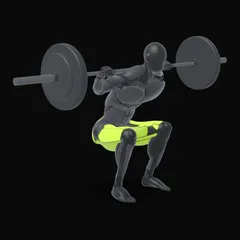
 Barbell SquatPlace the bar on your upper back, not on your neck, and step out of the rack. Stand with feet slightly wider than shoulder width, toes turned out a little.How to do the Barbell Squat →
Safety basics
- Squat inside a rack with the safety pins set just below your bottom position.
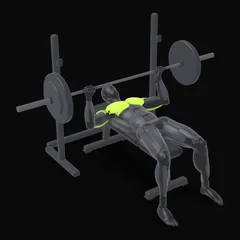
- Bench with a spotter who helps on your signal, or inside a rack with the safeties set just below chest height.
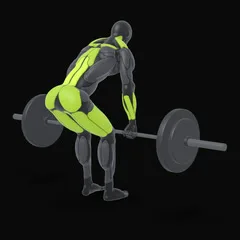
- On the deadlift, a failed rep just stays on the floor. Don’t try to grind it up with a rounded back.
Using your 1RM to program training
Once you have a number, three practical uses:
- Percentage programs. Many strength blocks, like the ones in our powerlifting program for beginners, use 70–90 % of 1RM. An estimate from last week’s sets keeps those percentages honest without retesting.
- Choosing a starting weight. Want to do sets of 8 on a new block? The table says that’s about 80 % of your max.
- Measuring progress. Your best set changes shape all the time: 100 kg × 5 one month, 95 kg × 8 the next. Which is better? Converting both to estimated 1RM (117 vs 120 kg with Epley) puts them on one scale. That’s the core of progressive overload: proof you’re getting stronger, even when the rep scheme changes.
One caution: don’t chase the estimate itself. If every session becomes a set to failure to “see the number go up,” you’ll accumulate fatigue and stall. Let the estimate come from the training you were going to do anyway.
Track the trend, not one session
Your strength on any given day moves with sleep, stress, food and how hard your last session was. A single estimated 1RM can swing 5 % either way. Plotted over eight or twelve weeks, though, the line is very informative: rising steadily, flattening (time to change something, see how to break a plateau), or dropping (time to look at recovery).
Doing this by hand means a spreadsheet and a formula per lift. Brick does it as you train: every time you log a set, it calculates the estimated 1RM, flags a new PR when you beat your previous best, and draws a strength trend for each exercise so you can see the curve without doing any maths.
Common mistakes
- Using sets of 15+ reps. The estimate can be off by 10 % or more.
- Mixing formulas. Epley one month, an online calculator with a different equation the next: your “progress” might just be the change of formula.
- Treating the estimate as a promise. It’s a statistical average. Some people can do 10 reps at 80 %, others only 6. If your real max keeps landing below your estimate, you’re probably an “endurance-strong” lifter: use a slightly lower number for your percentages.
- Testing too often. A max every two weeks costs recovery and teaches you nothing an estimate couldn’t.
Frequently asked questions
Which one rep max formula is the most accurate?
None is clearly best for everyone. Epley and Brzycki give almost the same answer around 5 to 10 reps and both are accurate enough for programming. What matters more is using the same formula every time and feeding it sets of 3 to 8 reps taken close to failure.
How many reps should I use to estimate my 1RM?
Sets of 2 to 6 reps give the most reliable estimates. Above 10 reps the error grows quickly, because muscular endurance starts to matter more than maximal strength. A hard set of 5 is a good default.
Is it safe to test a real one rep max?
For a healthy lifter with solid technique, a well-prepared test with safety bars or spotters is reasonably safe. It is tiring and adds little for most people, though. Beginners and anyone returning from injury should estimate instead.
How often should I test or re-estimate my 1RM?
Estimate it every week if you like, from your normal working sets: that's free information. A true max test makes sense every 8 to 16 weeks at most, typically at the end of a training block or before a meet.
Sources
- Zourdos MC, Klemp A, Dolan C, Quiles JM, Schau KA, Jo E, et al. (2016). Novel resistance training-specific rating of perceived exertion scale measuring repetitions in reserve. Journal of Strength and Conditioning Research
- Helms ER, Cronin J, Storey A, Zourdos MC (2016). Application of the repetitions in reserve-based rating of perceived exertion scale for resistance training. Strength and Conditioning Journal