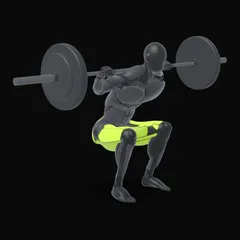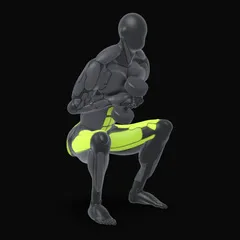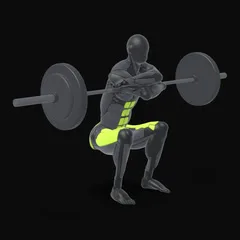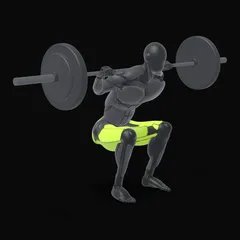
To squat properly, set the bar on your upper back, stand with your feet about shoulder-width apart and toes turned out slightly, brace your midsection, then sit down between your hips with your knees tracking over your toes until your thighs are at least parallel to the floor. Drive up through your whole foot, keeping your chest and hips rising together. Below is each step in detail, how to choose bar position and depth, and fixes for the most common squat problems.
Step-by-step barbell squat technique
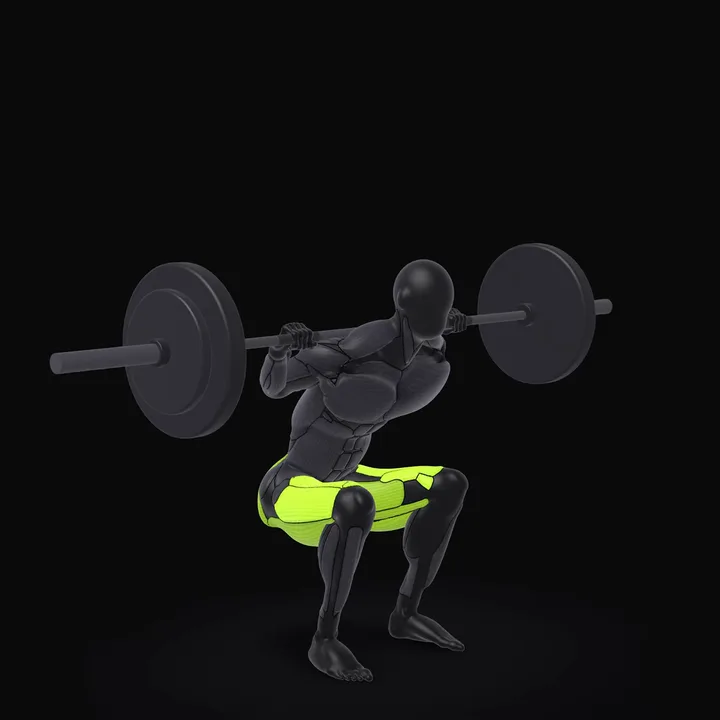 Barbell SquatPlace the bar on your upper back, not on your neck, and step out of the rack. Stand with feet slightly wider than shoulder width, toes turned out a little.How to do the Barbell Squat →
1. Set the rack
Put the bar hooks at about mid-chest height so you can unrack it with a small knee bend, not on your tiptoes. Set the safety pins or straps just below the height of the bar at the bottom of your squat. If you fail a rep, you sit down and set the bar on them. Squatting without safeties is how a bad day becomes an injury.
2. Get under the bar
- Grip: hands just outside your shoulders, or a bit wider if your shoulders are stiff. Squeeze the bar.
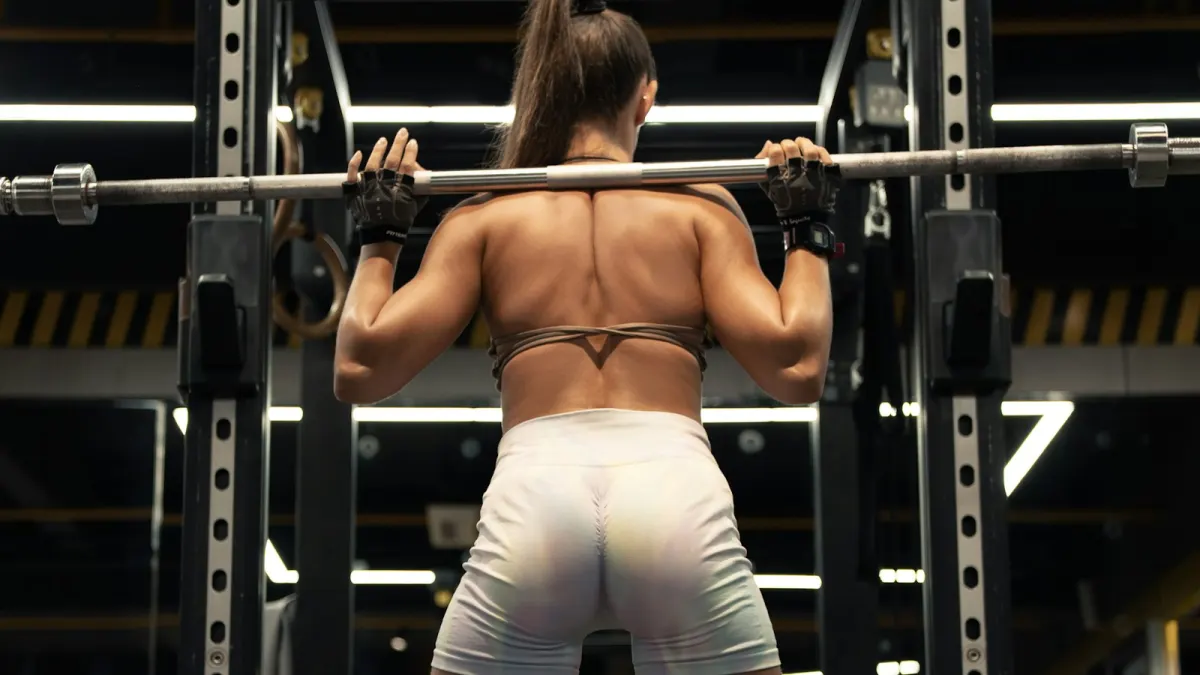
- Bar position: for a high-bar squat, the bar sits on your upper traps, below the bony bump at the base of your neck. For a low-bar squat, it sits lower, across the back of your shoulders (rear delts), held in place by squeezing your upper back.
- Elbows: pull them down and slightly back to create a shelf of tight muscle for the bar.
3. Unrack and step back
Stand up with the bar, take two or three small steps back, no more. Wasted steps waste energy.
4. Set your stance
Feet about shoulder-width apart, toes turned out 15–30°. Wider stances suit some people (often those with long legs or stiff hips), narrower stances suit others. Your stance is right if you can sit deep with heels down and knees tracking over your toes.
Think about a “tripod foot”: weight spread across your heel, the base of your big toe and the base of your little toe.
5. Brace
Take a big breath into your belly and sides, then tighten your midsection as if bracing for a punch. If you use a belt, push your belly into it. Hold this tension for the whole descent and the hardest part of the way up. Breathe out near the top, take a new breath and brace again for the next rep.
6. Descend
Break at the hips and knees at the same time and sit down between your heels. Push your knees out so they stay in line with your toes. Keep your chest up and your back in the same position all the way down. Control the descent; about 2 seconds is a good rhythm.
7. Hit depth
Go as deep as you can while keeping your heels down and your back steady. For most people that means the crease of the hip below the top of the knee (just below parallel).
8. Drive up
Push the floor away with your whole foot. Lead with your chest and upper back so your hips and shoulders rise at the same rate. Keep your knees pushing out. Stand tall at the top without leaning back.
How deep should you squat?
Deeper is generally better for muscle, and not worse for healthy knees. In a 10-week study, full squats and half squats grew the quads similarly, but full squats grew the glutes and adductors significantly more (Kubo et al., 2019). A review of knee and spine loading concluded that concerns about deep squats harming the knees are unfounded when technique is learned well and loads progress sensibly, and that heavy partial squats may actually load the joints more (Hartmann et al., 2013).
So: squat to the depth you can control. If you can’t reach parallel with a steady back and heels down, work on it with goblet squats, pause squats and a raised heel.
Should your knees go past your toes?
Usually, yes. When researchers had people squat with their knees restricted from moving forward, stress on the knee went down, but stress on the hips increased dramatically and the lifters had to lean much further forward (Fry et al., 2003). Letting your knees travel forward is a natural part of squatting deep, especially if you have long thighs.
What matters is the direction: your knees should follow your toes, not cave inward.
High bar vs low bar
| High bar | Low bar | |
|---|---|---|
| Bar position | Upper traps | Rear delts, 3–5 cm lower |
| Torso angle | More upright | More forward lean |
| Main emphasis | Quads more | Hips and posterior chain more |
| Depth | Usually deeper | Usually just below parallel |
| Typical use | General training, bodybuilding, weightlifting | Powerlifting, maximal loads |
Both are good. High bar is easier to learn for most people and great for quads. Low bar lets many people lift a bit more weight but needs good shoulder mobility. Pick one and stick with it for a training block. The front squat is a third option that keeps you even more upright and is very quad-dominant.
Common squat problems and fixes
| Problem | Likely cause | Fix |
|---|---|---|
| Knees cave in | Weak or unaware hip muscles, too heavy | Push knees out on the way up; lighter weight; pause squats; banded glute work in the warm-up |
| Heels lift | Stiff ankles, weight too far forward | Weightlifting shoes or small plates under heels; ankle mobility; sit back slightly more |
| Hips shoot up first (“good morning squat”) | Quads weaker than back, or losing brace | Lead with your chest; pause squats; front squats or leg press to build quads |
| Lower back rounds at the bottom | Going deeper than your control, poor brace | Squat to just above that point; brace harder; improve with goblet squats |
| Bar slides or hurts the neck | Bar too high or upper back loose | Lower the bar to the meaty part of the traps; squeeze shoulder blades |
| Falling forward | Weight on toes, chest dropping | Tripod foot; keep upper back tight; look slightly down, not up |
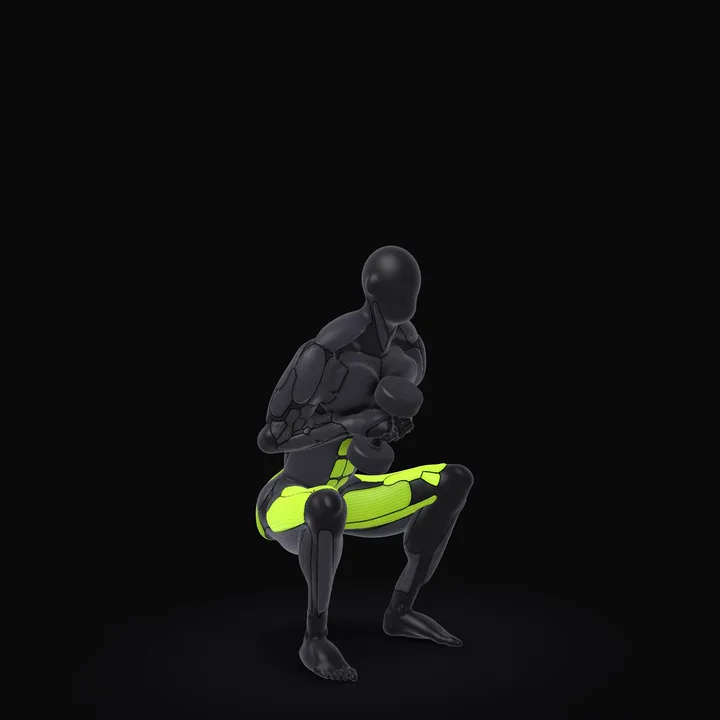 Dumbbell Goblet SquatHold one dumbbell vertically against your chest with both hands. Stand with feet slightly wider than shoulder width.How to do the Dumbbell Goblet Squat →
The goblet squat fixes many of these at once. Holding a weight in front of you naturally keeps your chest up and lets you sit between your hips. It’s the best way to learn the movement before loading a barbell.
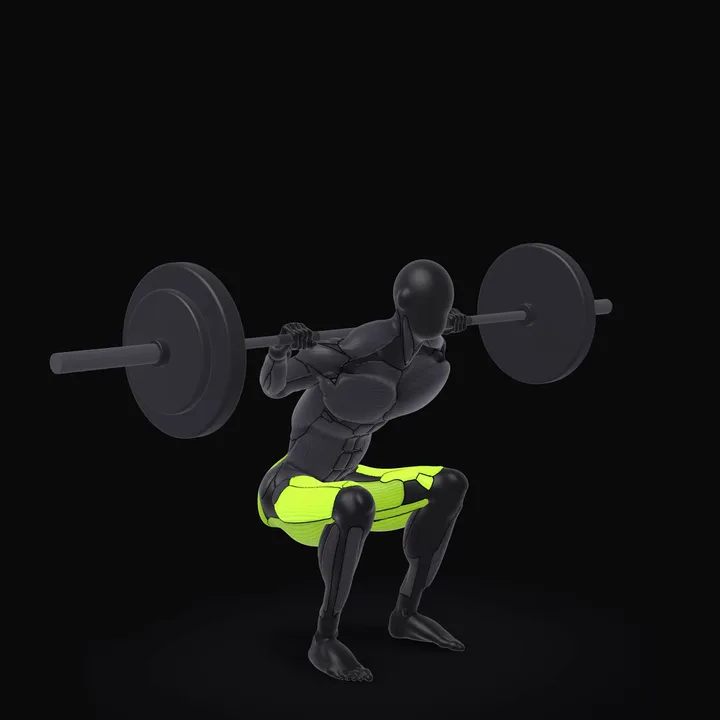 Barbell Pause SquatPlace the bar on your upper back and stand with feet slightly wider than shoulder width. Lower under control to the bottom of the squat with your back straight.How to do the Barbell Pause Squat →
The pause squat, with a 2–3 second pause at the bottom, teaches you to stay tight in the hole and builds strength out of it. Use about 70–80 % of your normal working weight.
Warm-up and mobility
Before squatting, spend 5 minutes on a bike, then do a few bodyweight squats with a pause at the bottom, and ramp up with the bar: empty bar × 10, then 3–4 progressively heavier sets of 3–5. Stiff ankles and hips can be improved over time; mobility routine for lifters has a short routine, and how to warm up before lifting covers ramp-up sets.
Film and log your squats
Filming one set from the side every week or two shows you depth, bar path and hip rise at a glance. Logging every set, with notes like “knees caved on rep 5” or “hit depth easily”, shows you whether a technique change is working. Once your form is consistent, how to increase squat has a 6-week plan to push the numbers.
Frequently asked questions
Should my knees go past my toes when squatting?
It's normal and usually fine for your knees to travel past your toes, especially if you have long thighs or squat deep. Forcing them back makes you lean forward and shifts stress to your hips and lower back. Keep your whole foot on the floor and let the knees go where they need to.
How deep should I squat?
As deep as you can while keeping your heels down and your lower back from rounding noticeably. For most people that's at least thighs parallel to the floor, and often deeper. Deep squats build more glute and inner-thigh muscle than half squats.
Should I look up or down when squatting?
Look straight ahead or slightly down at a point on the floor a couple of metres in front of you. Looking up at the ceiling tends to arch your neck and lower back.
Is it bad to squat with a rounded lower back?
A small tuck of the pelvis at the very bottom of a deep squat (butt wink) is common and usually harmless with light to moderate loads. A large, obvious rounding under heavy weight is worth fixing by squatting slightly less deep or improving your position.
What shoes should I squat in?
Flat, firm shoes or weightlifting shoes with a raised heel. Avoid soft running shoes, which compress under load. Raised heels make it easier to squat upright and deep, especially if your ankles are stiff.
Sources
- Kubo K, Ikebukuro T, Yata H (2019). Effects of squat training with different depths on lower limb muscle volumes. European Journal of Applied Physiology
- Fry AC, Smith JC, Schilling BK (2003). Effect of Knee Position on Hip and Knee Torques During the Barbell Squat. Journal of Strength and Conditioning Research
- Hartmann H, Wirth K, Klusemann M (2013). Analysis of the Load on the Knee Joint and Vertebral Column with Changes in Squatting Depth and Weight Load. Sports Medicine