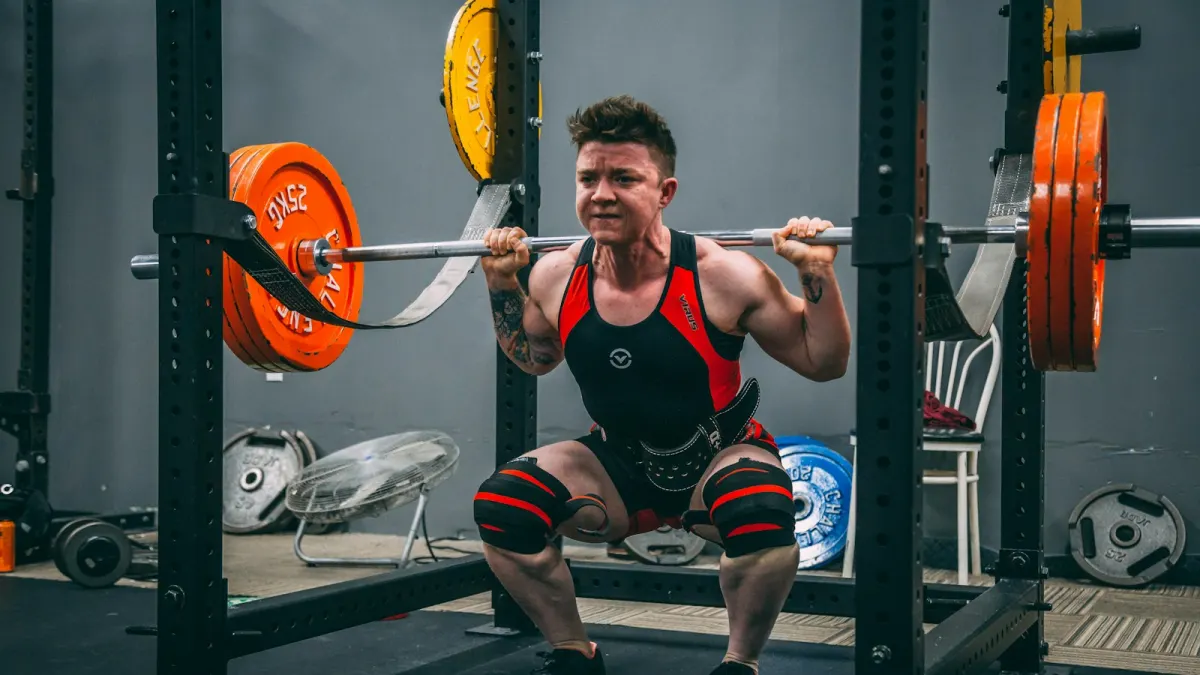
To increase your squat, make your technique repeatable, squat two or three times a week, use heavy sets of 3–6 alongside moderate volume, and add a variation that targets where you get stuck (usually pause squats or front squats). If stiff ankles or hips limit your depth, fix that too. Then run a structured block for six weeks before you judge it. Below is each step and a complete 6-week squat plan.
Step 1: make every rep the same
A squat that changes shape every rep can’t be loaded reliably. Before chasing numbers, lock in:
- The same bar position every session (high bar or low bar, not somewhere in between).
- The same stance, marked by where your feet line up with the floor or a plate.
- A real brace before every rep: big breath into your belly and sides, then tighten.
- The same depth every rep: at least hip crease below the top of the knee.
- A consistent descent speed, about 2 seconds, no dive-bombing.
Film your sets from the side. If you’re unsure about any of this, start with how to squat properly.
Step 2: squat more often
More frequent training was linked to bigger strength gains in a meta-analysis, mainly because it allowed more weekly volume (Grgic et al., 2018). The squat is a skill as much as a strength test; practising it two or three times a week makes your groove more consistent. One brutal leg day a week is usually less effective than two or three moderate ones.
Step 3: train heavy and moderate
Heavier loads produce the biggest gains in maximal strength, while muscle grows across a wide range (Schoenfeld et al., 2021). A good squat plan combines:
- Heavy work at 80–90 % of your max for 2–5 reps, to get used to heavy loads.
- Volume work at 65–77 % for 5–8 reps, to build the quads and glutes that move the bar.
- Variations at lighter loads that fix a specific weakness.
Step 4: pick the right variation
| Where you struggle | Variation | Why |
|---|---|---|
| Out of the bottom | Pause squat (2–3 s pause) | Removes the bounce, builds strength in the hole, teaches you to stay tight |
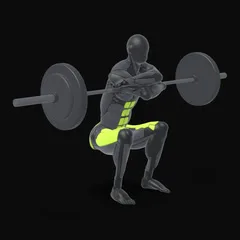
| Chest falls, hips shoot up | Front squat | Forces an upright torso, builds the quads and upper back |
| Losing depth or position | Tempo squat (3–4 s down) | Builds control and awareness |
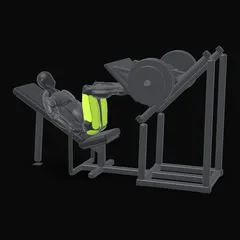
| General leg size | Leg press, hack squat, Bulgarian split squat | More quad and glute volume with less fatigue |
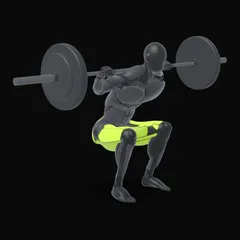
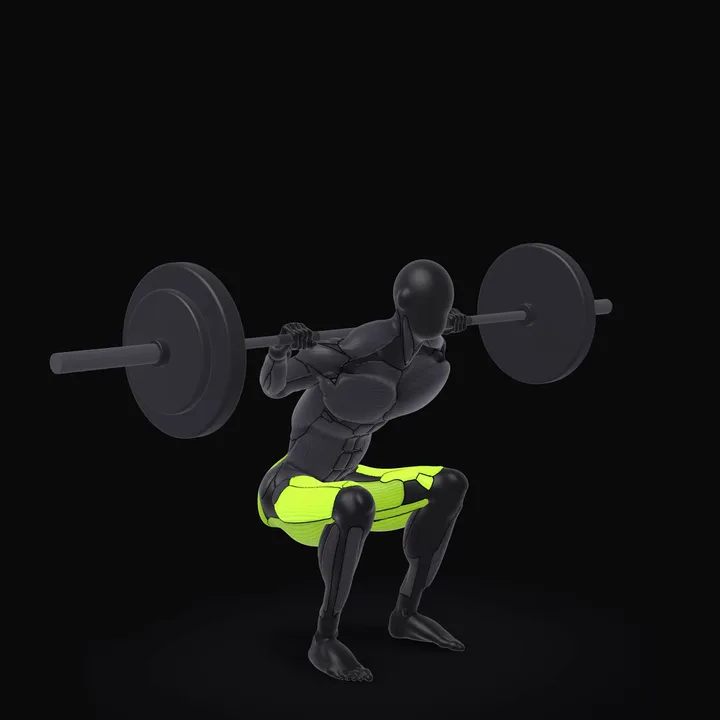 Barbell Pause SquatPlace the bar on your upper back and stand with feet slightly wider than shoulder width. Lower under control to the bottom of the squat with your back straight.How to do the Barbell Pause Squat →
Step 5: fix mobility only if it limits you
Stiff ankles (heels lifting, falling forward) and stiff hips (can’t reach depth without your back rounding) can limit your squat. Quick wins:
- Squat shoes or small plates under your heels make depth easier instantly.
- Goblet squat holds at the bottom for 30–60 seconds before squatting.
- Ankle mobility drills: knee-to-wall rocks for 10 reps per side.
You don’t need a long routine; mobility routine for lifters has a short one. If you can already reach a good depth with a steady back, mobility isn’t your limiter.
The 6-week squat plan
Three sessions a week (for example Monday, Wednesday, Friday). Percentages are of your estimated one-rep max. Estimate it from a recent hard set of 3–5 reps.
Day 1: heavy squat
| Week | Back squat |
|---|---|
| 1 | 4 × 5 at 77.5 % |
| 2 | 4 × 4 at 80 % |
| 3 | 5 × 3 at 82.5 % |
| 4 | 3 × 3 at 85 % |
| 5 | 3 × 2 at 87.5–90 % |
| 6 | Test: work up to a new max, or a heavy single at about 95 % |
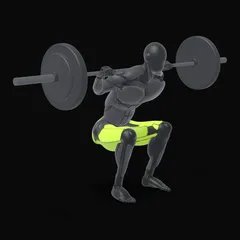
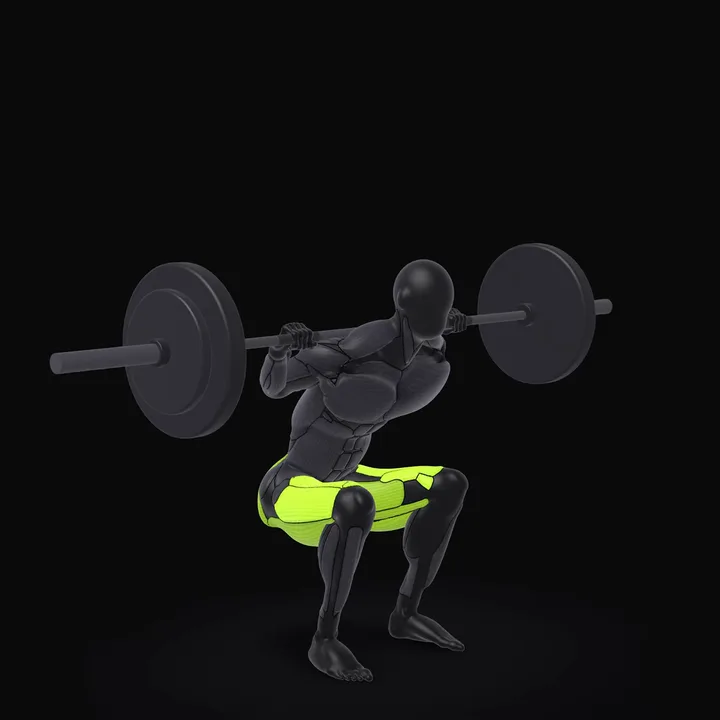 Barbell SquatPlace the bar on your upper back, not on your neck, and step out of the rack. Stand with feet slightly wider than shoulder width, toes turned out a little.How to do the Barbell Squat →
Day 2: pause squat and posterior chain
| Week | Pause squat (2 s) | Romanian deadlift |
|---|---|---|
| 1 | 3 × 4 at 65 % | 3 × 8 |
| 2 | 3 × 4 at 67.5 % | 3 × 8 |
| 3 | 4 × 3 at 70 % | 3 × 6 |
| 4 | 3 × 3 at 72.5 % | 3 × 6 |
| 5 | 3 × 2 at 75 % | 2 × 6 |
| 6 | Rest or light technique work | — |
Day 3: volume
| Week | Back squat or front squat | Leg press or split squat |
|---|---|---|
| 1 | 4 × 8 at 67.5 % (back) | 3 × 10–12 |
| 2 | 4 × 7 at 70 % | 3 × 10–12 |
| 3 | 4 × 6 at 72.5 % | 3 × 8–10 |
| 4 | 3 × 6 at 75 % | 3 × 8–10 |
| 5 | 3 × 5 at 70 % (light) | 2 × 8 |
| 6 | — | — |
If you choose front squats on day 3, use roughly 80–85 % of the back squat weights listed. Rest 3 minutes between heavy sets, 2 minutes between volume sets. Add leg curls and calf work wherever you like; the leg day workout shows how to round out a session.
Warming up for heavy squats
Use the same ramp-up every session: 5 minutes on a bike, 10 bodyweight squats and a 30-second goblet squat hold, then the empty bar × 10, about 40 % × 5, 55 % × 3, 65 % × 2, and on heavy days 75 % × 1 and 82 % × 1 before your work sets. The warm-up should rehearse your setup and brace, not tire you out.
What it looks like with real numbers
A lifter with an estimated max of 120 kg, loads rounded to the nearest 2.5 kg:
| Week | Day 1 (heavy) | Day 2 (pause) | Day 3 (volume) |
|---|---|---|---|
| 1 | 4 × 5 at 92.5 kg | 3 × 4 at 77.5 kg | 4 × 8 at 80 kg |
| 2 | 4 × 4 at 95 kg | 3 × 4 at 80 kg | 4 × 7 at 85 kg |
| 3 | 5 × 3 at 100 kg | 4 × 3 at 85 kg | 4 × 6 at 87.5 kg |
| 4 | 3 × 3 at 102.5 kg | 3 × 3 at 87.5 kg | 3 × 6 at 90 kg |
| 5 | 3 × 2 at 105–107.5 kg | 3 × 2 at 90 kg | 3 × 5 at 85 kg |
| 6 | Test | Rest | — |
The first two weeks should feel almost easy. That’s deliberate: the block builds momentum so the heavy weeks land on fresh legs.
When you miss reps
- Missed the last rep on a heavy day: repeat that week’s heavy session next week, then continue.
- Missed reps on two sessions in a row: lower your estimated max by 5 % and continue with the percentages.
- Depth is slipping as the weight rises: the weight is too heavy for now. Use the previous week’s load and own the depth.
- Knees, hips or lower back ache going into a session: turn it into a light technique day (3 × 3 at 60 %) and skip the accessories.
Testing in week 6
Warm up well, then take singles at about 80 %, 87 % and 93 %. If the 93 % single moves fast, attempt 100–103 %. Squat inside a rack with safeties set just below your bottom position, every time.
How to bail out of a squat safely
Practise this with an empty bar before you need it. If a rep stalls and won’t go up, sit down into the bottom position and let the bar settle on the safety pins or straps, then crawl out forward. With a spotter behind you, keep pushing and let them help you rack it. Never twist or let one side of the bar drop. For high-bar squats, dumping the bar backwards off your back is a technique some lifters use in a rack, but only with safeties in place and nobody behind you.
Adapting the plan
Only two leg days? Keep Day 1 and Day 3. Do the pause squats as the first exercise on Day 3 (3 × 3 at the Day 2 percentages), then 3 sets of the volume squats instead of 4.
Still a beginner? If you can still add 2.5–5 kg to your squat every session or week, keep doing that. Percentage blocks are for when simple linear progress has stopped, usually after the first 6–12 months.
Also deadlifting heavy? Keep the Romanian deadlifts on Day 2 light, or swap them for back extensions, and put your heavy deadlift on Day 3 after the volume squats with one or two sets only.
Common mistakes that cap your squat
- Chasing weight with shrinking depth. A squat that gets heavier and higher isn’t getting stronger.
- Maxing out every week. Testing replaces training.
- Skipping the variation day because it feels light. Pause and front squats are where weak points get fixed.
- No upper-back work. A collapsing upper back is where many heavy squats are lost; rows and front squats help.
- Changing bar position mid-block. Pick high bar or low bar for the full six weeks.
Other factors that move your squat
- Body weight and food. Squat strength climbs more easily in a slight surplus and stalls in a deep deficit.
- Sleep. Several short nights in a row reduce heavy-squat performance more than people expect.
- Bracing gear. A belt helps many people on sets above about 80 %.
- Patience with your lower back. If deadlifts and squats are both heavy in the same week, consider a lighter deadlift variation during this block.
When the plan stops working
If you finish the block with no improvement, look at your log before you change programs. Were the sets completed? Was depth consistent? Were sleep and food decent? If yes, take a deload week and rerun the block from a slightly higher starting max. Persistent stalls across several lifts are covered in how to break a plateau. If knee pain is what’s stopping you, read knee pain when squatting before adding load.
Frequently asked questions
How often should I squat to get stronger?
Two or three times a week works well for most people, with one heavier session and one or two lighter or variation sessions. That gives you plenty of practice without accumulating too much fatigue.
Where do most people get stuck in the squat?
Usually just above parallel, a few centimetres out of the bottom. Pause squats and a stronger brace are the most common fixes. Missing because your hips shoot up and your chest falls points to weak quads or a weak upper back.
Does leg press help your squat?
Yes, as an accessory. It builds the quads and glutes with much less fatigue than squatting, which can support your squat, though it doesn't replace practising the squat itself.
Should I wear a belt to squat more?
A belt helps most people brace harder on heavy sets and often adds a few kilos. Learn to brace without it first, then use it for your heaviest work.
How much can I increase my squat in 6 weeks?
Intermediates commonly add 5 to 10 kg (10 to 20 lb) to their estimated max over a well-run 6-week block. Beginners can add more; advanced lifters less.
Sources
- Grgic J, Schoenfeld BJ, Davies TB, Lazinica B, Krieger JW, Pedisic Z (2018). Effect of Resistance Training Frequency on Gains in Muscular Strength: A Systematic Review and Meta-Analysis. Sports Medicine
- Schoenfeld BJ, Grgic J, Van Every DW, Plotkin DL (2021). Loading Recommendations for Muscle Strength, Hypertrophy, and Local Endurance: A Re-Examination of the Repetition Continuum. Sports