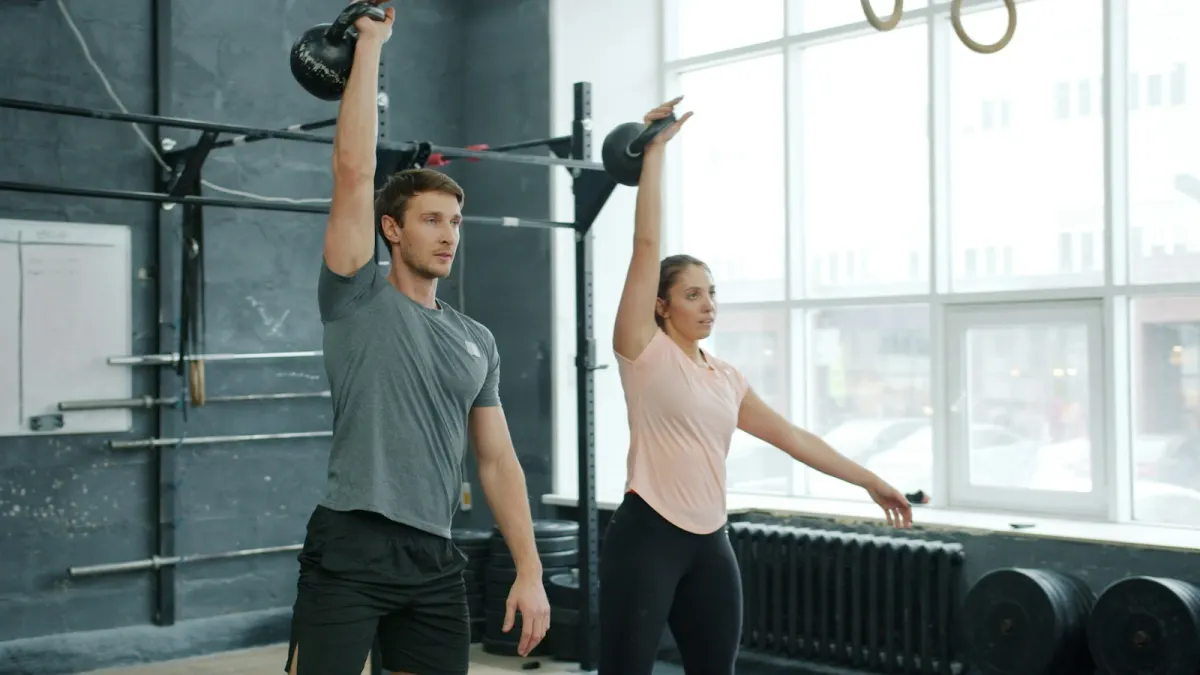
A good kettlebell workout plan is built on four moves (the swing, the goblet squat, the press and the clean), plus a row and a carry, trained three times a week with steadily heavier bells. That covers your whole body, builds real strength and gives you plenty of conditioning on the side. Below you’ll learn each key move, how to pick your bells, and a 3-day program that tells you exactly when to add reps, sets or weight.
Does kettlebell training build strength?
Yes. In one study, six weeks of twice-weekly kettlebell swing training improved half-squat strength and vertical jump about as well as jump squat training (Lake & Lauder, 2012). There’s a limit worth knowing, though: in another six-week study, a group doing traditional weightlifting and squats gained more squat strength than a group using a single 16 kg kettlebell (Otto et al., 2012).
The lesson isn’t “kettlebells don’t work.” It’s that a light bell stops challenging you quickly. If you want to keep getting stronger, you need heavier bells over time and exercises that make the most of the weight you have, like single-leg and single-arm work.
Which kettlebells to get
Kettlebells usually jump in 4 kg steps: 8, 12, 16, 20, 24, 28, 32 kg.
| You are… | Start with | Add next |
|---|---|---|
| New to training (most women) | 12 kg for swings and squats, 8 kg for presses | 16 kg |
| New to training (most men) | 16 kg for swings and squats, 12 kg for presses | 20–24 kg |
| Already strong | 20–24 kg for swings and squats, 16 kg for presses | a matching pair for double-bell work |
Your swing bell will always be heavier than your press bell, because the hips are much stronger than the shoulders.
The key moves
Swing
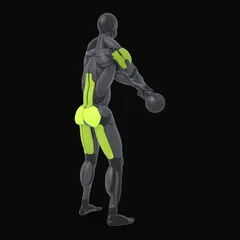
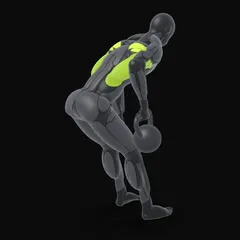
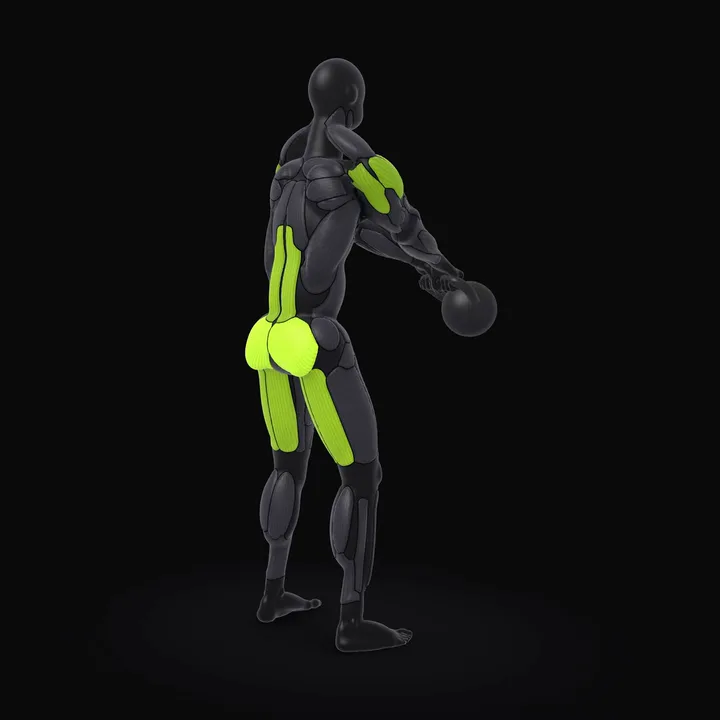 Kettlebell SwingStand with feet slightly wider than shoulder width and the kettlebell in front of you. Hinge at the hips with a flat back, grab the handle and hike the kettlebell back between your legs.How to do the Kettlebell Swing →
The kettlebell swing is a hip hinge done explosively. Stand with feet a bit wider than your hips, bell about 30 cm in front of you. Hinge, grab the handle, hike it back between your thighs like a football snap, then snap your hips forward to stand tall. The bell floats to about chest height because of your hips, not your arms. Let it fall back, hinge as it comes between your legs, repeat.
Common mistakes: squatting instead of hinging, lifting with the arms, leaning back at the top. If your lower back feels it more than your glutes and hamstrings, film a set; it’s usually a squat-swing.
Goblet squat
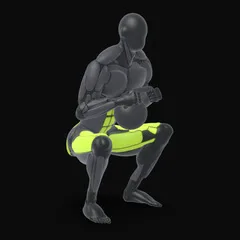
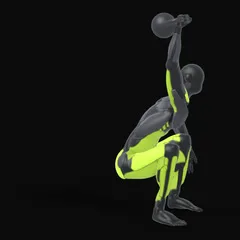
The goblet squat is the best squat for learning and a great leg builder in its own right. Hold the bell by the horns at your chest, elbows down, and sit down between your hips. Keep your chest up and heels down. Pause at the bottom.
Clean
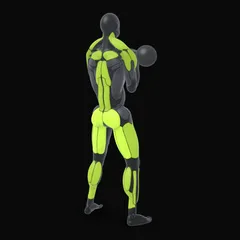
The kettlebell clean brings the bell from between your legs to the “rack” position (resting on your forearm, against your chest). It’s a smaller swing where you pull the bell close and let your hand slide around the handle so the bell lands softly instead of banging your wrist. Learn it single-arm first with the one-arm clean.
Press
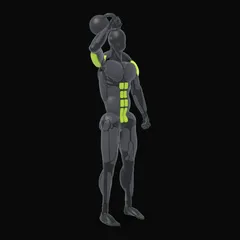
From the rack, press the bell overhead with the kettlebell overhead press: squeeze your glutes, brace, press up and slightly back so your arm finishes by your ear. Lower with control back to the rack.
Supporting moves
- One-arm kettlebell row for the back.
- Reverse lunges holding the bell in the goblet or rack position.
- Turkish get-up for shoulder stability and full-body control (learn it with a shoe balanced on your fist first).
- Farmer's carry or suitcase carry for grip and core.
The 3-day kettlebell program
Train Monday, Wednesday and Friday, or any three non-consecutive days. Days A and B are strength; Day C is power and conditioning.
Warm-up (5–7 minutes, every session)
- 10 halos each direction with your press bell.
- 10 hip hinges with a broomstick along your spine (head, upper back and tailbone touching it).
- 5 slow goblet squats with a 3-second pause at the bottom, gently pushing your knees out with your elbows.
- 10 kettlebell deadlifts, then 2 sets of 10 light swings, building up to the bell you’ll use.
- A few presses per arm with your lighter bell before the clean and press.
Day A: strength
| Exercise | Sets × reps | Rest |
|---|---|---|
| Clean + press (per arm) | 4 × 5 per arm | 90 s |
| Goblet squat | 4 × 8–12 | 90 s |
| One-arm row | 3 × 8–12 per arm | 60 s |
| Swing | 5 × 10 | 60 s |
| Farmer’s carry (one or two bells) | 3 × 30 m | 60 s |
Day B: strength
| Exercise | Sets × reps | Rest |
|---|---|---|
| Reverse lunge (goblet or rack) | 3 × 8–10 per leg | 90 s |
| One-arm floor press | 3 × 8–12 per arm | 60 s |
| Kettlebell deadlift (single-leg once easy) | 3 × 8–12 | 90 s |
| Alternating row (two bells) or one-arm row | 3 × 8–10 per arm | 60 s |
| Turkish get-up | 3 × 1 per side | 60 s |
| Halo | 2 × 5 each way | 30 s |
Day C: power and conditioning
| Exercise | Work | Rest |
|---|---|---|
| Swings, every minute on the minute | 10 minutes × 10–15 swings | rest of the minute |
| Goblet squat + press complex | 4 rounds × (5 squats + 5 presses per arm) | 90 s |
| Goblet squat hold at the bottom | 3 × 20–30 s | 45 s |
| Suitcase carry | 3 × 30 m per side | 45 s |
Each session takes 35–50 minutes.
How to progress with kettlebells
Kettlebell jumps are big: going from 16 kg to 20 kg is a 25 % increase. You can’t add weight every week, so progress in this order:
- Reps. Work up to the top of the rep range on every set.
- Sets. Add one set (for example, from 4 × 5 to 5 × 5 on clean and press).
- Density. Same work, shorter rest.
- Harder variation. Single-leg deadlift instead of two-leg, double-bell squats instead of goblet squats.
- Heavier bell. Start with the first set or two at the new weight, finish with the old one, and shift over the following weeks.
This is progressive overload adapted to fixed weights. Because it unfolds over weeks, write down the bell, the reps and the sets for every exercise.
What the first four weeks look like
Here’s a realistic start for someone with a 16 kg bell (swings, squats, rows) and a 12 kg bell (presses), looking only at Day A:
| Week | Clean + press (12 kg) | Goblet squat (16 kg) | Swings (16 kg) |
|---|---|---|---|
| 1 | 4 × 3 per arm | 4 × 8 | 5 × 10 |
| 2 | 4 × 4 per arm | 4 × 10 | 5 × 10, 60 s rest |
| 3 | 4 × 5 per arm | 4 × 12 | 6 × 10 |
| 4 | 5 × 5 per arm | 4 × 12, 3-second lowering | 6 × 10, 45 s rest |
Week 1 starts below the targets on purpose: the clean and press is a skill, and short sets keep it crisp. By week 5, the goblet squat is ready for the 20 kg bell: do your first two sets with it, the last two with the 16, and shift over the next few weeks.
When you miss reps
- One bad session: repeat it. Kettlebell work is technical, and a tired day shows up quickly.
- Stuck on a rep target for three weeks: add a set at fewer reps instead (for example 5 × 4 instead of 4 × 5), then build the reps back up.
- The jump to the next bell feels impossible: use ladders. On the press, do 1, 2, 3 reps per arm with the heavy bell and repeat the ladder 3–5 times. It builds volume at the new weight without failing sets.
- Every 6–8 weeks, or if your wrists, elbows or lower back feel beaten up, take an easy week: same exercises, half the sets, no conditioning finisher.
Adapting the plan
Only one bell? Pick one around your swing weight. Do presses and rows single-arm with more reps and slower lowering, and use single-leg deadlifts and lunges to make the legs work harder. It’s enough for the first few months.
Only two days a week? Do Day A and Day B, and finish each with 5 minutes of swings every minute on the minute. Day C is the one to drop.
Already lifting for a while? Use a matching pair of bells and replace goblet squats with double kettlebell front squats, the single clean and press with double clean and press, and rows with two-bell rows. The program stays the same; the load roughly doubles.
| Exercise | Easier | Harder |
|---|---|---|
| Swing | Kettlebell deadlift | One-arm swing |
| Goblet squat | Squat to a box | Double front squat |
| Clean + press | Dead clean, then press | Push press with a heavier bell |
| One-arm row | Supported row with a hand on a bench | Gorilla row with two bells |
| Turkish get-up | Half get-up (to the elbow or hand) | Full get-up with a heavier bell |
How long to run it, and what’s next
Run the plan for 10–12 weeks, or until the press and squat sets are easy with your heaviest bells. Then you have two options: buy the next pair of bells and start over with double-bell versions, or move to a mixed setup with dumbbells or a barbell for squats and presses, keeping swings and carries as the kettlebell part of your week.
Adding kettlebells to gym training
If you also lift with barbells, kettlebells fit well as:
- A swing finisher after lower-body days (5 × 10 heavy swings).
- A warm-up with goblet squats and halos before squatting.
- A conditioning day that’s easier on your joints than running.
For a broader home setup with dumbbells, see the dumbbell only workout plan and home gym essentials. If your goal is hip and glute strength in particular, kettlebell swings pair well with the advice in how to grow glutes.
Safety basics
- Clear space. Swings need room in front and behind you. Train away from furniture, kids and pets.
- Grip and chalk. A sweaty hand and a heavy swing don’t mix. Dry your hands; chalk helps.
- Set the bell down under control. At the end of swings, hike it back and place it on the floor in front of you. Don’t drop it from the top.
- Learn complex moves light. Turkish get-ups and snatches deserve a light bell and slow reps until they’re automatic.
Frequently asked questions
Can you build muscle with only kettlebells?
Yes, especially in your first year or two and if you have a few bells of different weights. Presses, rows, squats, lunges and swings cover the whole body. The limit is that kettlebells come in big jumps, so you'll lean on reps, sets and single-limb work to keep progressing.
What weight kettlebell should a beginner buy?
If you can only buy one, most women start well with 12 kg (about 25 lb) and most men with 16 kg (35 lb). That's heavy enough for swings and goblet squats. A second, lighter bell (8 or 12 kg) for presses makes the program much easier to run.
How many kettlebell swings should I do a day?
There's no magic number. In this plan you'll do 50 to 100 quality swings per session, three times a week. Daily swing challenges work for some people, but most get more out of fewer, crisper reps with a heavier bell.
Can I do kettlebell workouts every day?
Light days are fine, like a few minutes of swings or get-up practice. But hard strength sessions need a rest day between them so your grip, lower back and shoulders recover. Three hard sessions a week, with walks or easy mobility in between, is plenty for most people.
Are kettlebell workouts good for fat loss?
They help, because swings and complexes are demanding and raise your heart rate. But fat loss mostly comes from your diet. Use kettlebells to build and keep muscle, and manage calories in the kitchen.
Sources
- Lake JP, Lauder MA (2012). Kettlebell Swing Training Improves Maximal and Explosive Strength. Journal of Strength and Conditioning Research
- Otto WH, Coburn JW, Brown LE, Spiering BA (2012). Effects of Weightlifting vs. Kettlebell Training on Vertical Jump, Strength, and Body Composition. Journal of Strength and Conditioning Research