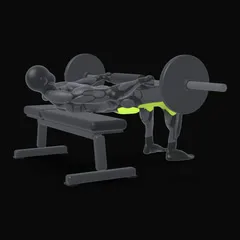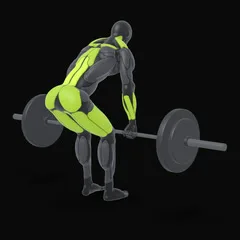
The best 4 day workout split for most people is upper/lower: two upper-body days and two lower-body days, so every muscle is trained twice a week in sessions of about an hour. Four full-body days and a torso/limbs split are good alternatives; a 4-day “bro split” that hits each muscle once a week is the weakest option. Below is a quick comparison, then a complete 4-day program you can start on Monday.
The 4-day split options, compared
What matters most in any split is weekly volume per muscle and hitting each muscle at least twice a week. With volume equal, split and full-body routines produce similar gains (Ramos-Campo et al., 2024), while training a muscle twice a week beats once a week when you don’t control volume (Schoenfeld et al., 2016). With that in mind:
| Split | Days | Each muscle per week | Good for | Watch out for |
|---|---|---|---|---|
| Upper/lower | U, L, U, L | 2× | Almost everyone | Upper days can run long |
| Full body ×4 | FB, FB, FB, FB | 4× | People who like short sessions | Hard to rank priorities; lots of warm-ups |
| Torso/limbs | Torso, Limbs, Torso, Limbs | 2× | More arm volume, shorter leg days | Arms and legs in one session is tiring |
| Push/pull/legs rotating | P, P, L, P… | about 1.3× | People who love PPL | Uneven weeks |
| Bro split | Chest, Back, Legs, Shoulders+arms | 1× | Enjoyment, variety | Less frequency per muscle |
Upper/lower wins for most people. The best workout split guide covers every split from two to six days if you want the full picture.
The recommended 4-day program
This is an upper/lower split with a twist: the two upper days and the two lower days have different emphases, so you cover every angle without repeating yourself.
| Mon | Tue | Wed | Thu | Fri | Sat | Sun |
|---|---|---|---|---|---|---|
| Upper 1: horizontal | Lower 1: quads | Rest | Upper 2: vertical | Lower 2: hips | Rest | Rest |
- Upper 1 leads with horizontal pushing and pulling (bench press, rows): chest and mid-back.
- Upper 2 leads with vertical pushing and pulling (overhead press, pull-ups): shoulders and lats.
- Lower 1 is squat-based: quads first.
- Lower 2 is hinge-based: hamstrings and glutes first.
Upper 1: horizontal push and pull
| Exercise | Sets × reps | Rest |
|---|---|---|
| Bench press | 4 × 5–8 | 2–3 min |
| Barbell row | 4 × 6–10 | 2 min |
| Incline dumbbell press | 3 × 8–12 | 2 min |
| Wide-grip cable row | 3 × 10–12 | 90 s |
| Cable lateral raise | 3 × 12–15 | 60 s |
| Incline curl + pushdown | 2 × 10–12 each (superset) | 60–90 s |
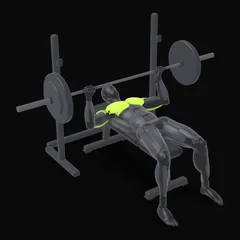
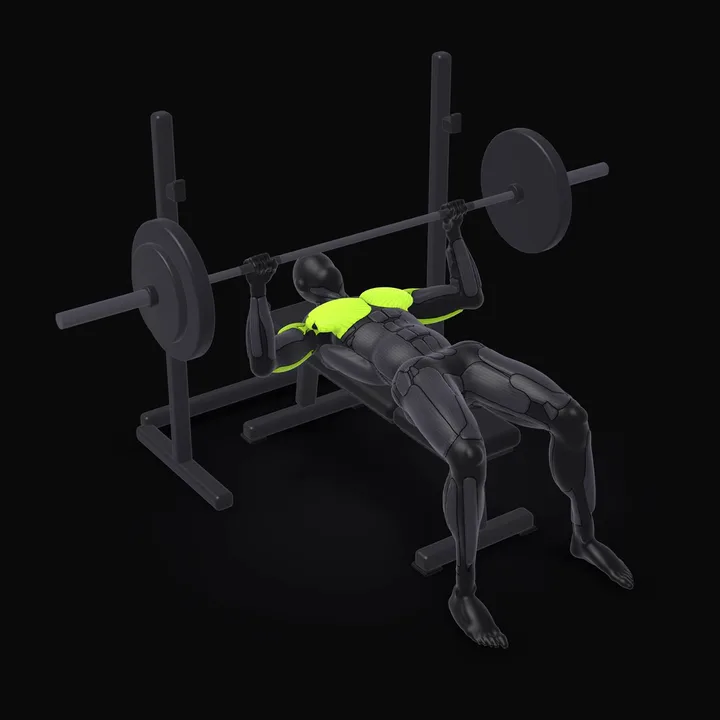 Barbell Bench PressLie on the bench with your eyes under the bar and your feet planted on the floor. Grip the bar slightly wider than shoulder width and pull your shoulder blades back and down.How to do the Barbell Bench Press →
Lower 1: quad focus
| Exercise | Sets × reps | Rest |
|---|---|---|
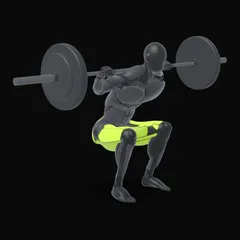
| Back squat | 4 × 5–8 | 3 min |
| Leg press | 3 × 10–12 | 2 min |
| Dumbbell Romanian deadlift | 3 × 8–12 | 2 min |
| Leg extension | 3 × 12–15 | 90 s |
| Standing calf raise | 4 × 10–15 | 60 s |
| Cable crunch | 3 × 10–15 | 60 s |
Upper 2: vertical push and pull
| Exercise | Sets × reps | Rest |
|---|---|---|
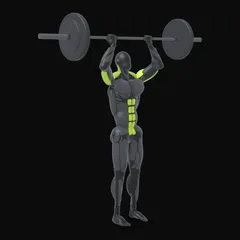
| Overhead press | 4 × 5–8 | 2–3 min |
| Pull-up (weighted or assisted) | 4 × 6–10 | 2 min |
| Machine chest press | 3 × 8–12 | 2 min |
| Close-grip pulldown | 3 × 10–12 | 90 s |
| Reverse pec deck | 3 × 12–20 | 60 s |
| Hammer curl + overhead extension | 2 × 10–12 each (superset) | 60–90 s |
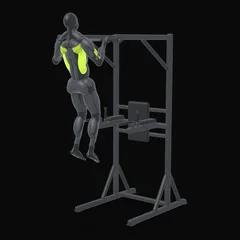
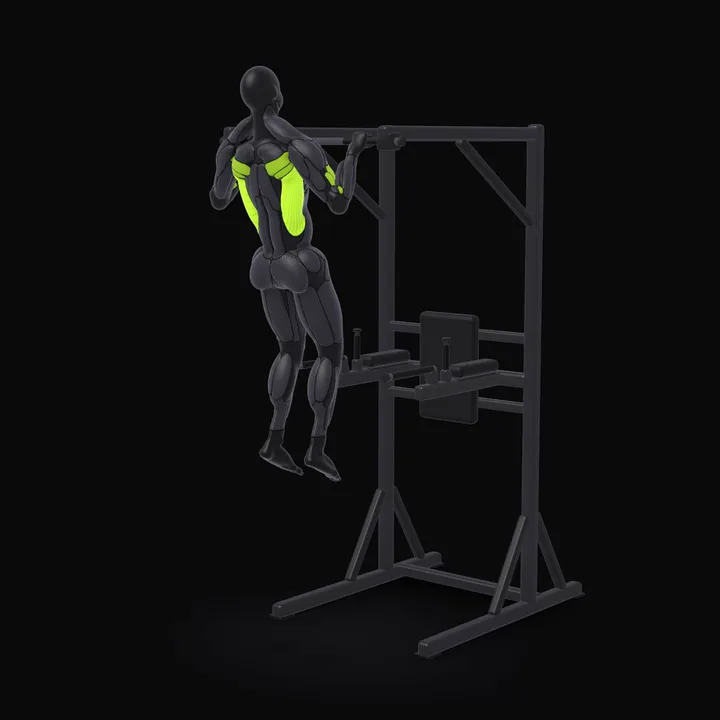 Pull-upGrab the bar with palms facing forward, hands slightly wider than your shoulders. Hang with straight arms and brace your core.How to do the Pull-up →
Lower 2: hip focus
| Exercise | Sets × reps | Rest |
|---|---|---|
| Deadlift | 3 × 4–6 | 3 min |
| Hip thrust | 3 × 8–12 | 2 min |
| Bulgarian split squat | 3 × 8–12 per leg | 90 s |
| Seated leg curl | 3 × 10–12 | 90 s |
| Seated calf raise | 3 × 12–20 | 60 s |
| Hanging knee raise | 3 × 10–15 | 60 s |
Weekly volume
| Muscle | Direct hard sets per week |
|---|---|
| Chest | 10 |
| Back | 14 |
| Shoulders | 4 presses + 6 raises/rear delt |
| Biceps / triceps | 4 each + compound work |
| Quads | 13 |
| Hamstrings / glutes | 15 |
| Calves | 7 |
That lands most muscles in the 10–20 sets per week range. Want more for a specific muscle? Add 2–3 sets of one exercise for it on the day where it isn’t the focus. How many sets per muscle per week explains how to set your own numbers.
How to progress
Use double progression on everything:
- Pick a weight you can lift for the bottom of the rep range on every set, with 2–3 reps in reserve.
- Add reps over the following sessions.
- When every set reaches the top of the range, add weight: 2.5 kg (5 lb) on upper-body barbell lifts, 5 kg (10 lb) on squats and deadlifts, the next pair on dumbbells.
That’s progressive overload in practice. Four sessions with 24 different exercises is far too much to keep in your head, so log it.
Your first 4 weeks
Here’s how the bench press on Upper 1 (4 × 5–8) might go for someone who starts at 70 kg:
| Week | Weight | Reps | Next step |
|---|---|---|---|
| 1 | 70 kg | 7, 6, 6, 5 | Same weight |
| 2 | 70 kg | 8, 7, 7, 6 | Same weight |
| 3 | 70 kg | 8, 8, 8, 7 | Same weight |
| 4 | 70 kg | 8, 8, 8, 8 | +2.5 kg next week |
Week 1 is for finding weights, so err on the light side: every set should finish with 2–3 reps left. By week 3 the main lifts can get closer, to 1–2 reps in reserve. Isolation exercises can go to failure on the last set from the start.
When you miss reps, and when to deload
- Missed the bottom of the range once: keep the weight and try again next week. With each lift trained once a week, a single off day is common.
- Missed it two weeks running: drop 5–10 % and work back up. You’ll usually pass the old number within a few weeks.
- Several lifts stalling together, or joints aching: take a deload week, same exercises with half the sets and lighter effort. Most people need one every 6–8 weeks on four days a week. The deload week guide explains the signs.
Warming up for the main lifts
Each day opens with a heavy compound lift, so ramp into it. Five minutes on a bike or rower, a few bodyweight squats or band pull-aparts depending on the day, then:
| Set | Load (% of work weight) | Reps |
|---|---|---|
| 1 | Empty bar | 8–10 |
| 2 | About 50 % | 5 |
| 3 | About 70 % | 3 |
| 4 | About 85 % | 1–2 |
The second exercise of the day needs one or two lighter sets. After that, your first work set can double as the warm-up.
Swaps for your gym and your body
| If… | Use | Instead of |
|---|---|---|
| No machines (home gym with rack) | Dumbbell bench, dumbbell rows, band pulldowns | Machine chest press, cable rows, pulldown |
| Deadlifts bother your back | Trap bar deadlift or a heavier Romanian deadlift | Conventional deadlift |
| Squats bother your knees | Leg press or hack squat as the main lift | Back squat |
| Can’t do pull-ups yet | Lat pulldown or assisted pull-ups | Pull-ups |
| Shoulders dislike overhead pressing | Landmine press or a high-incline dumbbell press | Overhead press |
Beginners can run every exercise with 3 sets instead of 4 for the first month and leave out the second isolation exercise on each day. Intermediates who recover well can add a set to their two weakest muscles. That’s the easiest way to personalize the program without rebuilding it.
Adjusting the split to your week
- Can’t do Mon–Tue–Thu–Fri? Monday, Wednesday, Friday, Saturday works. Keep the same order.
- Missed a session? Do it the next day and carry on in sequence. The order matters more than the weekday.
- Want a strength focus or a pure hypertrophy focus? The upper lower split program has both versions written out.
- Ready for more days? If you find yourself wanting a fifth and sixth session, the push pull legs workout plan is the natural next step.
- Only three days some weeks? Rotate the four sessions across your available days. You’ll finish the cycle every 9–10 days instead of every 7, which is fine.
The alternatives in brief
Four full-body days. Shorter sessions (45–50 minutes, 4–5 exercises), every muscle trained four times a week with 3–4 sets per session. Good if you like being in and out quickly. The trade-off is more warm-up time and less focus.
Torso/limbs. Torso days train chest, back and shoulders; limb days train legs, biceps and triceps. It gives arms more attention and fresher sessions, but limb days are long and tiring.
Four-day bro split. Chest/triceps, back/biceps, legs, shoulders/arms. People enjoy the “pump” of a dedicated day, and it can work for experienced lifters with high volume per session. For most, though, twice-a-week training gets more from the same time.
Which one should you pick?
Answer three questions:
- How long can each session be? Under 50 minutes: four full-body days. About an hour: upper/lower. Longer and you love arm work: torso/limbs.
- What are you trying to improve? Strength on the big lifts favors upper/lower, because each main lift gets its own fresh slot twice a week. Overall size works on any of them.
- What will you actually enjoy? A split you look forward to beats a theoretically better one you dread. If a chest day is what gets you to the gym, a well-built bro split is better than a skipped upper/lower.
If you can’t decide, run the recommended program above for 10–12 weeks. It’s the safest bet, and by the end you’ll know what you’d like to change.
How long each session takes
With warm-ups and the rest times listed, each session runs about 60–70 minutes. Lower 1 and Lower 2 tend to be the longest because of the 3-minute rests on squats and deadlifts. If you’re short on time, the supersets on the upper days are already built in; on lower days, pair the calf raises with the ab exercise and you’ll save another 5 minutes. Don’t shorten the rest on the first two exercises of any day: that’s where your heaviest, most productive sets happen.
Mistakes to avoid on a 4-day split
- Adding a fifth “arm day” in week one. The program already gives arms direct work twice a week, plus all the pressing and rowing.
- Letting the lower days slide. If one session gets skipped, it shouldn’t always be Lower 2.
- Going to failure on every set of deadlifts and squats. Save it for isolation exercises.
- Changing exercises every week. You can’t measure progress on a moving target.
Frequently asked questions
What is the best 4 day workout split?
For most people, upper/lower. It trains every muscle twice a week, keeps sessions to about an hour and gives you a rest day after every two sessions. Four full-body sessions and torso/limbs splits work too; a 4-day bro split is the weakest choice because each muscle is trained only once a week.
Is 4 days a week enough to build muscle?
Yes. Four sessions give you enough time to hit every muscle twice a week with 10 to 20 hard sets each, which covers what most people need. Plenty of advanced lifters train four days a week.
Which days should I lift on a 4-day split?
Monday, Tuesday, Thursday, Friday is the most common. Monday, Wednesday, Friday, Saturday also works. Avoid four days in a row followed by three off if you can, since the fourth session tends to be the weakest.
How long should I run a 4 day split before changing it?
Keep the same exercises for 8 to 12 weeks, with a deload around week 6 to 8. Change things when progress stalls even after a deload, and change only a few exercises at a time so you can still compare your numbers.
Can I do a push pull legs split in 4 days?
You can rotate push, pull and legs across four days so the cycle rolls over week to week. It works, but each muscle ends up trained about 1.3 times a week, so upper/lower usually gets more out of four sessions.
Sources
- Ramos-Campo DJ, Benito-Peinado PJ, Andreu-Caravaca L, Rojo-Tirado MA, Rubio-Arias JÁ (2024). Efficacy of Split Versus Full-Body Resistance Training on Strength and Muscle Growth: A Systematic Review With Meta-analysis. Journal of Strength and Conditioning Research
- Schoenfeld BJ, Ogborn D, Krieger JW (2016). Effects of Resistance Training Frequency on Measures of Muscle Hypertrophy: A Systematic Review and Meta-Analysis. Sports Medicine