A 2 day workout plan works if both sessions are full body: that way every muscle gets trained twice a week, and you can reach a solid amount of weekly volume in just two visits to the gym. You won’t build muscle as fast as someone training four or five days, but you’ll progress steadily, especially in your first couple of years. Below are two complete sessions, how to fit them into about an hour each, and what to realistically expect.
Is twice a week enough? Realistic expectations
Here’s the honest answer: two sessions a week build muscle and strength, but more training usually builds more.
The research supports both halves of that sentence. When total weekly volume is equal, training a muscle two, three or more times a week gives similar growth (Schoenfeld et al., 2019). So two days isn’t a problem in itself. The limit is volume: you can only do so many good sets in two sessions, and a 2025 meta-regression found that muscle growth keeps increasing with weekly sets, with diminishing returns at the high end (Pelland et al., 2025).
For strength, the minimum is surprisingly low. A meta-analysis on trained men found that a single hard set per exercise, two or three times a week, was enough to increase squat and bench press 1RM, though more volume did better (Androulakis-Korakakis et al., 2020). And if you’re just trying to hold on to what you have during a hectic stretch, strength and size can be maintained for months with as little as one session a week, as long as the loads stay heavy (Spiering et al., 2021).
What this means for you:
| Your situation | What two days a week gets you |
|---|---|
| Beginner (under 1 year) | Fast, visible progress. Close to what a 3-day plan would give. |
| Intermediate | Steady progress, slower than on 3–4 days. |
| Advanced or very busy period | Maintenance and slow gains on priority lifts. |
The 2-day workout plan
Put the sessions on two days that are spaced out: Monday and Thursday, or Tuesday and Friday.
Both days train everything. Day 1 is built around the squat and bench press, Day 2 around the deadlift and incline press, so each main movement gets one heavier and one lighter exposure across the week.
Day 1
| Exercise | Sets × reps | Rest |
|---|---|---|
| Back squat | 3 × 6–8 | 2–3 min |
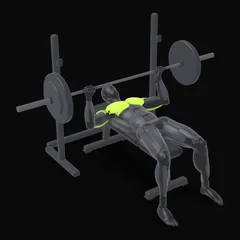
| Bench press | 3 × 6–10 | 2–3 min |
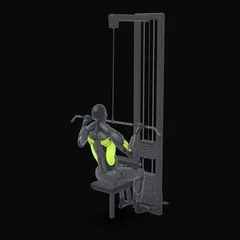
| Lat pulldown | 3 × 8–12 | 2 min |
| Romanian deadlift | 3 × 8–10 | 2 min |
| A1. Seated dumbbell press | 2 × 8–12 | — |
| A2. Seated cable row | 2 × 10–12 | 90 s after both |
| B1. EZ-bar curl | 2 × 10–12 | — |
| B2. Triceps pushdown | 2 × 10–12 | 60 s after both |
| Standing calf raise | 2 × 10–15 | 60 s |
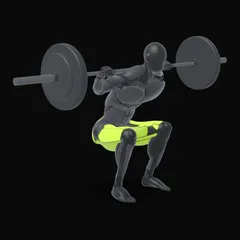
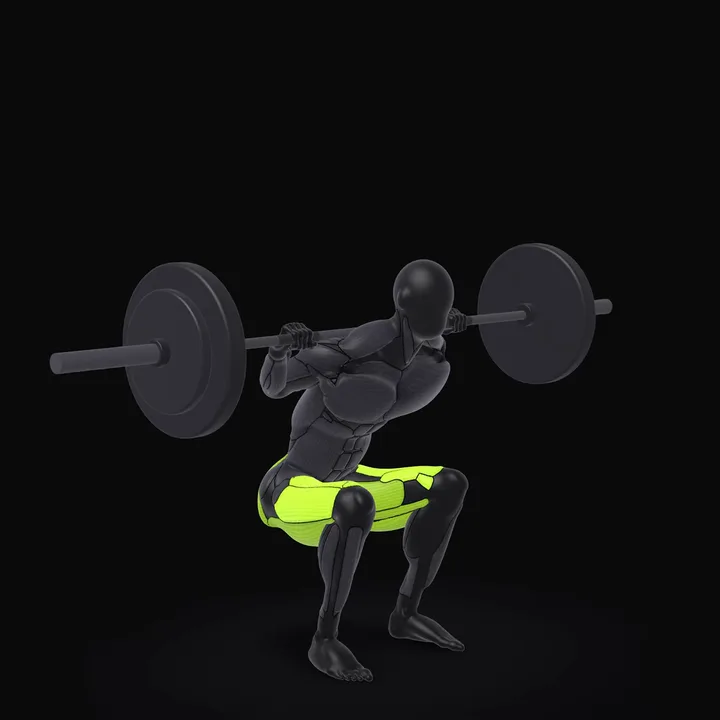 Barbell SquatPlace the bar on your upper back, not on your neck, and step out of the rack. Stand with feet slightly wider than shoulder width, toes turned out a little.How to do the Barbell Squat →
Day 2
| Exercise | Sets × reps | Rest |
|---|---|---|
| Trap bar deadlift (or barbell deadlift) | 3 × 5–6 | 3 min |
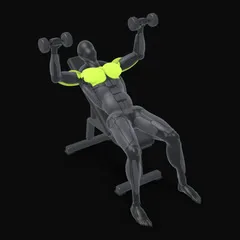
| Incline dumbbell press | 3 × 8–12 | 2 min |
| Chest-supported row | 3 × 8–12 | 2 min |
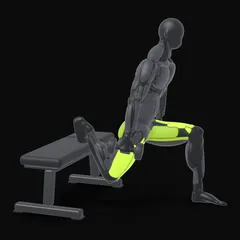
| Bulgarian split squat | 3 × 8–12 per leg | 90 s |
| A1. Lateral raise | 3 × 12–20 | — |
| A2. Face pull | 3 × 12–15 | 60 s after both |
| Seated leg curl | 2 × 10–12 | 90 s |
| Hanging knee raise | 2 × 10–15 | 60 s |
“A1/A2” means a superset: do one set of A1, then one set of A2, rest, repeat. Pairing exercises that don’t compete with each other (a press with a row, curls with pushdowns) saves time without hurting performance. There’s more on how that works in supersets and drop sets.
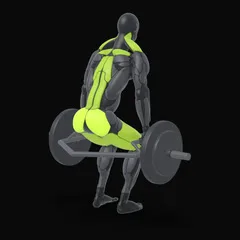
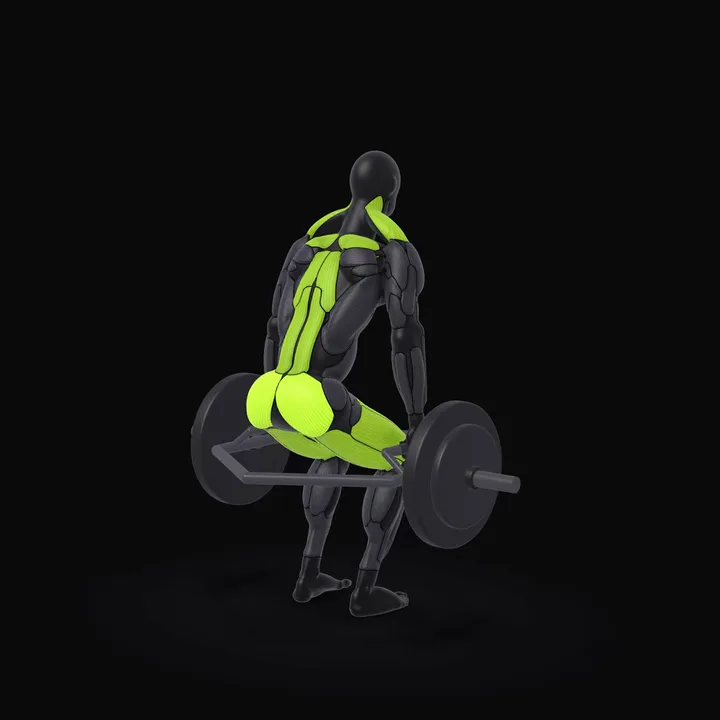 Trap Bar DeadliftStand in the middle of the trap bar with feet hip-width apart. Bend your knees and hips and grab the handles with a flat back and chest up.How to do the Trap Bar Deadlift →
Weekly volume
| Muscle | Hard sets per week |
|---|---|
| Quads | 6 (+ trap bar deadlifts) |
| Hamstrings and glutes | 8 |
| Chest | 6 (+ shoulder press) |
| Back | 8 (+ 3 sets of face pulls) |
| Shoulders | 2 presses + 6 raises and face pulls |
| Biceps / triceps | 2 direct each + compound work |
That’s on the lower side of the typical 10–20 sets per muscle range, which is the trade-off of a 2-day plan. Every set needs to be a good one. For more on these numbers, see how many sets per muscle per week.
What the first 8 weeks look like
| Weeks | Focus |
|---|---|
| 1–2 | Find your working weights. Stop each set with about 3 reps in reserve and nail the technique. |
| 3–6 | Add a rep or a little weight every session. Most lifts should move up week to week. |
| 7 | If several lifts have stalled, do a lighter week: same exercises, half the sets. |
| 8 | Push again. Compare your numbers with week 2. |
A typical beginner adds 15–25 kg (35–55 lb) to the squat and 5–10 kg (10–20 lb) to the bench press over those eight weeks on two sessions, with visible changes in the mirror following a bit later. Intermediates should expect smaller jumps: a rep here, 2.5 kg there. Both are real progress.
Getting the most out of two sessions
Train hard. With low volume, effort per set matters more. Finish most sets with 1–2 reps in reserve, and take isolation exercises to failure on the last set.
Don’t skip. Missing one of three sessions costs a third of your week. Missing one of two costs half. Pick days you can actually protect, and if you miss one, do it the next day you can rather than waiting for next week.
Progress every session. Use double progression: work up to the top of the rep range on every set, then add weight. That’s progressive overload in its simplest form, and with only two sessions, you need to know exactly what you did last time to beat it.
Keep the warm-up short. Five minutes on the bike, then ramp-up sets only for the first lift of the session. For a squat with 80 kg work sets, that might be: empty bar × 8, 40 kg × 5, 60 kg × 3, 70 kg × 1, then your three work sets. Later lifts need one lighter set at most, since you’re already warm.
Progression rules, with numbers
Each exercise has a rep range. Here’s how to move through it:
- Start each lift with a weight you could lift for about 3 more reps than the bottom of the range. On the squat’s 3 × 6–8, that’s a weight you could do 9–10 times if you had to.
- Add reps first. Each session, try to beat last time by one rep on at least one set.
- When every set hits the top of the range, add weight: 2.5 kg (5 lb) on upper-body barbell lifts, 5 kg (10 lb) on squats and deadlifts, the next dumbbell up on dumbbell work, one plate on machines.
- After a weight increase, you’ll drop back to the bottom of the range. That’s expected.
Here’s what that looks like on the bench press (3 × 6–10) over five sessions for someone starting at 60 kg:
| Session | Weight | Reps |
|---|---|---|
| 1 | 60 kg | 8, 7, 7 |
| 2 | 60 kg | 9, 8, 8 |
| 3 | 60 kg | 10, 9, 9 |
| 4 | 60 kg | 10, 10, 10 |
| 5 | 62.5 kg | 8, 7, 6 |
When you miss reps
- One bad session: repeat the same weight next time. With only two sessions a week, a poor night’s sleep shows up fast. Don’t read too much into it.
- Two sessions in a row below the bottom of the range: drop the weight 5–10 % and climb back through the range.
- Most lifts stalling at once: take the lighter week described above, then resume. If you’re under-eating or sleeping badly, fix that first.
Swaps if your gym (or home) is different
| If you don’t have… | Use | Instead of |
|---|---|---|
| A trap bar | Barbell deadlift or a heavier Romanian deadlift | Trap bar deadlift |
| A squat rack | Goblet squat or leg press | Back squat |
| Cables | One-arm dumbbell row, dumbbell curls, overhead dumbbell extension | Cable row, pushdown |
| A pulldown machine | Pull-ups or band-assisted pull-ups | Lat pulldown |
| A leg curl machine | Nordic curl negatives or a slower Romanian deadlift | Seated leg curl |
Keep the swap for the whole block so you can compare your numbers week to week.
How long to run it, and what comes next
Run the plan for 8–12 weeks, taking a lighter week whenever several lifts stall together, roughly every 6–8 weeks. After that, you have three good options:
- Keep it and simply change a few exercises (front squat for back squat, flat dumbbell press for incline) to give your joints and motivation a new challenge.
- Add a set to the first three exercises of each day if you can spare 15 more minutes.
- Add a third day and move to a full-body plan if your schedule opens up.
The structure barely changes. What changes is how much work you can fit into your week.
Making it shorter (or longer)
Only 45 minutes? Drop the arm superset on Day 1 and the leg curl on Day 2, and superset the third and fourth exercises as well (pulldown with Romanian deadlift works fine with machines nearby). The 30 minute gym workout has more templates for very short sessions.
Have 90 minutes? Add one set to each of the first three exercises. That pushes most muscles into the 9–12 sets a week range.
Found a third day? Switch to a 3-day full body workout plan. If you’re trying to decide how many days to aim for long term, how many days a week to work out lays it out by goal.
Who a 2-day plan is right for
- Parents, shift workers and anyone whose week only reliably has two free slots.
- People who play a sport or run and want strength training to support it.
- Lifters going through a busy phase (exams, a new job, a newborn) who want to keep their progress.
- Beginners who’d rather start with two sessions they’ll stick to than four they’ll quit.
Consistency beats ambition. Two sessions a week for a year will do far more for you than five sessions a week for a month.
Common mistakes with twice-a-week training
- Splitting body parts. “Upper on Monday, lower on Thursday” means each muscle once a week. Go full body.
- Cramming in twelve exercises. More exercises isn’t more effective. Eight well-chosen ones, done hard, beat twelve done half-heartedly.
- Short rest on the big lifts. Squats and deadlifts need 2–3 minutes. Save time with supersets on accessories, not by rushing the main work.
- Back-to-back days. Training Saturday and Sunday then nothing for five days works less well than spacing the sessions out.
Frequently asked questions
Is working out 2 days a week enough to build muscle?
Yes. Two full-body sessions let you train every muscle twice a week, which is the frequency most research supports. You'll gain more slowly than someone doing more weekly sets, but beginners and early intermediates make clear progress on two well-planned sessions.
Which two days should I train?
Space them out: Monday and Thursday, Tuesday and Friday, or Wednesday and Saturday. Two or three days between sessions gives you full recovery and keeps the week balanced.
Should I do full body or upper/lower with 2 days?
Full body. An upper/lower split on two days trains each muscle only once a week. Two full-body sessions double that frequency with the same time in the gym.
How long should each workout be if I only train twice a week?
Around 60 to 75 minutes. With only two sessions, each one has to carry more volume, so they run longer than a 3-day plan. Supersets on the accessory work keep them from dragging past that.
Can I add cardio on other days?
Yes, and it's a good idea for your health. Walking, cycling or easy runs on the off days won't hurt your lifting. Just avoid very hard leg sessions the day before a workout.
Sources
- Schoenfeld BJ, Grgic J, Krieger J (2019). How many times per week should a muscle be trained to maximize muscle hypertrophy? A systematic review and meta-analysis of studies examining the effects of resistance training frequency. Journal of Sports Sciences
- Androulakis-Korakakis P, Fisher JP, Steele J (2020). The Minimum Effective Training Dose Required to Increase 1RM Strength in Resistance-Trained Men: A Systematic Review and Meta-Analysis. Sports Medicine
- Spiering BA, Mujika I, Sharp MA, Foulis SA (2021). Maintaining Physical Performance: The Minimal Dose of Exercise Needed to Preserve Endurance and Strength Over Time. Journal of Strength and Conditioning Research
- Pelland JC, Remmert JF, Robinson ZP, Hinson SR, Zourdos MC (2025). The Resistance Training Dose Response: Meta-Regressions Exploring the Effects of Weekly Volume and Frequency on Muscle Hypertrophy and Strength Gain. Sports Medicine