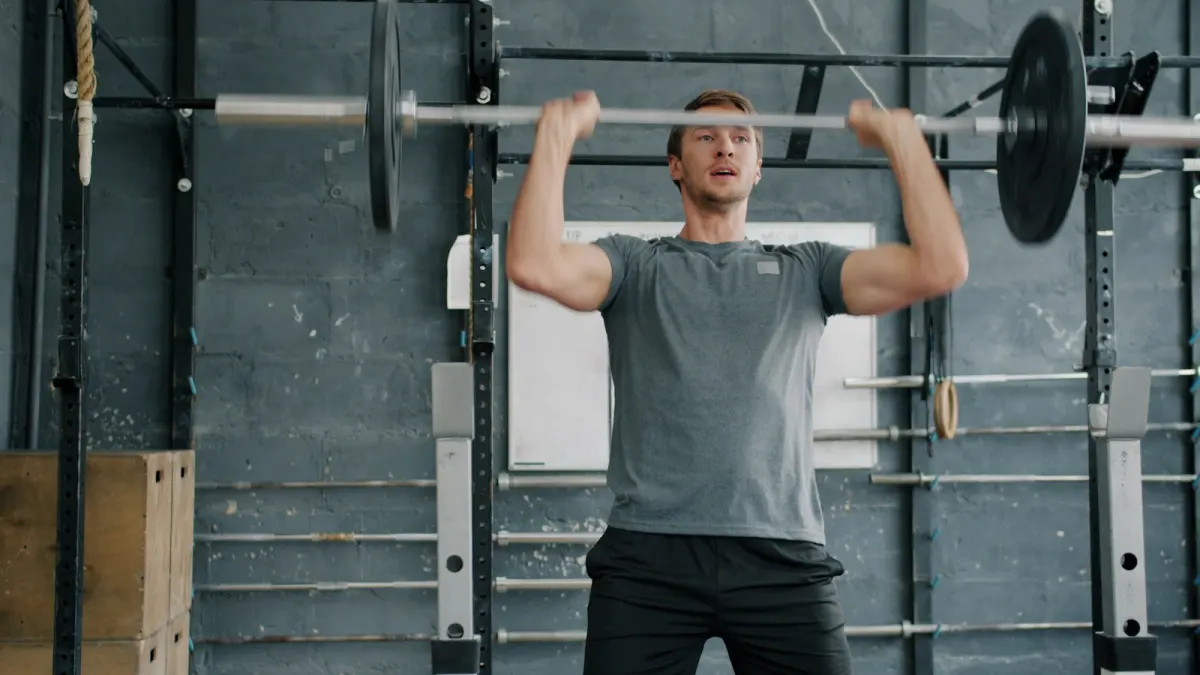
Good overhead press form looks like this: bar resting on your front delts, hands just outside your shoulders, glutes and midsection braced, then press the bar straight up past your face, move your head “through the window” once it passes, and lock out with the bar over the middle of your head and your arms by your ears. Standing or seated, barbell or dumbbells all work; each has a different purpose. Below are the steps, how the variations compare and how to keep making progress on a lift that moves slowly.
Step-by-step: standing barbell overhead press
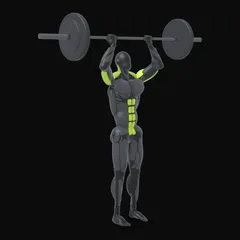
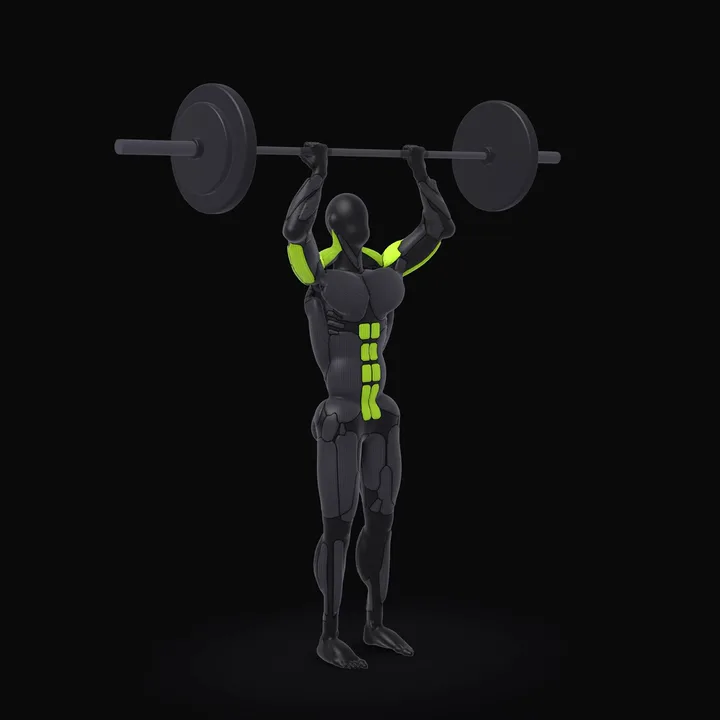 Barbell Overhead PressStand with feet hip-width apart and the bar on your upper chest, hands slightly wider than your shoulders. Brace your abs and glutes so your lower back doesn't arch.How to do the Barbell Overhead Press →
1. Set up in the rack
Put the bar at upper-chest height. Grip it just outside shoulder-width, so your forearms are vertical when viewed from the front. Bar low in your palms, wrists straight, thumbs wrapped.
2. Unrack into the front rack
Step under the bar so it rests on your front delts and upper chest, elbows slightly in front of the bar. Take one or two steps back. Feet about hip-width apart.
3. Brace from the ground up
Squeeze your glutes and quads, take a big breath into your belly and brace. Your ribs should stay down, not flared. This tension is what stops the press from turning into a backbend.
4. Press and move your head
Press the bar straight up. Pull your chin back slightly so the bar can travel in a straight line past your face. As soon as it passes your forehead, push your head forward “through the window” so the bar ends up over the middle of your head.
5. Lock out
Straighten your arms fully and shrug your shoulders up slightly toward your ears at the top. The bar, your shoulders, hips and mid-foot should line up when seen from the side.
6. Lower under control
Pull your head back, lower the bar to your front delts, and reset your brace before the next rep.
Standing vs seated, barbell vs dumbbell
A study comparing the four combinations found the standing barbell press allowed the heaviest loads, about 7 % more than the standing dumbbell press and about 10 % more than the seated dumbbell press. The variations demanding more stability, standing and with dumbbells, produced more deltoid activity overall (Saeterbakken & Fimland, 2013).
| Variation | Pros | Cons | Best for |
|---|---|---|---|
| Standing barbell | Heaviest loads, whole-body strength, easy to progress | Lower back can take over; slow to progress | Strength, general athleticism |
| Seated barbell | Less lower-back involvement | Lower loads, less core work | Shoulder strength when standing is a problem |
| Standing dumbbell | High stability demand, natural arm path | Hard to get heavy dumbbells in place | Shoulder strength and control |
| Seated dumbbell press | Shoulder-friendly, good stretch, easy to push close to failure | Lower loads | Building the delts |
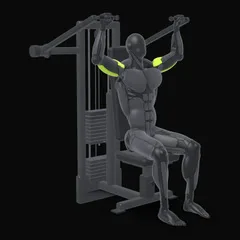
| Machine shoulder press | Safest to take to failure, very stable | No stability demand | Hypertrophy, high-rep work |
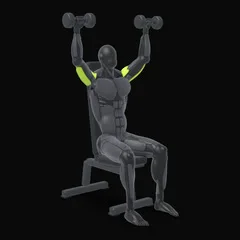
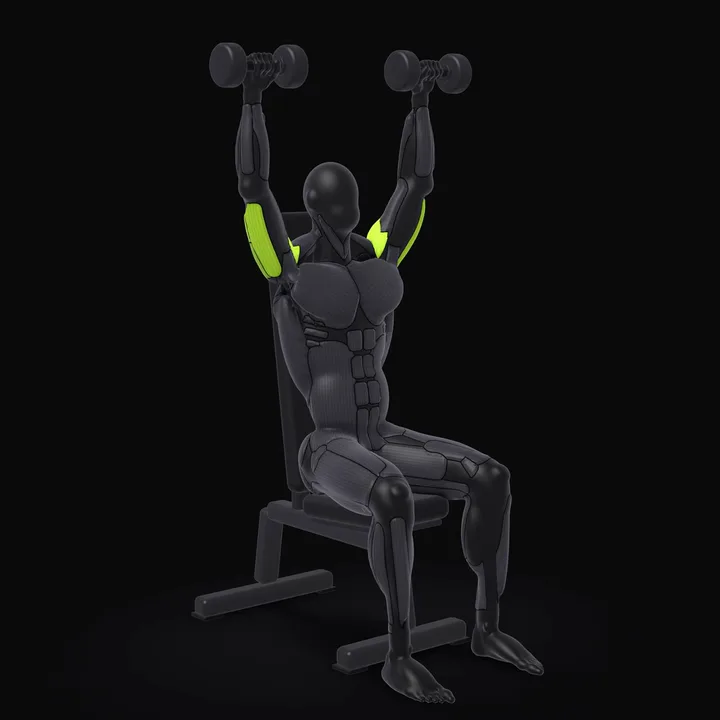 Dumbbell Shoulder PressSit on an upright bench holding the dumbbells at shoulder height, palms facing forward. Keep your back against the pad and your feet planted.How to do the Dumbbell Shoulder Press →
For building muscle, seated dumbbell or machine presses are often the best choice, because you can push them closer to failure safely. For overall strength, the standing barbell press is the classic. Many programs use one of each in the same week.
Common overhead press mistakes and fixes
| Mistake | Fix |
|---|---|
| Big backward lean | Squeeze glutes, brace, ribs down; lower the weight |
| Bar drifting forward | Move your head back, then forward under the bar; keep elbows under the bar |
| Elbows flared out wide at the start | Elbows slightly in front of the bar, forearms vertical |
| Wrists bent far back | Bar low in the palm, over the forearm bones |
| Soft lockout | Finish with arms straight and a slight shrug |
| Using the legs to “cheat” | That’s a push press; do it on purpose, not by accident |
Cues that help mid-set
Steps are for learning; cues are what you think about under the bar. Pick one or two, not all of them:
- “Squeeze the bar.” A hard grip makes your whole arm and shoulder tighter.
- “Ribs down, glutes tight.” Stops the lean-back before it starts.
- “Face back, then through.” Gets your head out of the way and back under the bar.
- “Push yourself under the bar.” At the top, think of moving your body forward under the bar rather than pushing the bar back.
- “Elbows under the bar.” If the bar drifts forward, your elbows have dropped behind it.
The push press
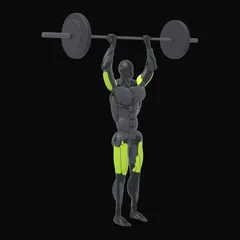
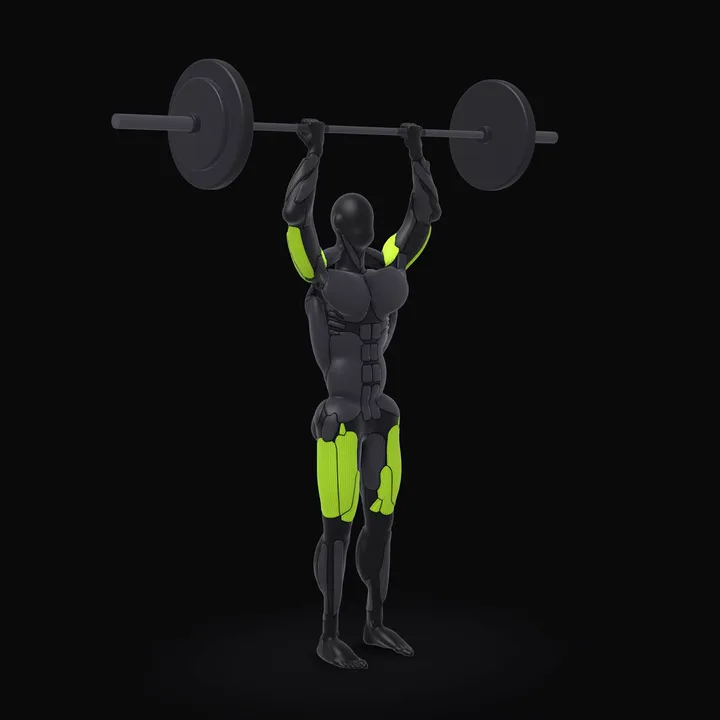 Barbell Push PressHow to do the Barbell Push Press →
The push press uses a quick dip and drive from the legs to get the bar moving, then you finish with your arms. It lets you handle 10–20 % more than a strict press and trains explosive power. It’s a useful second variation for athletes, or for overloading the top half of the press, but it isn’t a replacement for strict pressing if your goal is shoulder size.
Other overhead press variations and who they suit
| Variation | Why use it | Good for |
|---|---|---|
| Arnold press | Rotating dumbbell press, long range, light loads | Delt size, shoulders that like a neutral start |
| Half-kneeling single-arm dumbbell press | One side at a time, the core works hard to stay square | Fixing side-to-side differences, lower-back-friendly |
| Landmine press | Presses on an angle instead of straight up | Lifters who can’t get fully overhead without pain |
| Pike push-up | Bodyweight press with the hips high | Home training, calisthenics |
| Seated barbell press in a rack | Standing removed, safeties available | Heavy pressing when your back is tired |
Grip width and elbow position
Hands just outside the shoulders works for most people. Too wide shortens the range and puts more stress on the shoulders; too narrow makes the start position awkward. Keeping your elbows slightly in front of the bar (not directly out to the sides) puts your shoulders in a more comfortable position, especially if you’ve had shoulder trouble.
Programming and progression
The overhead press uses smaller muscles than the bench or squat, so it progresses slowly. Some tips:
- Rep ranges: 3–6 reps on the standing barbell press for strength, 6–12 on dumbbell and machine presses for size.
- Frequency: once or twice a week is plenty; your front delts also work in all your bench pressing.
- Small jumps: 1–1.25 kg (2.5 lb) plates are worth buying or borrowing. A 2.5 kg jump can be 5 % of your press.
- Double progression: add reps first, then weight. That’s the standard progressive overload approach applied to a slow lift.
| Goal | Exercise | Sets × reps | Rest |
|---|---|---|---|
| Strength | Standing barbell press | 3–5 × 3–6 | 3 min |
| Muscle | Seated dumbbell or machine press | 3–4 × 8–12 | 2 min |
| Both (common) | Barbell on one day, dumbbells on another | 3 × 5, then 3 × 10 | 2–3 min |
Here’s what slow but steady looks like on a standing press, starting at 40 kg for 3 × 5–8:
| Week | Weight | Reps |
|---|---|---|
| 1 | 40 kg | 6, 5, 5 |
| 2 | 40 kg | 7, 6, 6 |
| 3 | 40 kg | 8, 8, 7 |
| 4 | 40 kg | 8, 8, 8 → add 1 kg |
| 5 | 41 kg | 6, 6, 5 |
Five weeks for one kilo sounds tiny, but that pace adds roughly 10 kg to your press in a year. If reps go backwards for two sessions in a row, drop about 5 % and build back up.
How to pick your starting weight
Start with the empty bar for 2 sets of 8 to groove the head movement. Add 2.5–5 kg per set until a set of 6–8 feels hard but your back stays still. That’s your first working weight. Many people can’t press a 20 kg bar strictly at first; start with dumbbells or a machine and come back to the barbell in a few weeks.
Because progress comes in such small steps, you need your numbers in front of you every session.
Warm-up and mobility
Do a few band pull-aparts, arm circles and light presses with the empty bar before your work sets. If you can’t get your arms fully overhead without arching your back (test: stand with your back against a wall and raise your arms; your thumbs should reach the wall without your lower back leaving it), work on shoulder and upper back mobility; mobility routine for lifters has a short routine. Until then, use a slight incline or a landmine press.
How to miss an overhead press safely
A missed press usually stalls at forehead height and comes back down to your shoulders, which is uncomfortable but rarely dangerous. Keep your head back as it comes down so the bar doesn’t hit your face, then rack it. Press standing inside a rack with the safety arms set just below your shoulder height if you can, and on seated barbell presses always set them. With dumbbells, lower them to your shoulders, then to your thighs, before dropping them to the side. Never try to grind a rep while your lower back keeps arching further: end the set.
How the press fits into your shoulder training
The overhead press is mostly a front delt and triceps exercise. For shoulder width, add lateral raises; for full, round shoulders, add rear delt work. The full plan is in how to get bigger shoulders, and the technique for the raises is in lateral raise form.
Frequently asked questions
Is the overhead press bad for your shoulders?
Not for healthy shoulders with decent mobility and good technique. Pressing slightly in front of the head with elbows a bit forward suits most people. If overhead work causes pain, a slight incline press or landmine press is a shoulder-friendly alternative.
Why is my overhead press so weak compared with my bench?
That's normal. Most people overhead press roughly 60 to 70 % of their bench press, because the shoulders are smaller than the chest and you have to stabilize your whole body. It also progresses more slowly, often by just 1 to 2.5 kg at a time.
Should I lean back when overhead pressing?
Only slightly, to move your head out of the way as the bar passes. A big backward lean turns it into an incline press and stresses your lower back. Squeeze your glutes and brace to keep your ribs down.
Do I need the overhead press if I already bench?
Not strictly: the bench works your front delts and triceps too. But pressing overhead builds shoulder strength in a range the bench doesn't reach and trains your core to stay braced standing up. Most people benefit from one vertical press a week.
Should the bar go behind my head?
No need. Behind-the-neck pressing requires a lot of shoulder mobility and offers little extra benefit. Press in front of your face and finish with the bar over the middle of your head.
Sources
- Saeterbakken AH, Fimland MS (2013). Effects of Body Position and Loading Modality on Muscle Activity and Strength in Shoulder Presses. Journal of Strength and Conditioning Research