Strength training and hypertrophy training overlap far more than they differ. Both use hard sets and progressive overload, and both build muscle and strength. The main difference is emphasis: strength training uses heavier loads (about 1–6 reps) with longer rests and focuses on a few lifts you want to get better at, while hypertrophy training uses a wider range of loads (about 6–30 reps), more total sets and more exercise variety. Most people do best combining the two. Here’s how they compare and how to blend them.
What the research says
A meta-analysis comparing low-load (more than 15 reps) and high-load (8 reps or fewer) training found similar muscle growth with both, while high loads produced greater gains in maximal strength (Schoenfeld et al., 2017). A later review of the “repetition continuum” reached the same conclusion: hypertrophy can be achieved across a wide spectrum of loads, but maximal strength benefits most from heavy loads (Schoenfeld et al., 2021).
Why? Strength isn’t just muscle size. It also depends on how well your nervous system recruits and coordinates muscle fibres for a specific movement, which is a skill you improve by practising heavy lifts. Muscle growth, on the other hand, responds to mechanical tension and effort, which you can get from many loads as long as sets go close to failure.
Strength vs hypertrophy at a glance
| Variable | Strength focus | Hypertrophy focus |
|---|---|---|
| Reps per set | 1–6 | 6–15 (5–30 works) |
| Load | About 80–95 % of max | About 60–80 % of max |
| Proximity to failure | 1–3 reps in reserve | 0–3 reps in reserve |
| Rest | 3–5 min | 1–3 min |
| Weekly sets per muscle | Moderate | Higher (10–20) |
| Exercise choice | Few main lifts + close variations | Wider variety, more isolation work |
| Frequency per lift | Often 2–3× per week for the main lifts | Each muscle 2×+ per week |
| Measure of progress | 1RM or heavy rep maxes | Rep PRs, size, measurements |
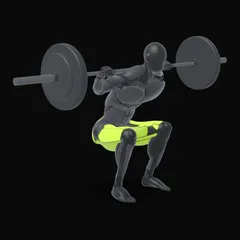
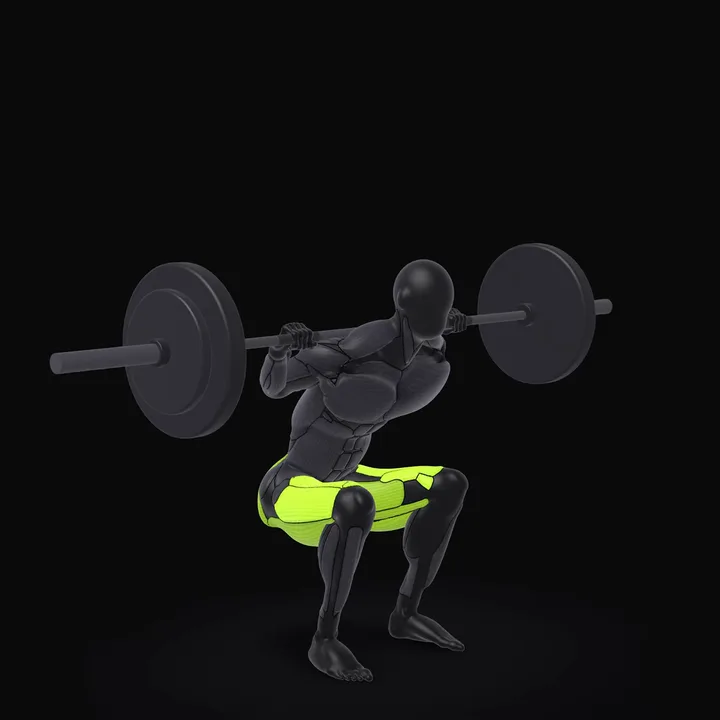 Barbell SquatPlace the bar on your upper back, not on your neck, and step out of the rack. Stand with feet slightly wider than shoulder width, toes turned out a little.How to do the Barbell Squat →
Where they overlap
- Both require progressive overload. Adding weight or reps over time is the engine of both.
- Both build muscle. Heavy strength training builds a lot of muscle, especially in your first years.
- Both build strength. Hypertrophy training makes you stronger, just less specifically on 1RM tests.
- Both need recovery, protein and sleep.
For most lifters, the differences only become important when you have a specific goal, like a powerlifting meet or a bodybuilding show.
Does a bigger muscle mean a stronger muscle?
Over the long run, yes. A muscle’s cross-sectional area sets a ceiling on how much force it can produce, so lifters who keep building muscle keep raising that ceiling. In the short term, though, the link is loose. Beginners often double their squat in a few months with modest muscle gain, because most early strength comes from learning the lift. And a bodybuilder with very large muscles may lift less than a smaller powerlifter who practises heavy singles every week.
That’s why the two approaches complement each other: hypertrophy work raises your ceiling, strength work teaches you to use more of it.
Why rest periods differ
Strength sets are heavy and demand a lot from your nervous system and your energy systems. Taking 3–5 minutes between them lets you lift the same heavy weight again with good technique. Hypertrophy sets with moderate loads recover a bit faster, so 1–3 minutes is usually enough, though longer rest still lets you do more reps on compound exercises. The full breakdown is in how long to rest between sets. The practical point: don’t cut rest on your heavy lifts to save time. Save time on the isolation work instead.
Frequency for strength
Strength benefits from practice. A meta-analysis found higher training frequency increased strength gains, largely because it allowed more total volume (Grgic et al., 2018). That’s why strength programs often squat or bench two or three times a week, with different intensities on different days. The powerlifting program for beginners and the 5x5 workout program are good examples.
How to combine them
The most practical approach for most people is a mix within each session:
- First exercise: strength. One main compound lift for 3–5 sets of 3–6 reps, with full rest.
- Next exercises: hypertrophy. Two to four exercises for 2–4 sets of 8–15 reps, with 1–2 minutes of rest.
- Last exercises: isolation. Small muscles, 10–20 reps, last set close to failure.
Example: a combined upper body day
| Exercise | Sets × reps | Focus |
|---|---|---|
| Bench press | 4 × 4–6 | Strength |
| Chest-supported row | 3 × 8–12 | Hypertrophy |
| Incline dumbbell press | 3 × 8–12 | Hypertrophy |
| Lat pulldown | 3 × 10–12 | Hypertrophy |
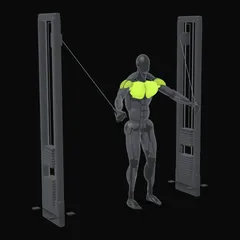
| Cable fly + lateral raise | 2 × 12–20 | Isolation |
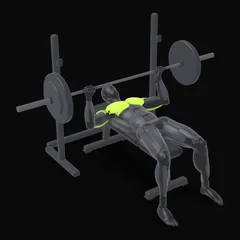
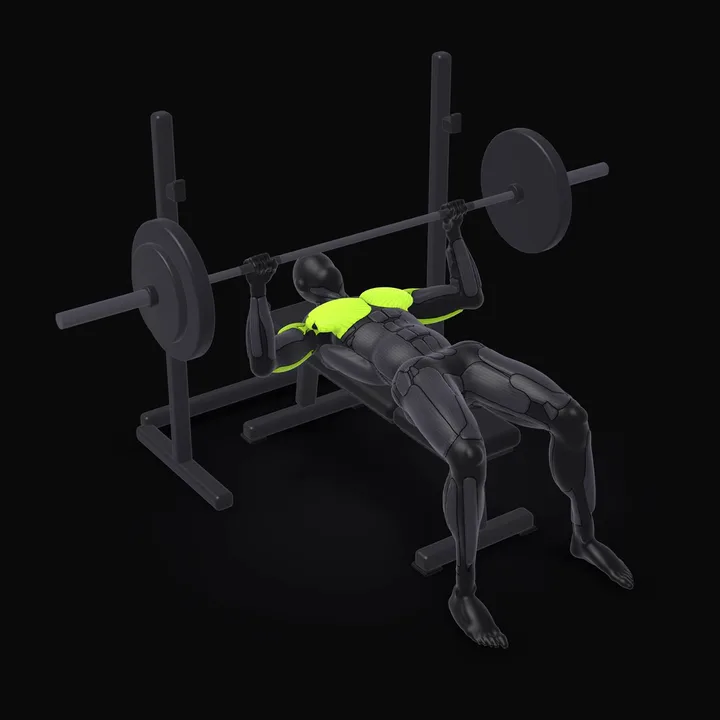 Barbell Bench PressLie on the bench with your eyes under the bar and your feet planted on the floor. Grip the bar slightly wider than shoulder width and pull your shoulder blades back and down.How to do the Barbell Bench Press →
The strength-leaning and hypertrophy-leaning versions of the upper lower split program show both ends of this spectrum in full.
Or alternate blocks
Another option is to alternate training blocks: 6–8 weeks with more strength emphasis, then 6–8 weeks with more hypertrophy emphasis. The muscle you build in the hypertrophy block gives you more to work with in the strength block, and vice versa.
Which should you prioritise?
| Your goal | Emphasis |
|---|---|
| Look better, build muscle | Mostly hypertrophy, with heavy work on 1–2 lifts |
| Get stronger on squat, bench, deadlift | Mostly strength, with hypertrophy accessories |
| Sport or general fitness | A mix; strength on main lifts, moderate reps elsewhere |
| Beginner | Doesn’t matter much yet; moderate reps (6–12) build both |
Whichever you choose, track how you’re progressing. Rep PRs at moderate weights and estimated 1RM trends on your main lifts tell you whether both qualities are moving.
Common mistakes
- Only training heavy singles for “strength”. Without enough volume, muscle and long-term strength stall.
- Only training high reps and never lifting heavy. You’ll grow, but your 1RM won’t keep pace.
- Thinking you must choose. Almost every good program combines both.
- Changing rep ranges every week. Pick a structure and give it 6–8 weeks.
For the bigger picture of muscle growth, see how to build muscle.
Frequently asked questions
What rep range is best for hypertrophy?
Muscle grows across a wide range, roughly 5 to 30 reps per set, as long as sets are taken close to failure. Most people find 6 to 15 reps the most practical: heavy enough to be efficient, light enough to be safe and not too painful.
What rep range is best for strength?
For maximal strength, heavy loads of about 1 to 6 reps (roughly 80 % of your max and above) work best, because strength is specific to lifting heavy weights. Moderate reps still build the muscle that supports strength.
Does building muscle make you stronger?
Yes, over time. A bigger muscle can produce more force, so muscle gain supports long-term strength. But strength also depends on skill and nervous system factors, which is why practising heavy lifts matters.
Can I train for strength and size at the same time?
Yes. Most good programs do both: heavy sets on the main lifts and moderate-rep sets on accessories. That approach is often called powerbuilding.
Sources
- Schoenfeld BJ, Grgic J, Van Every DW, Plotkin DL (2021). Loading Recommendations for Muscle Strength, Hypertrophy, and Local Endurance: A Re-Examination of the Repetition Continuum. Sports
- Schoenfeld BJ, Grgic J, Ogborn D, Krieger JW (2017). Strength and Hypertrophy Adaptations Between Low- vs. High-Load Resistance Training: A Systematic Review and Meta-analysis. Journal of Strength and Conditioning Research
- Grgic J, Schoenfeld BJ, Davies TB, Lazinica B, Krieger JW, Pedisic Z (2018). Effect of Resistance Training Frequency on Gains in Muscular Strength: A Systematic Review and Meta-Analysis. Sports Medicine