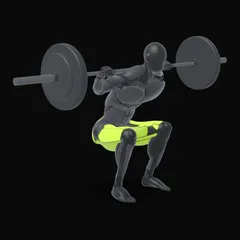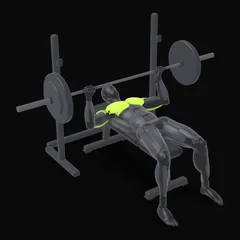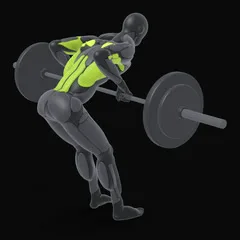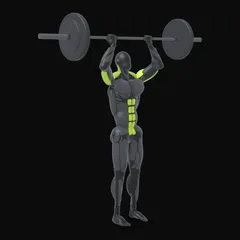
A 5x5 workout program means five sets of five reps on a handful of big barbell lifts (squat, bench press, row, overhead press, deadlift), three times a week, adding weight almost every session. It’s one of the oldest and most effective ways for a beginner to get strong quickly. Below is how it works, a 12-week plan that takes you from pure session-to-session progression to a weekly structure once that runs out, and how to tell when it’s time for something else.
How 5x5 works
The format has been around for decades, popularized by strength coaches in the 1960s and 70s, and it endures because it’s simple. Five reps per set is heavy enough to build strength (roughly 80–85 % of your max once the weights get serious) and light enough to practice good technique. Five sets give you 25 quality reps per lift, which is enough practice and enough work to drive progress.
Heavy, low-rep training is the most direct route to a bigger 1RM. Strength gains are specific to load: a review of the repetition continuum concluded that heavier loads produce the largest strength gains, while muscle growth happens across a wide range of loads (Schoenfeld et al., 2021). For untrained lifters, training each muscle about three times a week has produced the biggest strength gains in meta-analytic data (Rhea et al., 2003). Squatting every session, as 5x5 has you do, fits that well.
The two workouts
| Workout A | Workout B |
|---|---|
| Back squat 5 × 5 | Back squat 5 × 5 |
| Bench press 5 × 5 | Overhead press 5 × 5 |
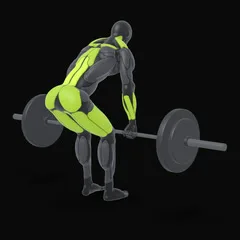
| Barbell row 5 × 5 | Deadlift 1 × 5 |
Train three non-consecutive days, alternating:
| Week | Mon | Wed | Fri |
|---|---|---|---|
| 1, 3, 5… | A | B | A |
| 2, 4, 6… | B | A | B |
The deadlift gets only one work set because it’s the most fatiguing lift and you’re already squatting three times a week.
Rest 3 minutes between sets of squats, bench and overhead press, and up to 5 when the weights get heavy. Longer rest periods tend to produce better strength gains (Grgic et al., 2018), and on a 5x5 the fifth set is where it counts.
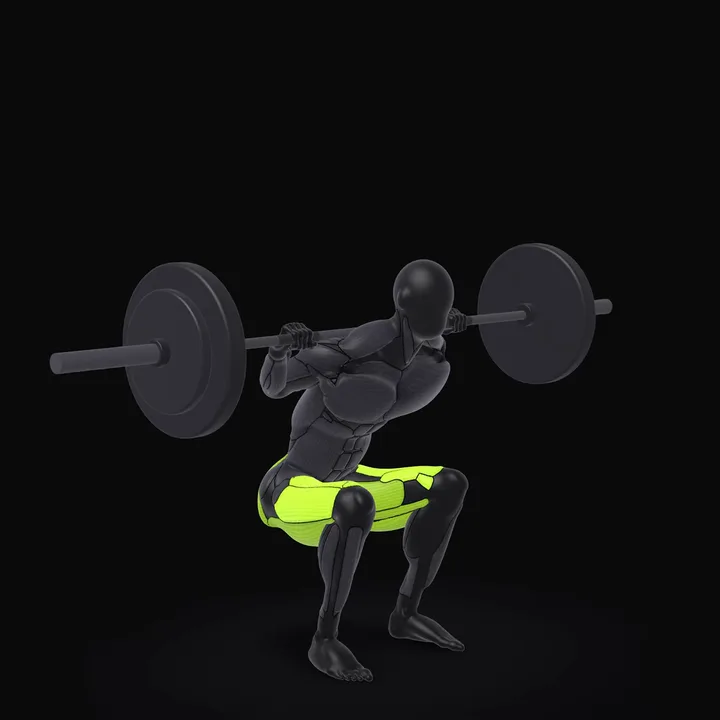 Barbell SquatPlace the bar on your upper back, not on your neck, and step out of the rack. Stand with feet slightly wider than shoulder width, toes turned out a little.How to do the Barbell Squat →
Choosing your starting weights
Start light. Lighter than feels useful. Early sessions are for learning the lifts, and the fast linear progress only lasts if you have room to climb.
- Complete beginner: empty bar (20 kg / 45 lb) on squat, bench, overhead press and row; 40 kg (95 lb) on the deadlift.
- Some lifting experience: about 50 % of the weight you could lift for 5 hard reps today.
Warm up with the empty bar and two or three lighter sets before your work sets. On the squat, for example: bar × 5 × 2, 40 kg × 5, 50 kg × 3, then 5 × 5 at 60 kg.
As the weights climb, your warm-up needs a few more steps. Here’s a sensible ramp for a 100 kg squat day:
| Set | Weight | Reps | Rest |
|---|---|---|---|
| 1 | 20 kg (bar) | 5 × 2 | As needed |
| 2 | 50 kg | 5 | 1 min |
| 3 | 70 kg | 3 | 1–2 min |
| 4 | 85 kg | 2 | 2 min |
| 5 | 95 kg | 1 | 2–3 min |
| Work | 100 kg | 5 × 5 | 3–5 min |
Bench and overhead press need a similar but shorter ramp. Because you’ve already squatted, the deadlift usually needs only two or three warm-up sets. Keep warm-up reps low so they don’t eat into your work sets.
The 12-week 5x5 plan
Weeks 1–4: add weight every session
Every time you complete all 25 reps, add weight next session:
| Lift | Increase per session |
|---|---|
| Squat | +2.5 kg (5 lb) |
| Bench press, row | +2.5 kg (5 lb) |
| Overhead press | +2.5 kg (5 lb), or +1.25 kg if available |
| Deadlift | +5 kg (10 lb) |
If you started light, these weeks feel easy. That’s the plan: you’re building a base of technique while the weight climbs fast. Here’s what the first four weeks look like for someone starting the squat at 40 kg and the bench at 30 kg:
| Week | Squat (Mon / Wed / Fri) | Bench press (A days) |
|---|---|---|
| 1 | 40 / 42.5 / 45 kg | 30 / 32.5 kg |
| 2 | 47.5 / 50 / 52.5 kg | 35 kg |
| 3 | 55 / 57.5 / 60 kg | 37.5 / 40 kg |
| 4 | 62.5 / 65 / 67.5 kg | 42.5 kg |
That’s close to 30 kg (65 lb) added to the squat in a month. It won’t continue at that pace forever, but it’s why 5x5 is so motivating at the start. The bench press moves slower because it’s trained only every other session and uses smaller muscles.
Weeks 5–8: handle the first stalls
At some point a lift will stop moving. The rules:
- Missed reps? Repeat the same weight next session.
- Missed the same weight three sessions in a row? Drop the weight by 10 % and add your usual increase each session again.
- Upper-body lifts stalling sooner than the squat? Normal. Switch them to smaller jumps (1–1.25 kg per session) if your gym has fractional plates.
- Stalled a second time after a reset? Move that lift to 3 × 5 and keep progressing.
During this phase, add two or three sets of accessories at the end of each session if you have energy: chin-ups, dips, face pulls, curls or planks.
Weeks 9–12: switch to weekly progression
When resets stop working, session-to-session progress is over. That’s a milestone, not a failure. Now each lift progresses once a week, with three different days:
| Day | Squat | Upper body | Pull |
|---|---|---|---|
| Mon (heavy) | 5 × 5 at this week’s target | Bench 5 × 5 | Row 5 × 5 |
| Wed (light) | 2 × 5 at about 80 % of Monday | Overhead press 4 × 5 | Deadlift 1 × 5 |
| Fri (top set) | Work up to one heavy set of 5, then 2 × 5 at 90 % | Bench: one heavy set of 5, then 2 × 5 at 90 % | Row 3 × 8 |
Add 2.5 kg (5 lb) to Monday’s targets each week you complete them. The Friday top set should beat last Friday’s. Wednesday is deliberately easy; it keeps your technique sharp without adding much fatigue.
Deloads on 5x5
During the session-to-session phase, the 10 % resets act as built-in deloads, so you rarely need a separate one. Once you’re on weekly progression, plan a lighter week every 6–8 weeks, or whenever several lifts stall together and your joints feel beaten up: keep the same days, drop to 3 × 5 at about 80 % of your recent work weights, and skip the accessories. The deload week guide covers the signs that you need one sooner.
Adapting 5x5 to your situation
Only two days a week
Run A and B once each per week, keeping the squat in both. Progress will be about a third slower than the classic version, and the deadlift and overhead press move only once a week. That’s fine: it’s still enough to get much stronger over a few months, and you’ll stall later because you recover so well between sessions.
Older lifters, smaller lifters, or slower recovery
Use smaller jumps from the start (1–1.25 kg on upper-body lifts, 2.5 kg on squat and deadlift), and consider 3 × 5 instead of 5 × 5 on the squat if three heavy squat days a week leave your knees or back sore. Starting the light Wednesday day earlier, around week 4 or 5, is another good option.
Lift swaps
| Problem | Swap | For |
|---|---|---|
| Lower back fried after rows | Chest-supported row 5 × 5 to 3 × 8 | Barbell row |
| Shoulder pain overhead | Seated dumbbell press or landmine press | Overhead press |
| No rack with safeties for bench | Dumbbell bench press | Barbell bench press |
| Deadlift from the floor feels wrong | Trap bar deadlift, if your gym has one | Conventional deadlift |
Keep the swap for the whole block so your numbers stay comparable.
How long does a session take?
Plan on 45–60 minutes early on and 75–90 minutes once the rests stretch to 4–5 minutes. If time is tight, superset the accessories, and do your warm-up sets for the next lift during the last rest period of the previous one.
Who 5x5 suits
5x5 is a great fit if you:
- are new to barbell training or coming back after a long break,
- want to get stronger on the main lifts as fast as possible,
- like simple plans with very few decisions,
- can train three times a week.
It’s less ideal if your main goal is building as much muscle as possible from the start, or if you’re already intermediate. The program has no direct work for arms, side delts, hamstrings or calves, and 25 heavy reps per lift is more strength practice than growth stimulus for experienced lifters. The guide on strength vs hypertrophy training explains where the two goals overlap.
When to move on
You’ve outgrown 5x5 when:
- you’ve completed the weekly progression phase and still stall,
- sessions take more than 90 minutes because of long rests between heavy sets,
- you’re more interested in size than in your numbers.
Good next steps are an intermediate full body workout plan, the upper lower split program (its strength-leaning version is a natural follow-on), or a powerlifting program for beginners if you want to compete.
Common 5x5 mistakes
- Starting too heavy. It cuts your linear progression from months to weeks.
- Cutting depth to make the weight. A squat that gets 20 kg heavier and 10 cm higher isn’t progress. If you’re unsure about depth, read how to squat properly and film a set.
- Not eating enough. Adding weight three times a week is hard on a calorie deficit. You don’t need a dirty bulk, but you do need enough food and protein.
- Skipping rest. Five heavy sets in a row with 90 seconds between them turns the last two sets into grinders.
- Never resetting. Forcing the same failed weight for weeks is how form breaks down and joints start to ache.
Frequently asked questions
Is 5x5 good for building muscle?
It builds muscle well for beginners, mainly because you get much stronger on big compound lifts. As you advance, the low exercise count and the lack of arm, shoulder and calf work start to limit growth, which is why most people add accessories or move to a hypertrophy-focused program after a few months.
How much weight should I add each 5x5 workout?
Start with 2.5 kg (5 lb) per session on the squat, bench, row and overhead press, and 5 kg (10 lb) on the deadlift. Once those jumps start failing, use smaller plates on the upper-body lifts, or switch to adding weight once a week.
Should I do 5x5 three times a week?
Yes, the classic setup is three full-body sessions a week on non-consecutive days, alternating two workouts. The squat is trained every session, which is a big reason it progresses so fast.
What do I do when I fail a 5x5 workout?
Repeat the same weight next time. If you fail the same weight three sessions in a row, drop it by about 10 percent and work back up. You'll usually pass your old stall point within two or three weeks.
How long does a 5x5 workout take?
About 45 to 60 minutes in the first weeks, when the weights are light and rests short. Later, with 3 to 5 minutes between heavy sets, expect 75 to 90 minutes. Sessions much longer than that are a sign it's time to move to a different program.
Can I add exercises to a 5x5 program?
A few. Two or three sets of curls, triceps work, face pulls or ab exercises at the end of the session won't hurt your progress. Avoid adding extra heavy compound lifts, since recovery is the bottleneck on 5x5.
Sources
- Schoenfeld BJ, Grgic J, Van Every DW, Plotkin DL (2021). Loading Recommendations for Muscle Strength, Hypertrophy, and Local Endurance: A Re-Examination of the Repetition Continuum. Sports
- Rhea MR, Alvar BA, Burkett LN, Ball SD (2003). A meta-analysis to determine the dose response for strength development. Medicine & Science in Sports & Exercise
- Grgic J, Schoenfeld BJ, Skrepnik M, Davies TB, Mikulic P (2018). Effects of Rest Interval Duration in Resistance Training on Measures of Muscular Strength: A Systematic Review. Sports Medicine