This full body workout plan gives you three different sessions a week: a heavy day (A), a medium day (B) and a light, higher-rep day (C). Every session trains your whole body, so each muscle is worked three times a week, but the exercises and rep ranges change from day to day. It’s built for lifters who have outgrown a basic beginner routine and want a full-body program that keeps working for months.
Why full body still works after the beginner stage
People tend to treat full-body training as a beginner thing and splits as what “real” lifters do. The research doesn’t back that up. A 2024 meta-analysis found no meaningful difference in strength or muscle growth between split and full-body routines when weekly volume was matched (Ramos-Campo et al., 2024). And when volume is equal, how often you train a muscle each week doesn’t seem to change growth much either (Schoenfeld et al., 2019).
So the real question is practical: does the program fit your week, and can you get enough quality sets in? Full body three days a week has real advantages:
- Missing a session costs less. Skip a push day on a split and your chest waits a week. Skip a full-body day and you’ve still trained everything twice.
- Fresh sets for every muscle. Six sets of quads spread over three days are usually better quality than six sets crammed into one leg day.
- Lots of practice on the main lifts. You squat, press and pull three times a week, which is great for technique and strength.
The catch is that sessions get long if you try to add too much. The plan below keeps each day at six or seven exercises.
If you’re comparing splits more broadly, the best workout split guide covers the trade-offs.
The program at a glance
| Day | Focus | Main rep range | Effort on most sets |
|---|---|---|---|
| A (Mon) | Heavy compounds | 4–6 | 2 reps in reserve |
| B (Wed) | Medium, different variations | 6–10 | 1–2 reps in reserve |
| C (Fri) | Light, higher reps, more isolation | 10–15 | 0–2 reps in reserve |
Changing the rep range across the week is called daily undulating periodization. It sounds fancy; in practice it means each day feels different, your joints get a break from heavy loading twice a week, and you train both strength and muscle in the same week. Muscle grows across a wide range of loads when sets are hard enough (Schoenfeld et al., 2021), so the light day isn’t a “recovery” day, it’s real work.
Day A: heavy
| Exercise | Sets × reps | Rest |
|---|---|---|
| Back squat | 4 × 4–6 | 3 min |
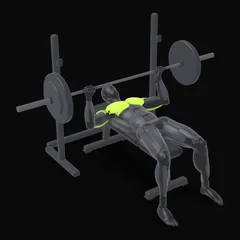
| Bench press | 4 × 4–6 | 3 min |
| Barbell row | 3 × 6–8 | 2 min |
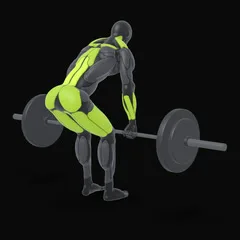
| Romanian deadlift | 3 × 6–8 | 2–3 min |
| Lateral raise | 3 × 12–15 | 60 s |
| Hanging knee raise | 2 × 10–15 | 60 s |
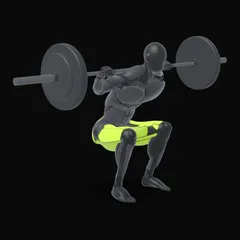
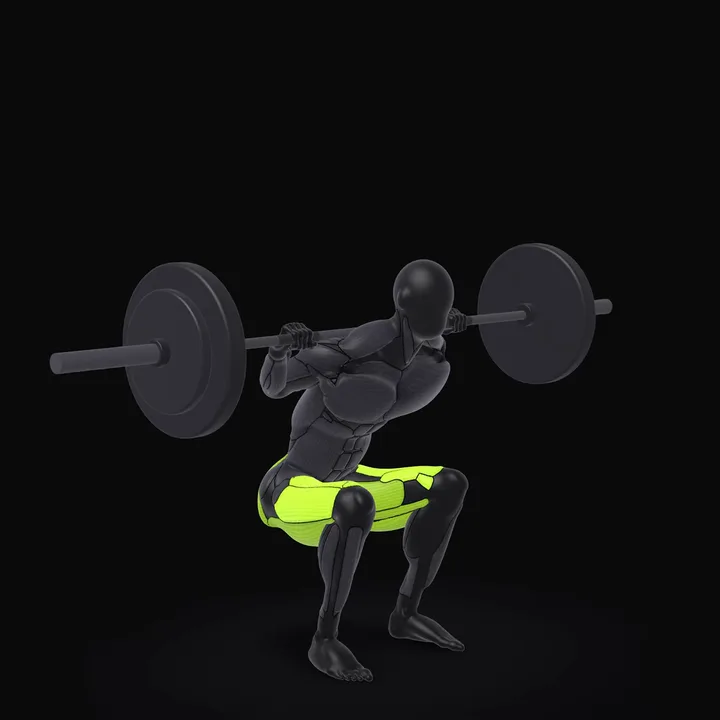 Barbell SquatPlace the bar on your upper back, not on your neck, and step out of the rack. Stand with feet slightly wider than shoulder width, toes turned out a little.How to do the Barbell Squat →
Day B: medium
| Exercise | Sets × reps | Rest |
|---|---|---|
| Deadlift | 3 × 4–6 | 3 min |
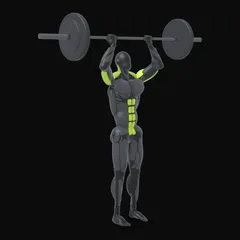
| Overhead press | 3 × 6–8 | 2–3 min |
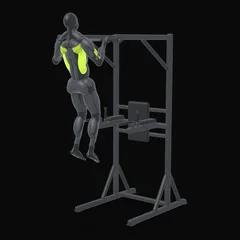
| Pull-up (add weight or assistance as needed) | 3 × 6–10 | 2 min |
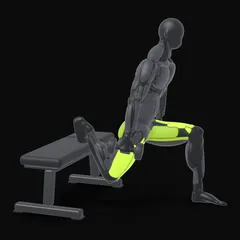
| Bulgarian split squat | 3 × 8–10 per leg | 2 min |
| Incline dumbbell press | 3 × 8–10 | 2 min |
| EZ-bar curl | 2 × 8–12 | 60–90 s |
| Triceps pushdown | 2 × 10–12 | 60–90 s |
The deadlift sits on the medium day on purpose. Putting it on the heavy day after heavy squats makes Monday brutal and leaves your lower back cooked for Wednesday.
Day C: light
| Exercise | Sets × reps | Rest |
|---|---|---|
| Leg press | 3 × 12–15 | 2 min |
| Machine chest press | 3 × 10–12 | 90 s |
| Lat pulldown | 3 × 10–12 | 90 s |
| Seated leg curl | 3 × 10–15 | 90 s |
| Seated cable row | 2 × 12–15 | 90 s |
| Cable lateral raise + face pull (superset) | 2 × 12–20 each | 60 s |
| Standing calf raise | 3 × 10–15 | 60 s |
Day C uses machines and cables because they let you push close to failure safely when you’re tired at the end of the week. Take the last set of each exercise to one rep shy of failure, or to failure on the isolation moves.
Weekly volume per muscle
| Muscle | Hard sets per week (direct) |
|---|---|
| Quads | 10 (+ deadlifts) |
| Hamstrings and glutes | 9 (+ squats and lunges) |
| Chest | 10 |
| Back | 11 |
| Shoulders | 3 presses + 7 raises and face pulls |
| Biceps / triceps | 2 each direct + lots of pulling and pressing |
| Calves | 3 |
That’s in the range that works well for most intermediates. If you want more on a lagging muscle, add 2 sets of one exercise for it on Day B or C, not three new exercises. For how to set your total, see how many sets per muscle per week.
How to progress
Treat each day as its own program. Monday’s squat is compared to last Monday’s squat, not to Friday’s leg press.
- Day A (heavy): use load progression. When you hit 6 reps on every set at 2 reps in reserve, add 2.5 kg (5 lb) to upper-body lifts or 5 kg (10 lb) to squats next week.
- Days B and C: use double progression. Add reps until you reach the top of the range on every set, then add the smallest weight step.
- Everything: if a lift stalls for two weeks, reduce the weight by 5–10 % and rebuild.
This is progressive overload in its most practical form. Three different sessions mean three sets of numbers to remember, so write them down.
A 9-week block
| Weeks | Plan |
|---|---|
| 1 | Start 10 % lighter than you think you can handle; learn the rhythm of the three days |
| 2–6 | Progress every session you can |
| 7 | Deload: same exercises, 2 sets each, weights about 10 % lighter |
| 8–9 | Push for rep PRs on Day A and B lifts, then reassess |
How to warm up without wasting 20 minutes
Full-body days start with a big lift, so a short, specific warm-up is enough:
- 3–5 minutes on a bike or rower, just enough to feel warm.
- Ramp-up sets for the first exercise. For a 100 kg (225 lb) squat on Day A: empty bar × 10, 60 kg × 5, 80 kg × 3, 90 kg × 1, then your work sets.
- One or two lighter sets before each later compound. By the time you get to the bench press, your body is warm; you only need to groove the movement.
- No warm-up sets for isolation work. Use the first rep or two of the first set as your warm-up.
That’s 8–10 minutes total. Long stretching routines before lifting aren’t needed; save them for after the session or a separate day.
What if you have a fourth day?
Some weeks you’ll have time for an extra session. Don’t repeat Day A. Add a short Day D of 30–40 minutes with whatever is lagging: for example 3 sets each of incline curls, overhead triceps extensions, lateral raises and calf raises. It adds volume to small muscles that recover quickly, without adding fatigue to your squat, bench and deadlift.
If you can train four days every week, a dedicated four-day program is a better fit than full body plus extras.
Exercise swaps
| Instead of | Use |
|---|---|
| Back squat | Hack squat or goblet squat |
| Deadlift | Trap bar deadlift |
| Bench press | Dumbbell bench press |
| Barbell row | Chest-supported row |
| Pull-up | Lat pulldown |
Pick a swap and keep it for the whole block.
Who this plan is for
Run this program if:
- you’ve done a beginner plan (like the beginner gym workout plan) for at least 3–6 months and progress has slowed,
- you can train three days a week but not reliably four or more,
- you like seeing each lift several times a week.
If you can only make two sessions most weeks, use the 2 day workout plan instead; it’s built for that. And if you’re unsure how many sessions you should aim for, how many days a week to work out breaks it down by goal.
Common mistakes on full-body programs
- Making every day heavy. Three heavy squat days a week wears most people down within a month. The heavy/medium/light structure is the point of the program.
- Adding “just one more” exercise. Seven exercises is the cap. Long sessions mean sloppy last exercises and skipped workouts.
- Rushing rest on Day A. Heavy sets of 4–6 need 2–3 minutes or your later sets fall apart.
- Ignoring how you feel. If you slept four hours, do Day A with the weights from Day B. Being flexible keeps you consistent.
Frequently asked questions
Is full body 3 times a week enough to build muscle?
Yes. Three full-body sessions give each muscle three exposures and plenty of weekly sets. Studies comparing full-body and split routines find similar muscle growth when total volume is the same, so the deciding factor is whether you can do the work and recover from it.
Can I do full body workouts on consecutive days?
It's better to leave a day between sessions, especially with heavy squats and deadlifts in every workout. If you must train two days in a row, put the light day (Day C) second.
How is this different from a beginner full body program?
A beginner plan repeats two simple workouts with the same rep ranges. This one uses three different sessions with heavy, medium and light days, more exercises per session and more weekly volume, which suits lifters who have stopped progressing every week.
How long do full body workouts take?
About 60 to 75 minutes for these sessions, including warm-up sets. The heavy day takes longest because of longer rests. Supersetting the arm and shoulder accessories saves 10 minutes if you need it.
Should I do cardio on a full body program?
You can. Easy cardio on rest days or after lifting is fine. Keep hard intervals away from the heavy day so they don't eat into your squat and deadlift performance.
Sources
- Ramos-Campo DJ, Benito-Peinado PJ, Andreu-Caravaca L, Rojo-Tirado MA, Rubio-Arias JÁ (2024). Efficacy of Split Versus Full-Body Resistance Training on Strength and Muscle Growth: A Systematic Review With Meta-analysis. Journal of Strength and Conditioning Research
- Schoenfeld BJ, Grgic J, Krieger J (2019). How many times per week should a muscle be trained to maximize muscle hypertrophy? A systematic review and meta-analysis of studies examining the effects of resistance training frequency. Journal of Sports Sciences
- Schoenfeld BJ, Grgic J, Van Every DW, Plotkin DL (2021). Loading Recommendations for Muscle Strength, Hypertrophy, and Local Endurance: A Re-Examination of the Repetition Continuum. Sports