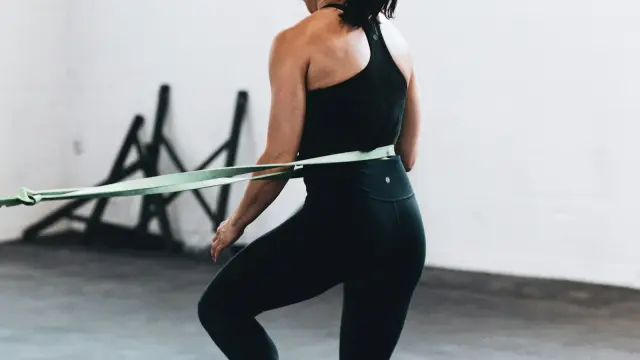
To do a push-up correctly, place your hands a bit wider than your shoulders, form a straight line from head to heels, brace your midsection and glutes, then lower your chest to the floor with your elbows angled about 45° from your body, and push back up to straight arms. If that’s too hard, raise your hands on a bench; if it’s too easy, raise your feet, slow down or add weight. Below is the full technique, the variations from easiest to hardest and how to use push-ups to build muscle.
Perfect push-up form
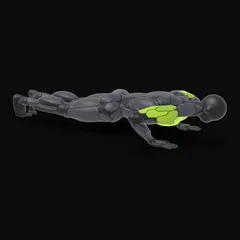
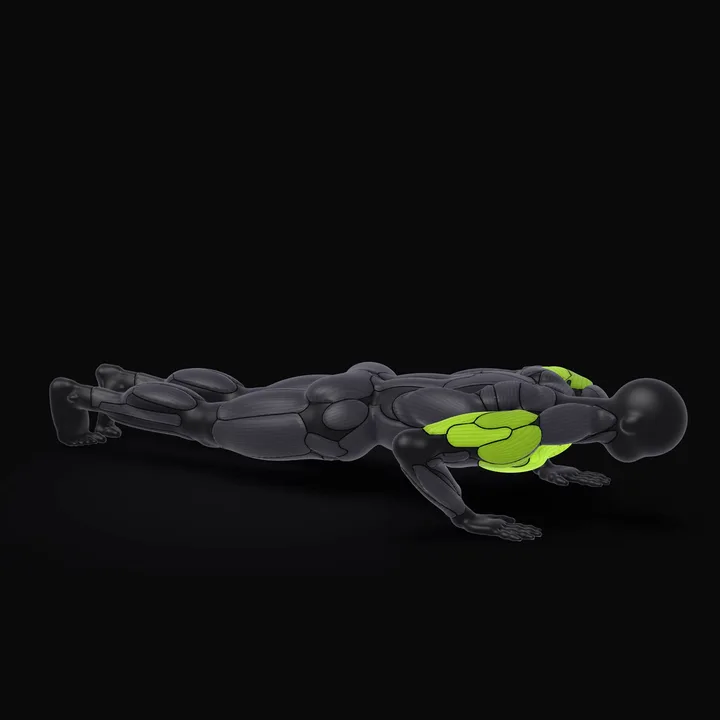 Push-upPlace your hands on the floor slightly wider than your shoulders and form a straight line with your body. Brace your abs and glutes so your lower back doesn't sag.How to do the Push-up →
- Hands: slightly wider than shoulder-width, under or slightly outside your shoulders, fingers spread and pointing forward or slightly out.
- Body line: straight from your head to your heels. Squeeze your glutes and brace your abs so your hips don’t sag or pike up.
- Head: neutral, looking at the floor slightly ahead of your hands. Don’t reach with your chin.
- Lower: bend your elbows, keeping them about 45° from your body (an arrow shape from above, not a T). Lower until your chest touches the floor or is a fist’s height above it.
- Push: press the floor away until your arms are straight. Your whole body rises as one piece.
- At the top: push a little further so your shoulder blades spread apart. This trains the serratus anterior and keeps your shoulders healthy.
A good rhythm is about 2 seconds down, a brief pause, then a strong push up.
Cues that keep each rep clean
- Setup: “Screw your hands into the floor.” Rotate your hands outward against the floor without moving them; your elbows tuck and your shoulders feel stable.
- Lowering: “Chest to the floor, not chin.” Your chest leads and your neck stays neutral.
- Bottom: “Stay a plank.” Glutes and abs stay tight, so your hips don’t touch first.
- Pushing up: “Push the floor away.” Think of moving your body away from the floor, not lifting yourself.
Warm up your wrists and shoulders
Push-ups put your wrists in a lot of extension. Before your first set, spend a minute on hands and knees rocking gently forward and back over your palms, then do 10 arm circles each way and 10 slow shoulder taps in the top push-up position. Finish with one easy set of incline push-ups.
Common push-up mistakes
| Mistake | Fix |
|---|---|
| Hips sagging | Squeeze glutes, brace abs; use an easier variation until you can hold the line |
| Hips piking up | Lower your hips into line; brace |
| Elbows flared to 90° | Tuck them to about 45°; turn hands slightly out |
| Half reps | Chest to the floor or close; arms fully straight at the top |
| Head dropping first | Keep your neck neutral; your chest leads |
| Wrist pain | Use push-up handles or dumbbells to keep wrists straight |
Push-up progressions: easiest to hardest
Find the level where you can do 5–15 good reps, and move up when you can do 3 sets of about 15–20.
| Level | Variation | How it changes difficulty |
|---|---|---|
| 1 | Wall push-up | Very little body weight on the hands |
| 2 | Incline push-up (hands on a bench or table) | Lower the surface to make it harder |
| 3 | Knee push-up | Shorter lever; keep the body straight from the knees |
| 4 | Push-up | Full body weight |
| 5 | Decline push-up (feet on a bench) | More weight on the hands, more upper chest |
| 6 | Deficit push-up (hands on plates or handles) | Deeper stretch for the chest |
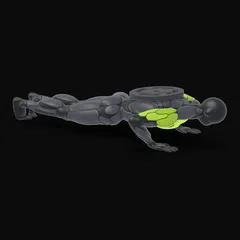
| 7 | Weighted push-up | Plate on the upper back or a weighted vest |
| 8 | Single-arm push-up | Strength and stability on one side |
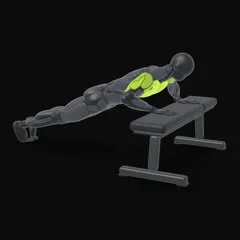
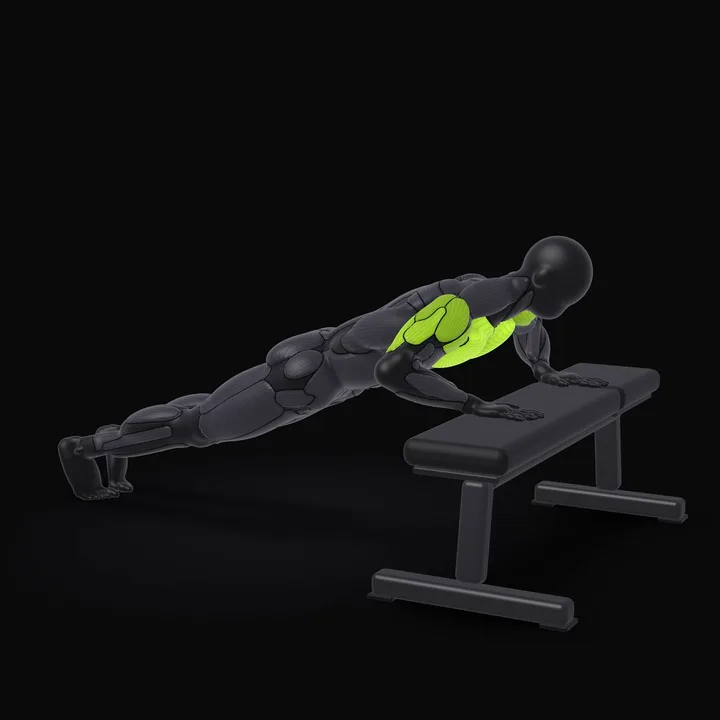 Incline Push-upPlace your hands on the edge of a bench, slightly wider than your shoulders. Walk your feet back so your body forms a straight line.How to do the Incline Push-up →
Other useful variations:
- Close-grip (diamond) push-up: more triceps.
- Wide push-up: a bit more chest, shorter range.
- Pike push-up: hips high, more shoulders; a step toward handstand push-ups.
Your first full push-up: a 6-week example
Here’s how someone who can do 10 incline push-ups with hands on a kitchen counter, and no full push-ups, might progress, training three times a week:
| Week | Main exercise | Sets × reps | Extra |
|---|---|---|---|
| 1 | Incline push-up, kitchen counter | 3 × 10 | Plank 3 × 20 s |
| 2 | Incline push-up, kitchen counter | 3 × 15 | Plank 3 × 30 s |
| 3 | Incline push-up, table or bench (lower) | 3 × 10 | 2 × 5 slow negatives from the floor |
| 4 | Incline push-up, bench | 3 × 13 | 2 × 5 slow negatives |
| 5 | Incline push-up, low step | 3 × 10 | 2 × 3 full push-ups, as many sets as clean |
| 6 | Full push-up | 4 × 3–5 | Finish with 1 set of incline push-ups to near failure |
A negative means getting into the top of a push-up and lowering yourself to the floor over 3–5 seconds, then resetting on your knees. It’s the quickest bridge between the incline and the floor. If a step feels too big, stay on the same height for another week.
How to test your max
Testing every few weeks shows real progress. Warm up, then do one set of strict push-ups at a steady pace: chest to a fist’s height or lower, arms straight at the top, no rest in the top position longer than a breath. Stop when your form breaks, not when you can wriggle out one more. Write down the number and test again in 4 weeks, under the same conditions.
Do push-ups build muscle?
Yes, as long as they’re hard enough. In one study, band-loaded push-ups and bench presses at matched muscle activity produced similar strength gains over five weeks (Calatayud et al., 2015). In another, push-ups adjusted to match a light bench press load produced similar gains in chest and triceps thickness and in bench press strength over eight weeks (Kikuchi & Nakazato, 2017).
The catch: once you can do 30 or 40 push-ups, regular push-ups become an endurance exercise. To keep building muscle, make each rep harder rather than doing more of them:
- Raise your feet.
- Use handles for a deeper range.
- Slow down to 3–4 seconds on the way down with a pause at the bottom.
- Add weight with a plate on your upper back (have a partner place it) or a vest.
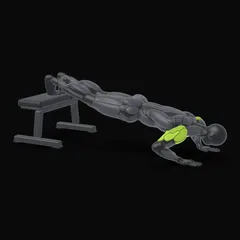
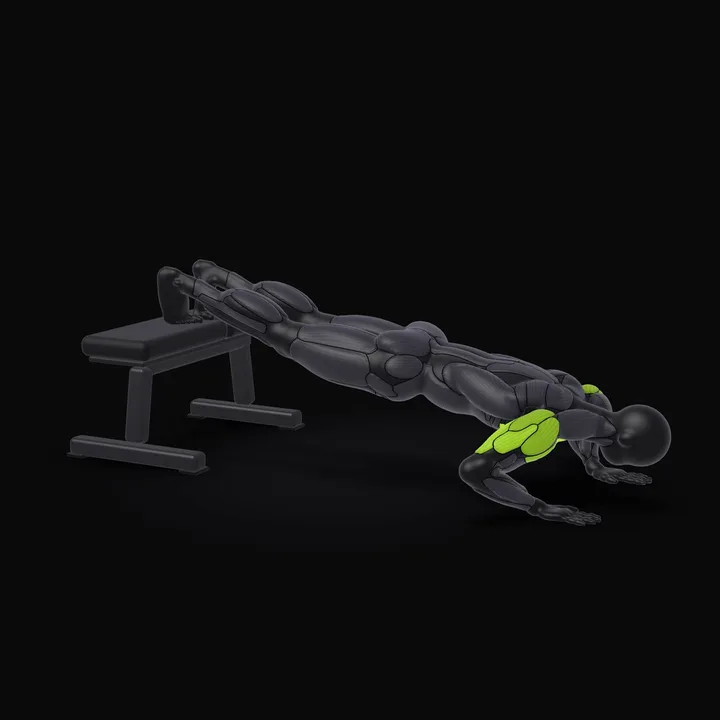 Decline Push-upPut your toes on a bench and your hands on the floor, slightly wider than your shoulders. Brace your core to keep your body in a straight line.How to do the Decline Push-up →
How to use push-ups in a program
| Goal | Sets × reps | Frequency |
|---|---|---|
| First push-up | Incline push-ups 3 × 8–15, lowering the surface | 3 times a week |
| Muscle | 3–4 sets of 8–20, 0–2 reps from failure, harder variations as needed | 2–3 times a week |
| More reps (a test, a military or police standard) | 5–6 sets of 50–60 % of your max, plus one max set a week | 3 times a week |
| Strength | Weighted or single-arm work, 4 × 5–8 | 2 times a week |
For muscle: 3–4 sets close to failure, 2–3 times a week. Count push-ups as chest sets, just like bench press. They work as a main exercise at home, or as a finisher after pressing in the gym. For how chest volume adds up over a week, see how to build chest muscle.
For your first push-ups: do incline push-ups 3 times a week, lowering the surface every week or two. Most people get to full push-ups within a month or two.
At home: combine push-ups with rows, split squats and hip work. The home workout without equipment has a full plan, and calisthenics for beginners shows the full push-up ladder alongside pull-ups and dips.
Track the variation, reps and tempo for each set, so you can see when it’s time to step up.
Push-ups and health
Push-up capacity is a simple test of upper body strength and endurance. In a 10-year study of more than 1,100 male firefighters, those who could do more than 40 push-ups had far fewer cardiovascular events than those who could do fewer than 10 (Yang et al., 2019). That’s an association in one group of active men, not proof that push-ups prevent heart disease, but it’s a nice reason to keep them in your routine.
Push-ups vs bench press
Neither is better; they’re different tools. The bench press is easier to load heavily and progress in small steps. Push-ups need no equipment, let your shoulder blades move freely, and train your core at the same time. Many lifters do both. If the bench press is your main lift, how to bench press covers its technique.
Frequently asked questions
How many push-ups should I do a day?
There's no magic number. For building muscle, 3 to 4 hard sets two or three times a week works better than a fixed daily total. Each set should end close to failure, whether that's 8 reps or 30.
Do push-ups build muscle as well as the bench press?
When the load is matched, yes. Studies comparing push-ups and bench press at similar effort found similar gains in chest and triceps size and strength. The challenge is making push-ups harder as you get stronger.
Why do push-ups hurt my wrists?
Your wrists are bent back under load. Try push-up handles, dumbbells or fists to keep your wrists straight, turn your hands slightly outward, and warm up your wrists before training.
Are knee push-ups worth doing?
Yes, as a step toward full push-ups. Keep your body straight from knees to head. Incline push-ups with hands on a bench are often a better regression because they keep the full-body position.
How many push-ups is good?
As a rough guide, 10 to 20 strict push-ups is a solid level for most adults, 30 or more is very good. In one study of male firefighters, those who could do more than 40 had far fewer heart problems over ten years, though that's an association, not proof of cause.
Sources
- Calatayud J, Borreani S, Colado JC, Martin F, Tella V, Andersen LL (2015). Bench press and push-up at comparable levels of muscle activity results in similar strength gains. Journal of Strength and Conditioning Research
- Kikuchi N, Nakazato K (2017). Low-load bench press and push-up induce similar muscle hypertrophy and strength gain. Journal of Exercise Science & Fitness
- Yang J, Christophi CA, Farioli A, Baur DM, Moffatt S, Zollinger TW, Kales SN (2019). Association Between Push-up Exercise Capacity and Future Cardiovascular Events Among Active Adult Men. JAMA Network Open