A home workout without equipment can build real muscle if you do two things: take your sets close to failure, and keep moving to harder variations of each exercise as you get stronger. Push-ups, split squats, single-leg hip work and table rows cover your whole body. Below are the progressions for each movement, a 3-day sample week, and the methods that keep you progressing for months without buying a single dumbbell.
Can bodyweight training really build muscle?
Yes, with one condition: the sets have to be hard. A network meta-analysis covering low, moderate and high loads found that muscle growth was similar across load ranges, while heavier loads had an edge for maximal strength (Lopez et al., 2021). Your muscles don’t know whether the resistance is a barbell or your own body. They respond to tension and effort.
Push-ups are the best-studied example. When push-ups were loaded with elastic bands to match the muscle activity of a 6-rep bench press, strength gains over five weeks were similar to bench pressing (Calatayud et al., 2015). Another study found that progressing through harder push-up variations improved bench press strength about as well as training on the bench press itself over four weeks (Kotarsky et al., 2018).
The limit isn’t the muscle; it’s you running out of harder variations. For legs especially, bodyweight gets easy fast for two-legged exercises. That’s why single-leg work is the backbone of the plan below.
The four movement patterns and their progressions
Work through each ladder from the top. Stay on a level until you can do 3 sets of about 15–20 clean reps, then move down to the next one.
Push
| Level | Exercise |
|---|---|
| 1 | Incline push-up (hands on a table or counter) |
| 2 | Knee push-up |
| 3 | Push-up |
| 4 | Decline push-up (feet on a chair) |
| 5 | Close-grip (diamond) push-up or slow-tempo decline push-ups |
| 6 | Single-arm push-up (assisted at first) |
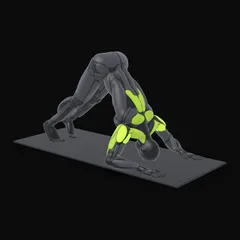
For shoulders, add pike push-ups once regular push-ups are solid. For triceps, bench dips off a sturdy chair work, but stop if they bother the front of your shoulders.
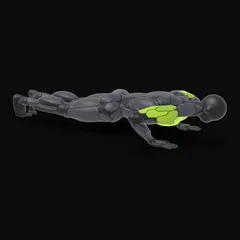
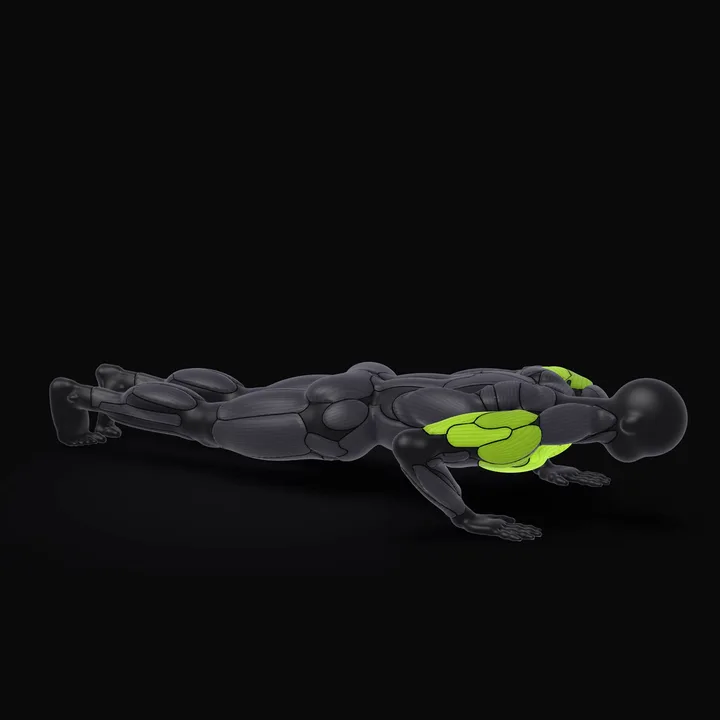 Push-upPlace your hands on the floor slightly wider than your shoulders and form a straight line with your body. Brace your abs and glutes so your lower back doesn't sag.How to do the Push-up →
Pull
This is the hard one without equipment. Your options:
| Level | Exercise |
|---|---|
| 1 | Superman holds and prone back raises |
| 2 | Towel row: loop a towel around a closed door’s handles on both sides, lean back and row |
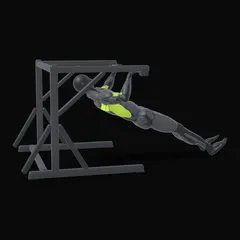
| 3 | Table row (inverted row), knees bent |
| 4 | Table row with legs straight |
| 5 | Table row with feet raised on a chair |
Only do table rows under a heavy, solid table that won’t tip, and test it carefully first. Honestly, if you’re serious about training at home, a doorway pull-up bar is the single best purchase you can make. It unlocks chin-ups and pull-ups, which build your back and biceps better than anything else here. The guide on how to do pull-ups takes you from zero to your first rep.
Squat and lunge
| Level | Exercise |
|---|---|
| 1 | Squat to a chair |
| 2 | Bodyweight squat |
| 3 | Walking lunge or reverse lunge |
| 4 | Bulgarian split squat (rear foot on a chair or sofa) |
| 5 | Bulgarian split squat with a 3-second lowering and a pause at the bottom |
| 6 | Assisted pistol squat, then pistol squat |
The Bulgarian split squat is the most useful exercise in this whole article. It’s hard enough to challenge strong legs for 10–15 reps, and you can make it harder by slowing down or by holding a full backpack.
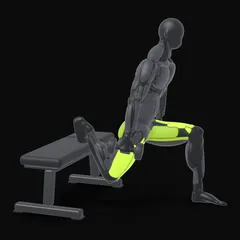
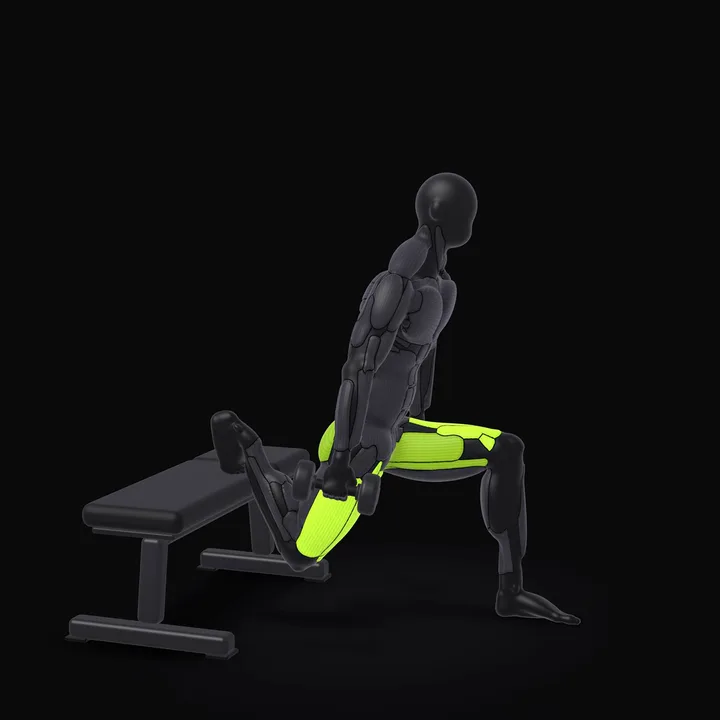 Dumbbell Bulgarian Split SquatStand in front of a bench and rest the top of your rear foot on it, holding a dumbbell in each hand. Lower straight down by bending your front knee until your thigh is nearly parallel to the floor.How to do the Dumbbell Bulgarian Split Squat →
Hinge and glutes
| Level | Exercise |
|---|---|
| 1 | Glute bridge |
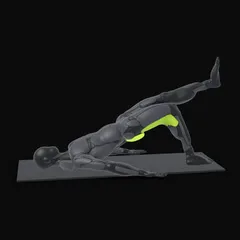
| 2 | Single-leg glute bridge |
| 3 | Single-leg hip thrust (shoulders on the sofa) |
| 4 | Single-leg Romanian deadlift, slow, holding a backpack |
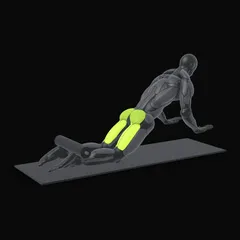
| 5 | Nordic hamstring curl (feet anchored under a sofa), lowering only at first |
Nordic curls are brutal on the hamstrings. Start with just 3–5 slow lowerings and expect sore legs for a few days.
Core and calves
Planks, side planks, hollow holds and reverse crunches cover the core. For calves, do single-leg calf raises on a stair step, with a full stretch at the bottom.
A sample home workout week
Three full-body sessions, for example Monday, Wednesday and Friday. Pick the level of each exercise that lets you do the reps listed with good form and a real effort.
Day 1
| Exercise | Sets × reps | Rest |
|---|---|---|
| Push-up (your level) | 4 × 8–20 | 90 s |
| Bulgarian split squat | 3 × 10–15 per leg | 60–90 s |
| Table row or towel row | 4 × 8–15 | 90 s |
| Single-leg glute bridge | 3 × 12–20 per leg | 60 s |
| Plank | 3 × 30–60 s | 45 s |
Day 2
| Exercise | Sets × reps | Rest |
|---|---|---|
| Pike push-up | 3 × 6–12 | 90 s |
| Reverse lunge | 3 × 12–15 per leg | 60–90 s |
| Table row, feet raised | 3 × 8–12 | 90 s |
| Single-leg Romanian deadlift | 3 × 10–12 per leg | 60 s |
| Bench dips (chair) | 3 × 10–15 | 60 s |
| Single-leg calf raise | 3 × 12–20 per leg | 45 s |
Day 3
| Exercise | Sets × reps | Rest |
|---|---|---|
| Decline push-up | 4 × 6–15 | 90 s |
| Bulgarian split squat, slow lowering | 3 × 8–12 per leg | 90 s |
| Towel row or superman | 3 × 12–15 | 60 s |
| Nordic curl (lowering only) | 3 × 3–6 | 2 min |
| Hollow hold + side plank | 2 rounds each | 45 s |
Each session takes 30–40 minutes. If you want more, add a fourth day or one set to each exercise, but only once three days feel manageable.
How to keep progressing at home
In a gym you add weight. At home you have more levers, and you should use them in roughly this order:
- More reps. Within your target range, beat last time’s numbers.
- Harder variation. When you hit the top of the range on every set, move down the ladder.
- Slower tempo. A 3–4 second lowering and a 1-second pause at the bottom make any exercise harder. It’s especially useful for split squats and push-ups.
- Shorter rest or more sets. Use this when you’ve run out of variations, adding one set at a time.
- Load from the house. A backpack filled with books or water bottles turns split squats, push-ups and glute bridges into loaded exercises. Weigh it and note the weight.
All of this is progressive overload applied to bodyweight. And it only works if you know what you did last time. Write down the variation, reps and tempo for every set.
How hard should bodyweight sets be?
Harder than most people think. Twenty easy push-ups do much less than twelve where the last two are a real grind. Finish most sets with one or two reps in reserve: you could do one or two more with good form, but not five. If you’re unsure, take your last set of each exercise to failure once a week and you’ll quickly learn what “close” feels like. The article on training to failure explains how far to push and when.
Common home workout mistakes
- Doing circuits of easy exercises forever. Fifty jumping jacks and thirty air squats will make you sweat, but once they’re easy they stop building muscle. Sweat isn’t the goal; hard sets are.
- Rushing the reps. Bouncing out of the bottom of a push-up or squat takes tension off the muscle. Control the lowering, especially on the hardest variations.
- Skipping pulling work. Push-ups every day and no rows is how home trainees end up with rounded shoulders. Match your pushing sets with pulling sets, even if the pulling is just towel rows.
- Changing the routine every week. Keep the same exercises for at least four to six weeks so you can see whether your reps go up.
- Training in random gaps. Put three sessions in your calendar like appointments. At home there’s no commute to commit you, so a fixed time does that job.
Where home training hits its limits
Be realistic about two things:
- Legs get harder to challenge. Once you can do 20 slow Bulgarian split squats per leg, bodyweight leg work becomes more conditioning than muscle building. A pair of adjustable dumbbells or a kettlebell extends your progress by years. The dumbbell only workout plan shows what to do with them.
- Pulling without a bar is limited. Table rows work, but a pull-up bar works better.
None of this means you need a gym. It means a couple of small purchases go a long way after the first six months. If you want to go deeper into bodyweight skills, calisthenics for beginners builds on everything here.
Frequently asked questions
Can you build muscle at home without equipment?
Yes, especially in your first year or two of training. Muscle responds to hard sets, not to the source of the resistance. The challenge is making exercises harder as you get stronger, which is why progressions like incline to standard to decline push-ups matter more than any single workout.
How many times a week should I do a home workout?
Three full-body sessions a week on non-consecutive days is a good default. Bodyweight sessions are less fatiguing for your joints than heavy lifting, so four short sessions also work if that fits your week better.
How do I train my back at home with no equipment?
Rows under a sturdy table, towel rows from a door frame and prone back raises all work. If you can spend money on one thing, buy a doorway pull-up bar: pull-ups and chin-ups are the best back builders you can do at home.
How many reps should I do in a bodyweight workout?
Anywhere from about 5 to 30 reps per set builds muscle as long as you finish each set close to failure. When you can do more than about 25 to 30 clean reps, move to a harder variation rather than adding endless reps.
Is a 20-minute home workout enough?
It can be if it's hard. Twenty minutes of focused sets with short rests, three or four times a week, beats an hour of half-hearted exercise. The sample week below takes 30 to 40 minutes per session.
Sources
- Kotarsky CJ, Christensen BK, Miller JS, Hackney KJ (2018). Effect of Progressive Calisthenic Push-up Training on Muscle Strength and Thickness. Journal of Strength and Conditioning Research
- Calatayud J, Borreani S, Colado JC, Martin F, Tella V, Andersen LL (2015). Bench press and push-up at comparable levels of muscle activity results in similar strength gains. Journal of Strength and Conditioning Research
- Lopez P, Radaelli R, Taaffe DR, et al. (2021). Resistance Training Load Effects on Muscle Hypertrophy and Strength Gain: Systematic Review and Network Meta-analysis. Medicine & Science in Sports & Exercise