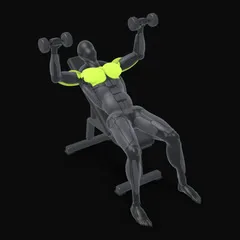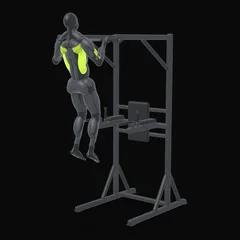
A bulking workout plan should do one thing: make sure the extra calories you’re eating go into muscle rather than fat. That means training each muscle twice a week, gradually increasing your weekly sets over the bulk, and pushing your main lifts up steadily. Below are the rules for training in a surplus and a complete 12-week, 5-day program that ramps up volume in three phases.
Why the training matters more than the food
Eating more than you burn makes muscle gain easier, but it doesn’t direct the extra energy anywhere in particular. Without a strong training stimulus, a surplus mostly becomes body fat. A review on energy surplus and hypertrophy concluded that a surplus supports muscle growth, but that the size of the surplus should be modest, because larger surpluses add fat without clearly adding more muscle, especially in trained lifters (Slater et al., 2019).
For the food side, a review of off-season bodybuilding nutrition recommends a surplus of roughly 10–20 % above maintenance and a gain of about 0.25–0.5 % of body weight per week for novices and intermediates (Iraki et al., 2019). The details of calories, protein and food choices are in how to bulk. This article is about what to do in the gym.
The rules for training on a bulk
1. Use the extra recovery to do more. A surplus is when you recover best. A 2025 meta-regression found that muscle growth keeps increasing as weekly sets go up, though each extra set adds less than the one before (Pelland et al., 2025). A bulk is the right time to work toward the higher end of what you can recover from. Start moderate, then add.
2. Train each muscle twice a week. Spreading volume over two sessions keeps every set productive. A five-day upper/lower rotation does this neatly.
3. Progress on purpose. In a deficit, holding your strength is a win. On a bulk, your main lifts should be going up. If your bench press hasn’t moved in a month while the scale climbs, something’s off: effort, sleep, or the program.
4. Mix heavy and moderate work. Heavy sets of 5–8 on compound lifts build the strength that lets you load everything else heavier. Sets of 8–15 and 12–20 on isolation work pile up volume without beating up your joints.
5. Keep cardio in. Two or three easy sessions a week keep your conditioning up, which helps you handle high-volume sessions. Just eat for them.
The 12-week bulking program
Five sessions a week: four upper/lower days plus a fifth day for arms, shoulders and weak points.
| Mon | Tue | Wed | Thu | Fri | Sat | Sun |
|---|---|---|---|---|---|---|
| Upper A | Lower A | Rest | Upper B | Lower B | Arms and delts | Rest |
Upper A (strength focus)
| Exercise | Sets × reps | Rest |
|---|---|---|
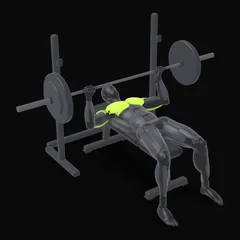
| Bench press | 3 × 5–8 | 3 min |
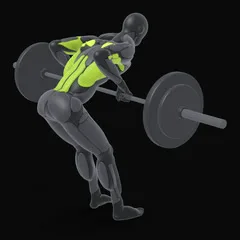
| Barbell row | 3 × 6–10 | 2 min |
| Incline dumbbell press | 3 × 8–12 | 2 min |
| Lat pulldown | 3 × 8–12 | 2 min |
| Lateral raise | 2 × 12–20 | 60 s |
Lower A (squat focus)
| Exercise | Sets × reps | Rest |
|---|---|---|
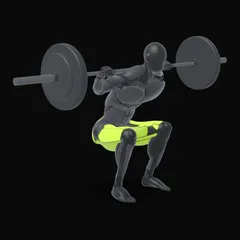
| Back squat | 3 × 5–8 | 3 min |
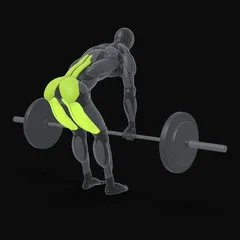
| Romanian deadlift | 3 × 8–10 | 2–3 min |
| Leg press | 3 × 10–15 | 2 min |
| Lying leg curl | 3 × 10–12 | 90 s |
| Standing calf raise | 3 × 10–15 | 60 s |
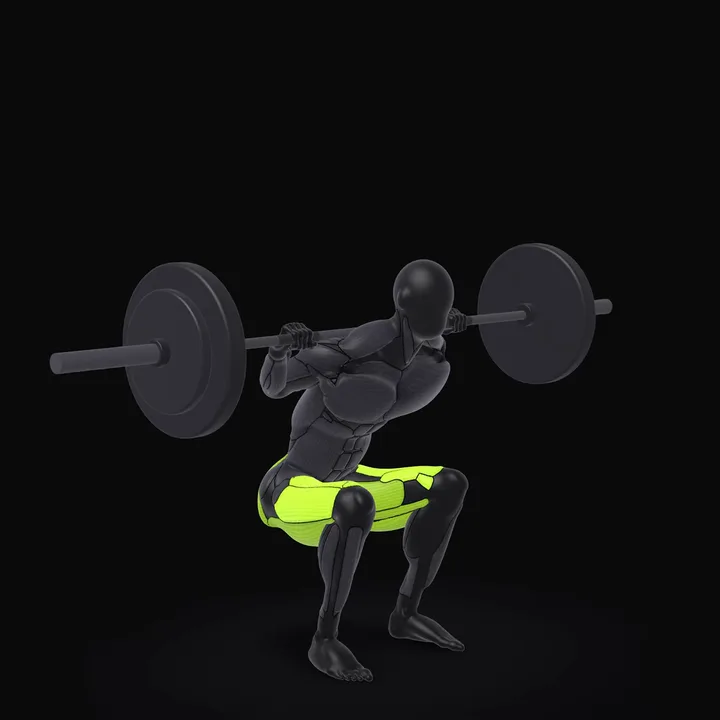 Barbell SquatPlace the bar on your upper back, not on your neck, and step out of the rack. Stand with feet slightly wider than shoulder width, toes turned out a little.How to do the Barbell Squat →
Upper B (volume focus)
| Exercise | Sets × reps | Rest |
|---|---|---|
| Seated dumbbell press | 3 × 8–10 | 2 min |
| Pull-up (weighted when you can) | 3 × 6–10 | 2 min |
| Machine chest press | 3 × 10–12 | 90 s |
| Chest-supported row | 3 × 10–12 | 90 s |
| Cable fly | 2 × 12–15 | 60 s |
Lower B (hinge and single-leg focus)
| Exercise | Sets × reps | Rest |
|---|---|---|
| Deadlift or hack squat | 3 × 5 / 3 × 8–10 | 3 min |
| Bulgarian split squat | 3 × 8–12 per leg | 2 min |
| Seated leg curl | 3 × 10–15 | 90 s |
| Leg extension | 2 × 12–15 | 90 s |
| Seated calf raise | 3 × 12–20 | 60 s |
Arms and delts
| Exercise | Sets × reps | Rest |
|---|---|---|
| Close-grip bench press | 3 × 6–10 | 2 min |
| EZ-bar curl | 3 × 8–12 | 90 s |
| Cable lateral raise | 3 × 12–20 | 60 s |
| Overhead rope extension | 3 × 10–15 | 60 s |
| Incline dumbbell curl | 2 × 10–12 | 60 s |
| Reverse pec deck | 3 × 12–20 | 60 s |
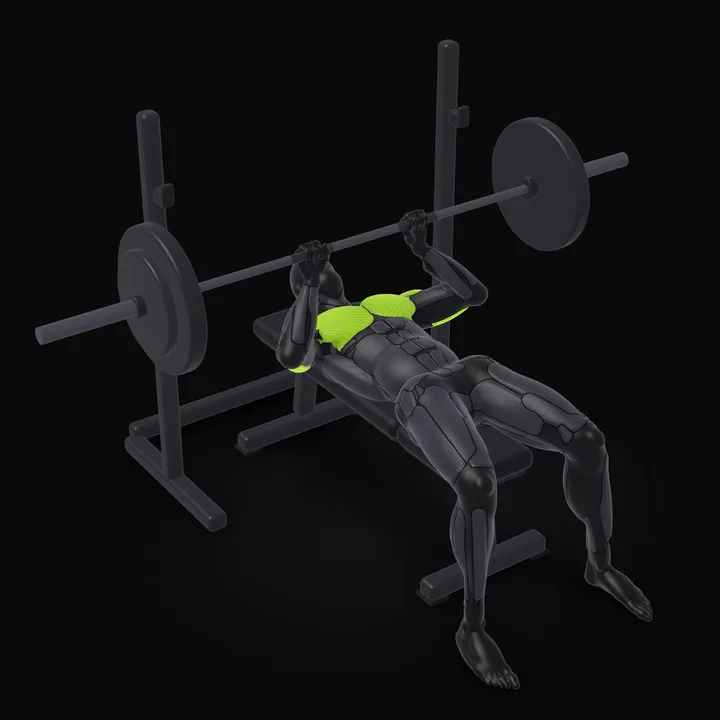 Barbell Close-grip Bench PressLie on the bench and grip the bar at shoulder width or slightly narrower. Lower the bar to your lower chest, keeping your elbows close to your body.How to do the Barbell Close-grip Bench Press →
The fifth day is the easiest to skip and also the easiest to recover from: small muscles, light loads, little systemic fatigue. If life gets busy, drop it and run the four main days. If a muscle other than arms is lagging (calves, for example), swap one or two exercises here for it.
Ramping the volume across 12 weeks
Instead of starting at your maximum, add sets in phases. This lets you see how you respond and gives you somewhere to go as the bulk progresses.
| Phase | Weeks | Change | Typical weekly sets per muscle |
|---|---|---|---|
| 1. Base | 1–4 | Program as written | 10–13 |
| 2. Build | 5–8 | +1 set on the first two exercises of each day | 13–16 |
| 3. Peak | 9–11 | +1 more set on the first exercise of each day, isolation work to failure on the last set | 15–18 |
| Deload | 12 | Back to phase 1 sets, weights about 10 % lighter | about 6–8 |
Only move to the next phase if you’re still progressing and recovering. If weeks 5–8 already leave you flat, stay at phase 2 volume. More sets only help if you can do them well. The article on how many sets per muscle per week explains the ranges in more detail.
After the deload, you can start another 12-week block with slightly higher weights, or move into a maintenance phase or a cut.
How to progress each week
Use double progression on every exercise: hit the top of the rep range on every set, then add weight (2.5 kg / 5 lb on upper-body barbell lifts, 5 kg / 10 lb on squats and deadlifts, the next pair on dumbbells). Most sets should end with 1–2 reps in reserve; isolation exercises can go to failure on the last set.
On a bulk, a useful rule of thumb: each main lift should improve by at least a rep or a little weight every one to two weeks. If it doesn’t, look at your logbook before changing anything else. More detail on the method is in how to apply progressive overload.
A worked example: the squat in weeks 1–4
Lower A’s squat is 3 × 5–8. Say you start at 90 kg, a weight you could squat about 9–10 times:
| Week | Weight | Reps | Next week |
|---|---|---|---|
| 1 | 90 kg | 7, 6, 6 | Same weight |
| 2 | 90 kg | 8, 7, 7 | Same weight |
| 3 | 90 kg | 8, 8, 8 | +5 kg |
| 4 | 95 kg | 7, 6, 6 | Same weight |
That pace, roughly 5 kg every two or three weeks on the squat and 2.5 kg every two or three weeks on the bench, is realistic for an intermediate on a well-run bulk. Beginners often move faster; lifters with several years behind them slower.
When you miss reps
- One bad session: repeat the weight. Don’t drop it.
- Two weeks without progress on a lift: check the basics first. Is your weekly average weight actually rising? Are you sleeping 7+ hours? If yes, drop that lift 5–10 % and build back through the range.
- Several lifts stalling and everything aching: that’s accumulated fatigue. Take your deload now instead of waiting for week 12. The deload week guide covers how to run one.
Warming up for heavy days
Higher volume on a bulk means your first sets need to be good ones. Five minutes of easy cardio, then ramp into the first lift: empty bar × 8–10, about 50 % × 5, 70 % × 3, 85 % × 1–2, then your work sets. The second compound of the day needs one or two lighter sets; isolation work none. Day-specific routines are in how to warm up before lifting.
Adapting the plan
Four days instead of five
Drop the arms and delts day and add one set of curls and one of triceps work to each upper day, plus a set of lateral raises to Upper B. You’ll lose a little arm and delt volume and keep everything else.
Beginners
If you’ve been lifting for less than a year, you don’t need the volume ramp. Run phase 1 for the whole 12 weeks, add weight more often, and use the fifth day only if you’re recovering easily. Your gains will come from getting stronger, not from extra sets.
Swaps
| If… | Swap to | Instead of |
|---|---|---|
| Lower back takes a beating | Hack squat or leg press as the Lower B main lift, chest-supported rows | Deadlift, barbell row |
| No machines (home gym with rack) | Dumbbell press, dumbbell flyes, Nordic curl negatives, banded pulldowns | Machine press, cable fly, leg curls, pulldown |
| Shoulders dislike barbell bench | Dumbbell bench press or a slight-incline machine press | Barbell bench press |
| Elbows sore from arm day | Cable curls and pushdowns at higher reps | EZ-bar curl, close-grip bench |
Keep a swap for the full block so you can compare your numbers week to week.
Checking that the bulk is working
Every two weeks, look at three things together:
| Check | What you want to see |
|---|---|
| Body weight (weekly average) | Rising about 0.25–0.5 % per week |
| Main lifts | Going up steadily |
| Waist measurement | Rising slowly, not racing ahead of your weight |
Weight up, lifts up, waist slowly up: perfect. Weight up fast, lifts flat, waist up fast: eat a bit less and check your training. Weight flat, lifts flat: eat more. That simple loop prevents most failed bulks.
Common bulking mistakes in the gym
- Treating the bulk as permission to train less hard. The food helps only if the sets are hard.
- Adding volume all at once. Jumping from 10 to 20 sets per muscle in a week leads to aches and stalls. Ramp it.
- Testing your max every week. Use your rep PRs as the measure. Heavy singles add fatigue and little muscle.
- Skipping legs because they make you hungry and tired. That’s half your potential muscle gain.
- Dropping all cardio. You’ll be out of breath on sets of 15 on the leg press, which costs you reps.
For the full picture of how muscle growth works, including sleep and protein, see how to build muscle.
Frequently asked questions
Should I train differently when bulking?
The principles stay the same, but a surplus lets you handle and recover from more. Most people do best by gradually adding sets across a bulk and pushing progression on their main lifts harder than they could during a cut.
How many days a week should I train on a bulk?
Four or five days is the sweet spot for most people. That's enough to train every muscle twice a week with high volume, while keeping sessions around an hour.
Should I do cardio while bulking?
Yes, a moderate amount. Two or three sessions of easy cardio a week help your health, conditioning and appetite. Just account for the extra calories so your weight still goes up at the rate you want.
How fast should I gain weight on a bulk?
About 0.25 to 0.5 % of your body weight per week is a good target for beginners and intermediates, so roughly 0.2 to 0.4 kg (0.5 to 0.9 lb) a week for a 80 kg (175 lb) person. Faster usually means more fat, not more muscle.
What if my strength isn't going up on a bulk?
Check that your weight is actually rising, that you're sleeping enough and that you're following a structured progression. If all three are in place and lifts still stall, take a deload week, then continue.
Sources
- Iraki J, Fitschen P, Espinar S, Helms E (2019). Nutrition Recommendations for Bodybuilders in the Off-Season: A Narrative Review. Sports
- Slater GJ, Dieter BP, Marsh DJ, Helms ER, Shaw G, Iraki J (2019). Is an Energy Surplus Required to Maximize Skeletal Muscle Hypertrophy Associated With Resistance Training. Frontiers in Nutrition
- Pelland JC, Remmert JF, Robinson ZP, Hinson SR, Zourdos MC (2025). The Resistance Training Dose Response: Meta-Regressions Exploring the Effects of Weekly Volume and Frequency on Muscle Hypertrophy and Strength Gain. Sports Medicine