How much you should be able to bench depends on your bodyweight, sex and how long you’ve trained. As a rough guide, a man with about a year of steady training benches 0.75 to 1 times his bodyweight for one rep, and a woman around 0.5 times hers. A bodyweight bench is a solid intermediate lift for men and an advanced one for women. The tables below give the same kind of benchmarks for the squat, deadlift and overhead press.
How to read strength standards
Strength standards aren’t research findings in the way protein needs or training volume are. No study has measured “the average squat of a gym-goer.” The numbers below come from what coaches see over years and from what competitive lifters achieve, scaled down. They’re useful because they give you a sense of scale. They’re dangerous if you treat them as a judgement.
Three things move your numbers a lot:
- Bodyweight. Heavier lifters lift more in absolute terms, but less per kilo of bodyweight. A 60 kg lifter benching 1.25× is about as impressive as a 100 kg lifter benching 1.1×.
- Limb length and build. Long arms make the bench harder; a long torso and short thighs make the squat easier. You can’t train your way out of your skeleton.
- Training age. How many years you’ve trained consistently, not how long you’ve had a gym membership.
The levels below are defined by training age: beginner (first months), novice (around 6–12 months of consistent training), intermediate (roughly 1–3 years), advanced (several years of focused strength training).
Strength standards for men
Multiply by your bodyweight to get a one rep max target.
| Lift | Beginner | Novice | Intermediate | Advanced |
|---|---|---|---|---|
| Bench press | 0.5× | 0.75× | 1–1.25× | 1.5× + |
| Squat | 0.75× | 1.25× | 1.5–1.75× | 2× + |
| Deadlift | 1× | 1.5× | 2× | 2.5× + |
| Overhead press | 0.35× | 0.55× | 0.65–0.75× | 1× |
Example for an 80 kg (176 lb) man: a novice level means roughly a 60 kg (132 lb) bench, 100 kg (220 lb) squat and 120 kg (265 lb) deadlift. Intermediate means about 80–100 kg bench, 120–140 kg squat, 160 kg deadlift.
Strength standards for women
| Lift | Beginner | Novice | Intermediate | Advanced |
|---|---|---|---|---|
| Bench press | 0.3× | 0.5× | 0.65–0.75× | 1× + |
| Squat | 0.5× | 0.85× | 1.1–1.25× | 1.5× + |
| Deadlift | 0.6× | 1× | 1.4× | 1.9× + |
| Overhead press | 0.2× | 0.35× | 0.45–0.5× | 0.65× |
Example for a 62 kg (137 lb) woman: novice means about a 30 kg (66 lb) bench, 52 kg (115 lb) squat and 62 kg (137 lb) deadlift; intermediate around 40–45 kg bench, 70–78 kg squat and 87 kg deadlift.
The gap is largest on upper-body lifts, mostly because women carry a smaller share of their muscle in the upper body. That’s about starting points, not about how well women respond to training. In the meta-analysis by Roberts, Nuckols and Krieger (2020), men and women made similar relative gains in muscle size and lower-body strength on the same programs, and women made larger relative gains in upper-body strength.
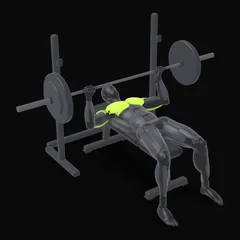
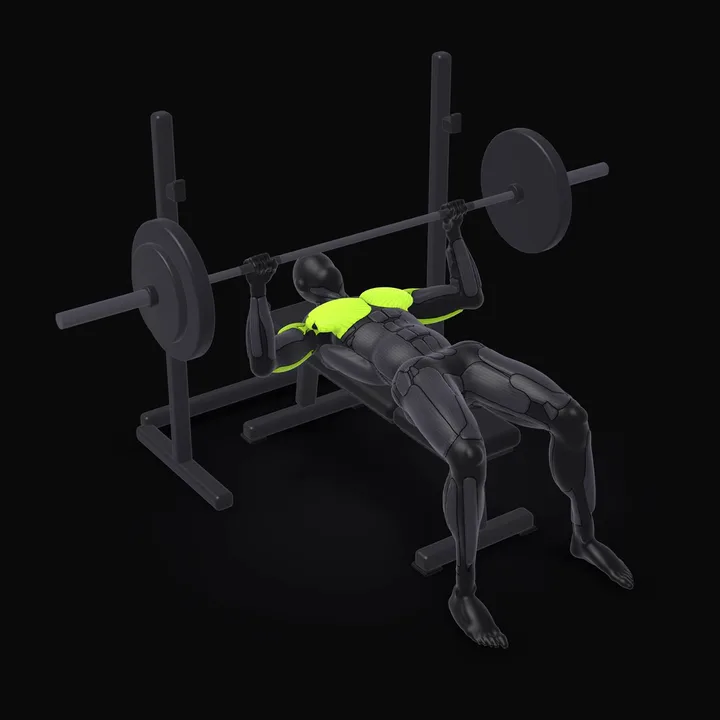 Barbell Bench PressLie on the bench with your eyes under the bar and your feet planted on the floor. Grip the bar slightly wider than shoulder width and pull your shoulder blades back and down.How to do the Barbell Bench Press →
Bodyweight benchmarks
Standards aren’t only about barbells. These are good markers of relative strength and need no gym.
| Movement | Solid | Strong |
|---|---|---|
| Pull-ups (strict, men) | 8–10 | 15 + |
| Pull-ups (strict, women) | 1–3 | 8 + |
| Push-ups (men) | 25–30 | 40 + |
| Push-ups (women) | 10–15 | 25 + |
| Dips (men) | 10–15 | 20 + |
If you can’t do a pull-up yet, that’s very common and very fixable; our pull-up guide has a progression.
How to find out where you stand (without maxing out)
You don’t need to test a true one rep max. Take your heaviest recent set of 3 to 8 reps done near failure and use a formula: weight × (1 + reps ÷ 30). For example, 90 kg × 5 reps on the squat gives about 105 kg. Our guide on how to calculate your one rep max has the full table and the pitfalls.
Divide by your bodyweight and you have your ratio. Do this for each big lift: most people find one lift lagging behind the others, which is useful information.
Signs one lift is out of balance
- Squat much lower than deadlift (say 1.0× vs 1.8×): often a mobility or technique issue in the squat, or simply less practice.
- Overhead press below half your bench: common if you’ve skipped vertical pressing.
- Bench close to your squat: usually means legs have been skipped. Time for more leg days.
How fast should your strength go up?
Fast at first, then slower. Beginners often add weight to the bar every session for weeks, because much of the early gain is your nervous system learning the movement. After a year, a 2.5 kg (5 lb) jump per month on the bench is a good pace. After several years, a few kilos a year is normal.
Competitive lifters show the same pattern. In a 15-year analysis of nearly 1,900 powerlifters, Latella and colleagues (2020) found the strongest men improved at about half the rate of the least strong ones, a ceiling effect that applies to everyone eventually.
| Training age | Realistic bench progress (men) | Realistic squat progress |
|---|---|---|
| 0–6 months | +2.5 kg per week or two | +5 kg per week or two |
| 6–18 months | +2.5 kg per month | +5 kg per month |
| 2–4 years | +5–10 kg per year | +10–15 kg per year |
Women typically progress with similar percentages but smaller absolute jumps, which is why 1.25 kg micro-plates are so useful.
How to move up a level
The recipe is boring and it works:
- Train each big lift 1–3 times a week with sets in the 3–8 rep range for strength, plus some higher-rep work for muscle.
- Apply progressive overload: add a rep or a little weight whenever you hit the top of your rep range.
- Build muscle. A bigger muscle is a stronger muscle; past the novice stage, more strength largely comes from more muscle.
- Sleep and eat enough protein. Not glamorous, but they decide how well you recover.
- Follow a structured plan. For specific lifts, see how to increase your bench press and how to increase your squat, or try a powerlifting program for beginners.
Seeing the curve helps. Brick turns every logged set into an estimated 1RM, flags new PRs automatically and draws a strength trend per exercise, so you can see whether your bench is still climbing without testing a max.
The healthy way to use standards
Use the tables to answer “roughly where am I?” and “which lift is lagging?” Don’t use them to decide whether you’re any good. A 50-year-old who started last year and squats 1× bodyweight has done something more impressive than a 22-year-old ex-rugby player squatting 1.5× after a month.
Compare yourself to yourself three months ago. If that comparison is positive, you’re on the right track, whatever the table says.
Frequently asked questions
Is benching your bodyweight good?
Yes. For a man, a bodyweight bench press usually takes one to two years of consistent training and puts you clearly past the beginner stage. For a woman, a bodyweight bench is an advanced lift that most lifters never reach.
What is the average bench press for a man?
There's no reliable population average, because most men never bench at all. Among men who train regularly, 0.75 to 1 times bodyweight after a year or so is typical, which is about 60 to 80 kg (130 to 175 lb) for an 80 kg man.
How long does it take to bench 100 kg (225 lb)?
For an average-sized man training the bench press twice a week, somewhere between one and three years is common. Lighter and older lifters take longer; heavier lifters with a good starting point sometimes get there in under a year.
Do strength standards apply to dumbbell or machine presses?
Not directly. Machines vary too much between brands, and dumbbells involve more stabilisation. Use your own numbers on those exercises as a personal benchmark instead.
Sources
- Latella C, Teo WP, Spathis J, van den Hoek D (2020). Long-term strength adaptation: a 15-year analysis of powerlifting athletes. Journal of Strength and Conditioning Research
- Roberts BM, Nuckols G, Krieger JW (2020). Sex differences in resistance training: a systematic review and meta-analysis. Journal of Strength and Conditioning Research