A good gym workout plan for women looks a lot like a good plan for anyone: three full-body sessions a week built on squats, hinges, hip thrusts, presses and rows, with weights that get heavier over time. The plan below does exactly that, with enough glute work to satisfy the most common goal and enough upper-body work to build real, balanced strength. It runs for 12 weeks and suits beginners as well as women coming back to the gym.
Do women need a different program?
No. A meta-analysis comparing men and women on the same training programs found similar relative gains in muscle size and lower-body strength, and larger relative gains in upper-body strength for women (Roberts et al., 2020). Women do tend to recover a little faster between sets and handle slightly more reps at a given percentage of their max, but the principles are the same.
What does differ is often the starting point and the goals. Many women start with less upper-body strength and want more glute development. This plan reflects that: every session has a hip-dominant movement, and upper-body work is never skipped, because a weak upper back is what holds most people back on everything from push-ups to posture.
Three myths worth dropping
- “Lifting will make me bulky.” Building a lot of muscle is slow and hard for everyone, and slower for women because of lower testosterone. More on that in will lifting weights make me bulky.
- “Light weights and high reps tone, heavy weights bulk.” “Toning” is building some muscle and losing some fat. Both light and heavy loads build muscle when sets are hard; heavier loads build more strength.
- “I need to plan around my cycle.” A 2023 review found no consistent influence of menstrual cycle phase on strength performance or training adaptations (Colenso-Semple et al., 2023). Train by how you feel on the day.
The program
Train three non-consecutive days, for example Monday, Wednesday and Friday. Every muscle gets hit about three times a week; training a muscle at least twice a week reliably beats once a week for growth (Schoenfeld et al., 2016).
Workout A
| Exercise | Sets × reps | Rest |
|---|---|---|
| Goblet squat (later: back squat) | 3 × 8–12 | 2 min |
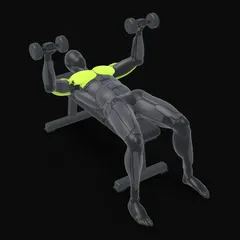
| Dumbbell bench press | 3 × 8–12 | 2 min |
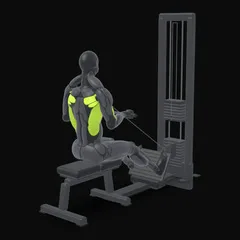
| Seated cable row | 3 × 10–12 | 90 s |
| Hip thrust | 3 × 8–12 | 2 min |
| Lateral raise | 2 × 12–15 | 60 s |
| Dead bug | 2 × 8 per side | 45 s |
Workout B
| Exercise | Sets × reps | Rest |
|---|---|---|
| Romanian deadlift (dumbbells or barbell) | 3 × 8–10 | 2 min |
| Lat pulldown | 3 × 8–12 | 90 s |
| Seated dumbbell shoulder press | 3 × 8–12 | 90 s |
| Reverse lunge | 3 × 10 per leg | 90 s |
| Cable glute kickback | 2 × 12–15 per leg | 60 s |
| Dumbbell curl + pushdown | 2 × 10–12 each (superset) | 60 s |
Workout C
| Exercise | Sets × reps | Rest |
|---|---|---|
| Leg press | 3 × 10–15 | 2 min |
| Incline dumbbell press | 3 × 8–12 | 90 s |
| Chest-supported row | 3 × 10–12 | 90 s |
| Bulgarian split squat | 2 × 8–12 per leg | 90 s |
| Seated leg curl | 2 × 10–15 | 60 s |
| Face pull | 2 × 12–15 | 60 s |
| Hip abduction machine | 2 × 15–20 | 60 s |
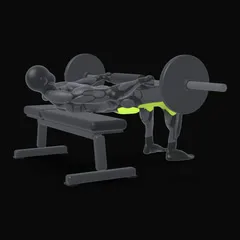
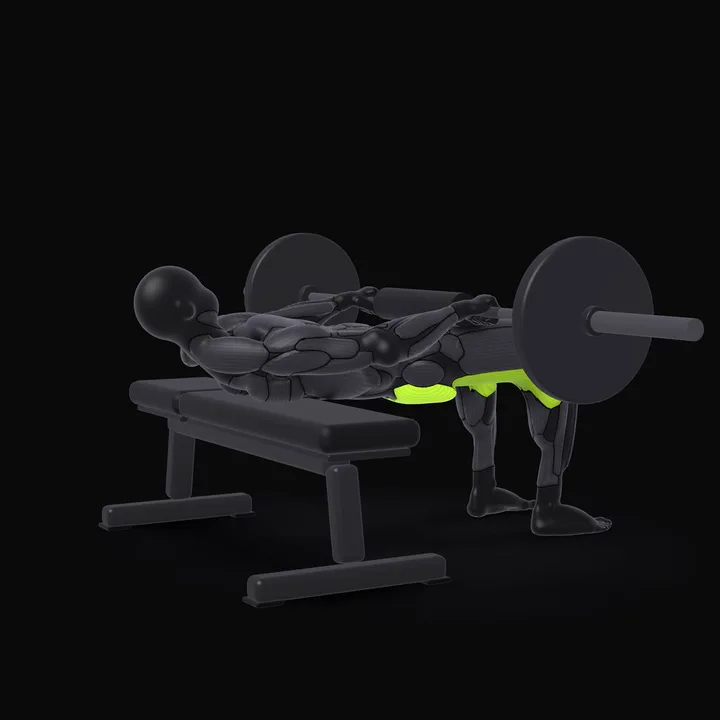 Barbell Hip ThrustSit on the floor with your upper back against the edge of a bench and the bar over your hips, using a pad. Bend your knees and plant your feet flat on the floor.How to do the Barbell Hip Thrust →
Rotate A, B, C in order. If you miss a day, just do the next workout in the sequence.
Weekly volume at a glance
| Area | Hard sets per week |
|---|---|
| Glutes (hip thrust, RDL, lunges, split squats, kickbacks, abduction) | about 16 |
| Quads | about 11 |
| Hamstrings | 5 + lots from hinges |
| Back | 9 |
| Chest | 6 |
| Shoulders | 3 presses + 4 raises and face pulls |
| Arms | 2 each + compound work |
How to start and how to progress
Weeks 1–2: learn the moves. Choose weights where you could do 3–4 more reps at the end of each set. Focus on control: lower the weight in about two seconds, pause briefly, lift with intent.
Not sure where to start? These are typical first-session weights for a woman new to lifting. Treat them as a starting guess and adjust after the first set:
| Exercise | Typical starting weight |
|---|---|
| Goblet squat | 8–12 kg dumbbell |
| Hip thrust | Empty bar (20 kg) or a 12–16 kg dumbbell |
| Dumbbell bench press | 2 × 6–8 kg (12–16 kg total) |
| Romanian deadlift | 2 × 8–10 kg dumbbells or an empty bar |
| Lat pulldown, seated row | 20–30 kg on the stack |
| Lateral raise | 2 × 2–4 kg |
If the first set feels easy enough that you could do 6 or more extra reps, go up one step for the next set. Within two weeks you’ll know your real working weights.
Weeks 3–12: progress every week. Use double progression:
- Work in the given rep range (say 8–12).
- Each session, try to add one rep to one or more sets.
- Once every set hits 12, go up to the next weight and start back at 8.
Small increases are the point. Going from 10 kg to 12 kg dumbbells is a 20 % jump, so you’ll often spend a few weeks adding reps before moving up. That’s normal. The full method is in how to apply progressive overload.
You only know whether you’re progressing if you know last week’s numbers.
What the first 4 weeks can look like
Two lifts from a typical first month, logged as the total weight (two 8 kg dumbbells = 16 kg):
| Week | Hip thrust (3 × 8–12) | Dumbbell bench press (3 × 8–12) |
|---|---|---|
| 1 | 30 kg: 10, 10, 9 | 16 kg: 10, 9, 8 |
| 2 | 30 kg: 12, 12, 12 | 16 kg: 11, 10, 10 |
| 3 | 40 kg: 10, 9, 9 | 16 kg: 12, 12, 11 |
| 4 | 40 kg: 12, 11, 11 | 16 kg: 12, 12, 12 |
Notice the difference: lower-body lifts like the hip thrust often jump quickly in the first months, while upper-body lifts move in smaller steps. Both are on track.
When you miss reps
- One off session? Repeat the same weight next time. Sleep, stress and a busy week all show up in the gym.
- Stuck for two or three sessions? Drop the weight by about 10 % and climb back up through the rep range.
- Tired and stalling on almost everything? Take an easy week: same workouts, half the sets, lighter effort. Then pick up where you left off. Planning one around week 7 or 8 is a good habit.
Technique notes for the key lifts
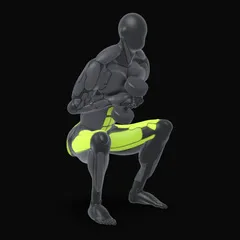
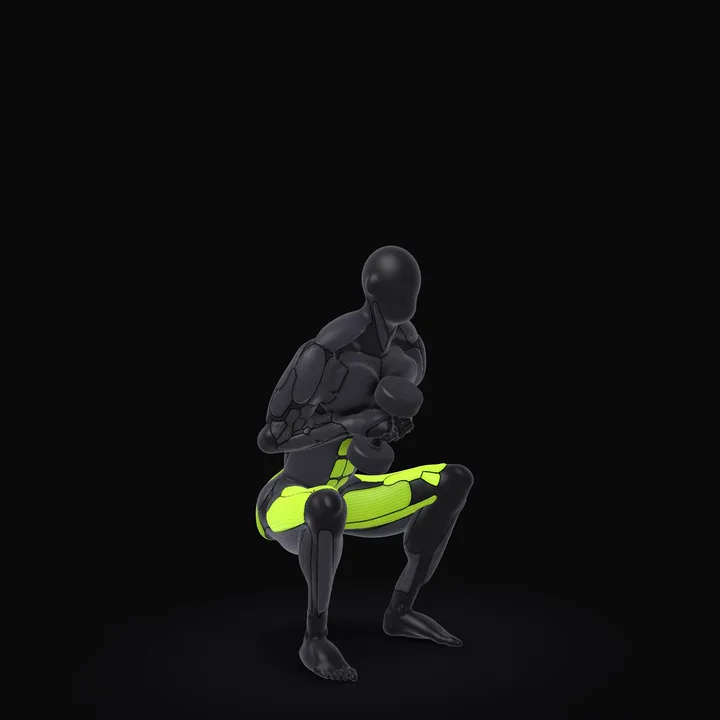 Dumbbell Goblet SquatHold one dumbbell vertically against your chest with both hands. Stand with feet slightly wider than shoulder width.How to do the Dumbbell Goblet Squat →
- Goblet squat: hold the dumbbell against your chest, sit down between your hips, keep your heels down. Go as low as you can with a neutral back. Move to the barbell squat once you’re using the heaviest dumbbell you can hold comfortably.
- Hip thrust: upper back on the edge of a bench, bar padded over your hip crease, chin tucked. Drive through your heels and finish with your ribs down, not by arching your lower back. The full setup is in hip thrust form.
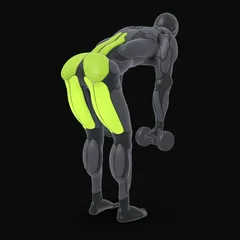
- Romanian deadlift: soft knees, push your hips back, keep the weights close to your legs, stop when your hamstrings are fully stretched.
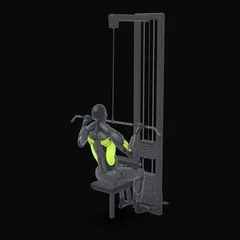
- Rows and pulldowns: think “elbows to back pockets”, pause for a second, control the return.
A 4-day option
If you can train four days a week and want more glute and upper-body work, keep Workouts A, B and C and add a short Workout D, about 40 minutes, on a day that isn’t right before Workout A:
| Exercise | Sets × reps | Rest |
|---|---|---|
| Dumbbell or machine hip thrust | 3 × 12–15 | 90 s |
| Assisted pull-up | 3 × 6–10 | 2 min |
| Step-up | 2 × 10–12 per leg | 90 s |
| Incline push-up | 2 × as many as you can minus 2 | 60 s |
| Cable lateral raise | 2 × 12–15 | 60 s |
The assisted pull-up is there for a reason: a first unassisted pull-up is one of the most satisfying goals in the gym, and it’s very achievable within a year for most women who train their back consistently.
Swaps if something doesn’t fit
| If… | Swap to | Instead of |
|---|---|---|
| The gym’s hip thrust setup is always busy | Dumbbell or machine hip thrust, glute bridge with a barbell | Barbell hip thrust |
| Lunges bother your knees | Step-ups to a lower box, or leg press with feet higher | Reverse lunge, split squat |
| No cable station free | Band kickbacks, one-arm dumbbell rows, dumbbell triceps extensions | Cable kickback, cable row, pushdown |
| Wrists hurt on presses | Neutral-grip dumbbell press or machine chest press | Dumbbell bench press |
| Training at home with dumbbells | Goblet squat, dumbbell RDL, one-arm row, floor press, dumbbell hip thrust | Machines and cables |
Keep a swap for the whole block so you can compare your numbers week to week.
After the 12 weeks
At the end of the plan, look back at your logs. If most lifts are still going up, keep going for another 8–12 weeks with a few exercise changes (barbell squat for goblet squat, barbell RDL for dumbbells). If progress has slowed and you can train four days, the upper lower split program is a natural next step, with more volume per session for both glutes and upper body.
How to warm up
Five minutes on a bike, rower or incline treadmill, then two lighter sets of your first exercise (for example 10 reps with a light dumbbell, then 5 reps with a medium one before your goblet squat work sets). That’s it. Long static stretching before lifting isn’t necessary; if you enjoy it, do it after your session.
What about the scale?
If you’re also trying to lose fat, you may see your weight barely move in the first month while your clothes fit differently. You’re adding a little muscle and water to trained muscles while losing fat. Track your lifts, your waist measurement and progress photos rather than relying on the scale alone. For a dedicated glute focus once you’ve run this plan, read how to grow glutes. For the bigger picture of nutrition, sleep and training, the guide on how to build muscle pulls it all together.
Common mistakes
- Only training legs and glutes. A strong back and shoulders make every lower-body exercise easier and improve how you look and stand.
- Staying on the same weights for months. If 8 kg dumbbells still feel the same as in week one, they’re not doing much anymore.
- Endless cardio before lifting. A 5-minute warm-up is enough. Do longer cardio after lifting or on other days.
- Not eating enough protein. Aim for protein at every meal; muscle needs the building blocks.
Frequently asked questions
Should women train differently from men?
Not in any fundamental way. Research finds that women and men gain muscle at similar relative rates, and women often gain upper-body strength faster relative to where they started. The same principles apply: big exercises, enough sets, progressive overload and enough protein.
Will lifting weights make me bulky?
Very unlikely. Building noticeable muscle takes years of deliberate effort and eating for it. What most women see from lifting is a firmer, stronger, more defined shape, especially when combined with a sensible diet.
How heavy should women lift?
Heavy enough that the last couple of reps of each set are genuinely hard. For most exercises that means a weight you can lift 6 to 15 times with good form, stopping one to three reps before you couldn't do another.
Should I change my training around my period?
You don't need to. Current research doesn't show consistent effects of menstrual cycle phase on strength or training results. If you feel worse on certain days, it's fine to go a bit lighter; otherwise train as normal.
How long until I see results from lifting?
Strength usually goes up within the first few weeks. Visible changes in shape typically take two to three months of consistent training, and depend a lot on nutrition and sleep too.
Sources
- Roberts BM, Nuckols G, Krieger JW (2020). Sex Differences in Resistance Training: A Systematic Review and Meta-Analysis. Journal of Strength and Conditioning Research
- Colenso-Semple LM, D'Souza AC, Elliott-Sale KJ, Phillips SM (2023). Current evidence shows no influence of women's menstrual cycle phase on acute strength performance or adaptations to resistance exercise training. Frontiers in Sports and Active Living
- Schoenfeld BJ, Ogborn D, Krieger JW (2016). Effects of Resistance Training Frequency on Measures of Muscle Hypertrophy: A Systematic Review and Meta-Analysis. Sports Medicine